When discussing infrastructure development, the most important question is often ignored:
Should we build at all?
Before construction begins, every infrastructure project must undergo rigorous economic feasibility analysis. The real question is not whether we can build — but whether we should build.
Economic feasibility determines whether a project creates net value for society, justifies public investment, and efficiently allocates scarce resources.
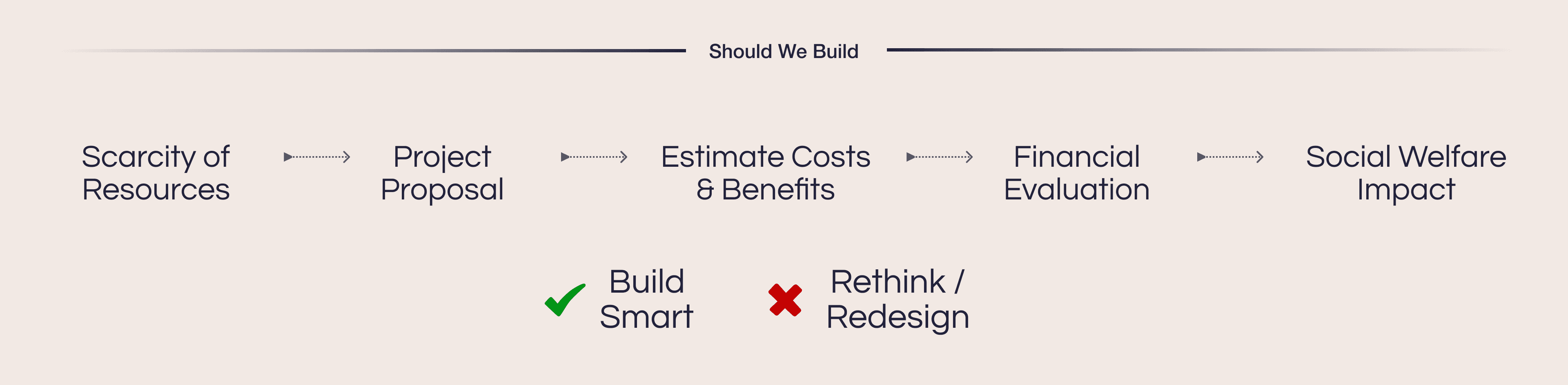
The Economic Foundation: Scarcity, Choice, and Resource Allocation
At its core, economics is built on one principle:
Resources are limited. Human wants are unlimited.
Land, capital, labour, time, and public funds are all scarce. Because of this scarcity, governments and private developers must make strategic choices about which infrastructure projects to pursue.
The pricing mechanism helps allocate resources to their most productive uses. In infrastructure planning, this ensures that every rupee invested generates maximum economic and social return.
This is the foundation of economic feasibility in infrastructure projects.
Welfare Economics and Infrastructure Decision-Making
Economic feasibility is rooted in welfare economics, which evaluates how projects affect overall societal well-being — not just profit.
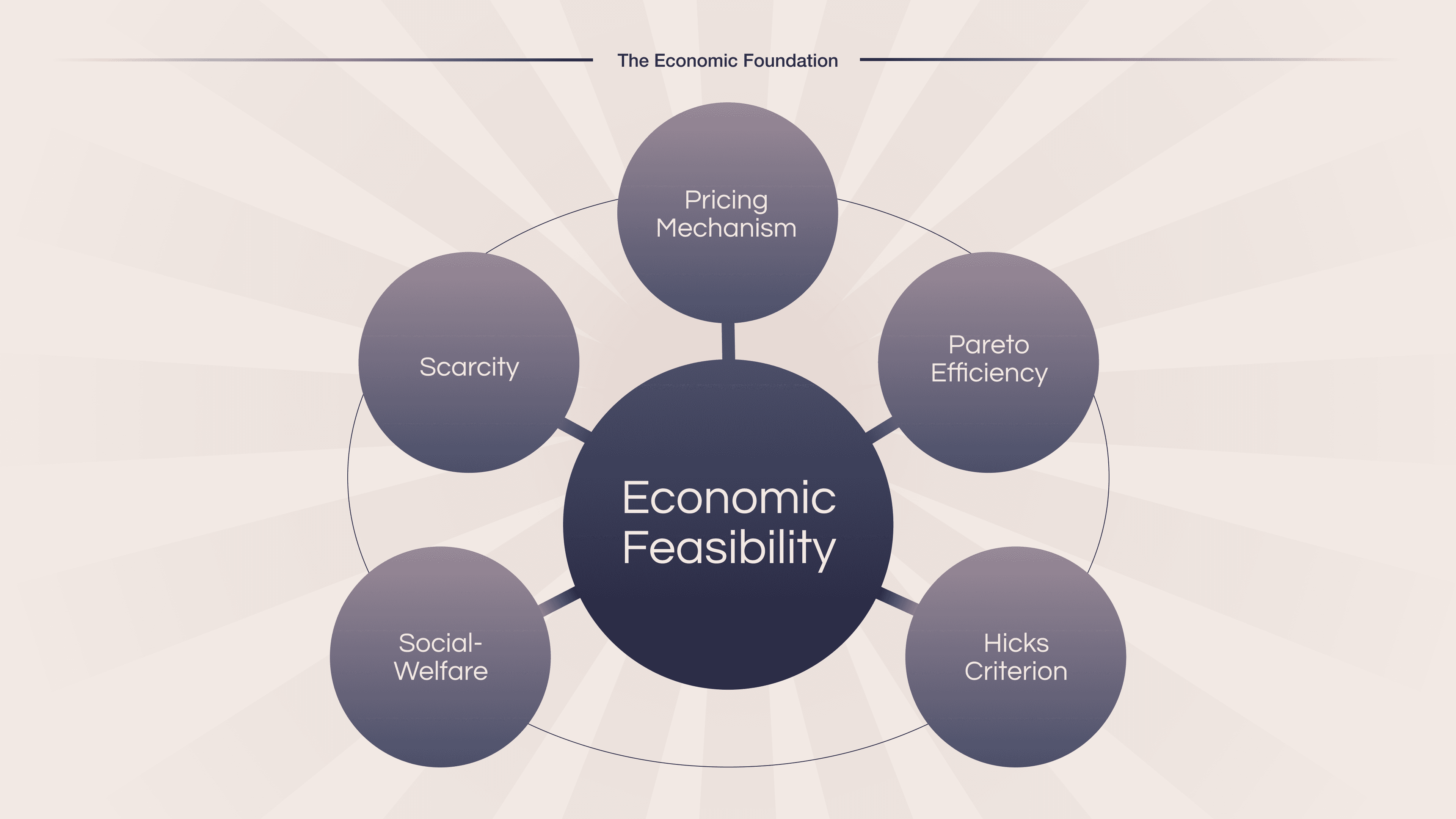
One of the earliest contributors to this field was Vilfredo Pareto, who introduced the concept of Pareto Efficiency. A project is Pareto efficient if it improves someone’s welfare without making anyone worse off.
However, real-world infrastructure rarely meets this standard.
That is where Kaldor-Hicks efficiency becomes relevant. It states that a project is acceptable if total benefits exceed total costs — even if some individuals lose — because, theoretically, winners could compensate losers.
This principle underpins Cost-Benefit Analysis (CBA).
The Core Objective: Maximise Net Social Benefits
The primary goal of economic feasibility analysis in infrastructure projects is simple:
Ensure total social and economic benefits exceed total costs.
This goes beyond financial profitability. It includes:
Travel time savings
Reduced congestion
Environmental impact
Social equity effects
Economic productivity gains
A strong feasibility study determines whether the project is the best possible use of public and private capital.
Financial Evaluation Tools in Infrastructure Feasibility
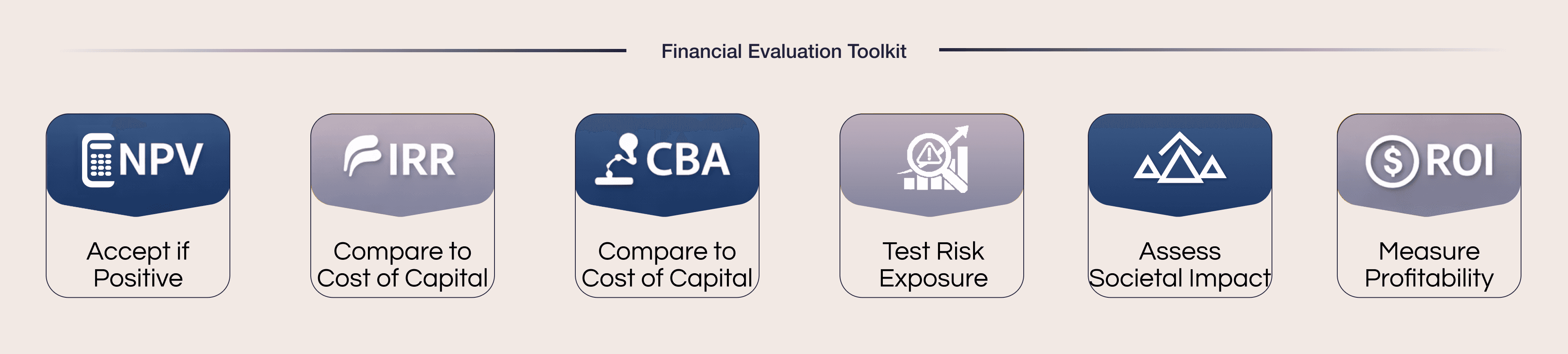
Infrastructure and project finance professionals rely on structured evaluation tools to assess economic viability.
1. Discounted Cash Flow Methods
Net Present Value (NPV) – Measures the present value of future cash flows.
Internal Rate of Return (IRR) – Indicates investment efficiency and profitability.
2. Simple Financial Metrics
Payback Period – Time required to recover initial investment.
Simple Rate of Return – Annual return compared to total cost.
3. Risk & Uncertainty Tools
Break-Even Analysis – Identifies the point at which revenue equals cost.
Sensitivity Analysis – Tests project resilience under changing assumptions.
These tools are fundamental in project finance and infrastructure investment decision-making.
Cost-Benefit Analysis (CBA) in Infrastructure Projects
Cost-Benefit Analysis (CBA) evaluates both financial and social returns of infrastructure projects.
It answers key policy and investment questions:
Does this project improve public welfare?
Is it better than doing nothing?
Are the long-term benefits worth the capital cost?
CBA compares the “without-project” scenario to the “with-project” scenario to determine whether society gains overall.
This is central to evaluating economic feasibility of transportation projects.
Why Traffic Forecasting Is Critical in Transportation Infrastructure
In toll roads, bridges, and expressways, traffic forecasting determines financial sustainability.
Traffic projections directly affect:
Investment size
Toll pricing strategy
Debt structuring
Revenue forecasts
Infrastructure capacity
Overestimated traffic leads to revenue shortfalls and financial distress. Underestimated traffic leads to congestion and capacity failure.
This systematic overestimation is known as optimism bias, a major risk factor in infrastructure project finance.

Importance of Early Traffic Studies
Conducting traffic studies early improves infrastructure feasibility outcomes by:
Identifying real demand
Structuring sustainable financing
Setting realistic toll rates
Designing appropriate infrastructure scale
Common traffic forecasting methods include:
Origin–Destination Surveys
Traffic Count Studies
Four-Step Travel Demand Models
Economic Trend Analysis
Willingness-to-Pay Surveys
Accurate forecasting strengthens both financial and economic feasibility.
Case Study: Bandra-Worli Sea Link
The Bandra-Worli Sea Link (BWSL) in Mumbai provides important lessons in infrastructure economic feasibility and project finance.

Project Overview
Original Cost Estimate: ₹400–₹665 crore
Final Cost: ₹1,634 crore+
Later Expansions: Up to ₹5,100 crore
Delay: Over 5 years
Causes of Cost Overruns
Design modifications
Contract award delays
Delayed government funding
Consultant changes
The government committed ₹580 crore but had released only ₹100 crore by 2007. Developers were forced to borrow, resulting in approximately ₹37 crore in additional annual interest costs.
Lessons in Economic Feasibility from the Sea Link
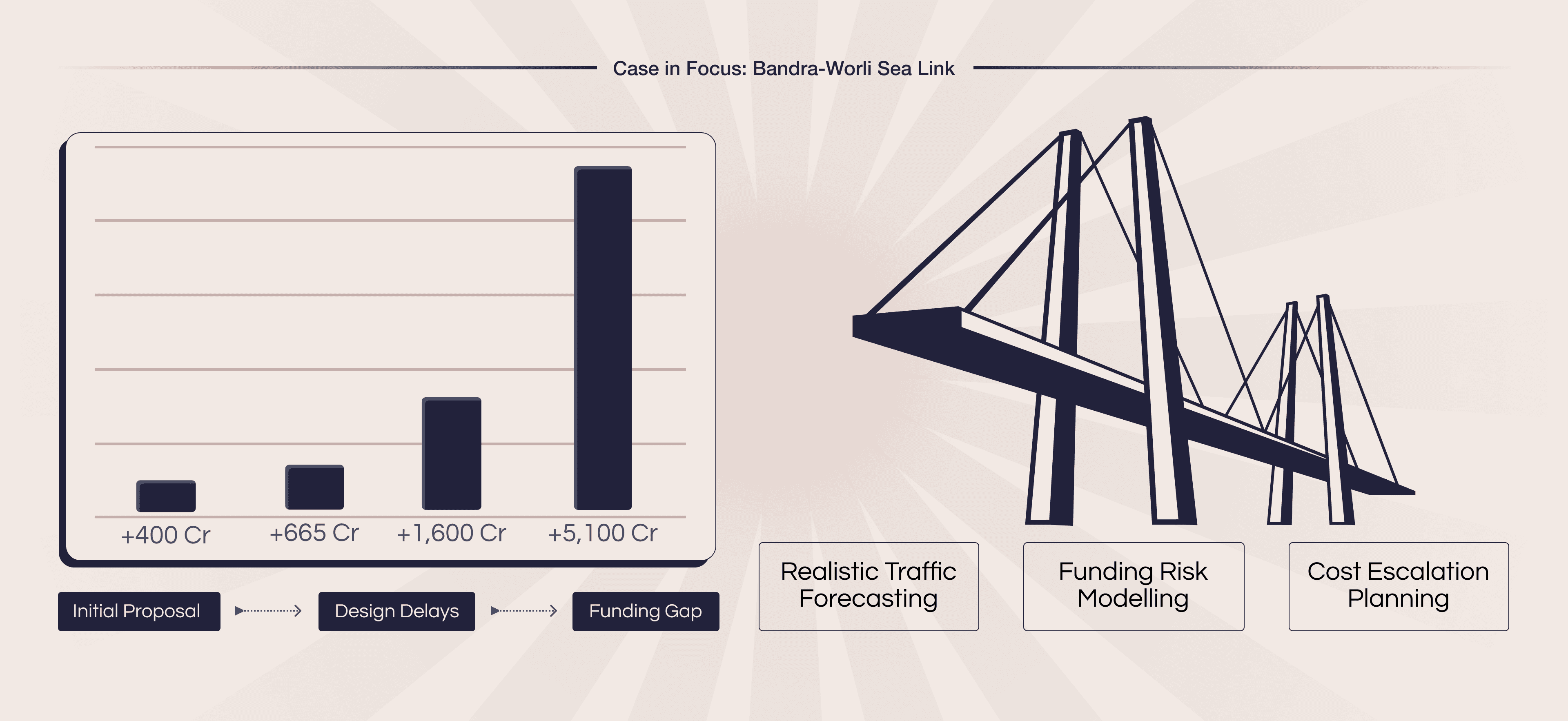
1. Realistic Traffic Forecasting Is Essential
Forecast models must include multiple demand scenarios and account for toll avoidance behaviour.
2. Funding Strategy Must Be Structured Clearly
Define:
Who pays
When payments occur
Risk-sharing mechanisms
Contingency planning
3. Plan for Time and Cost Escalation
Infrastructure projects frequently experience delays. Feasibility models must incorporate escalation risk.
4. Assess Institutional Capacity
Are agencies equipped to manage large-scale infrastructure? Institutional coordination affects economic outcomes.
5. Consider Opportunity Cost
Could the same funds produce greater public benefit elsewhere? Economic feasibility requires comparing alternatives.
Beyond Numbers: The Intangible Value of Infrastructure
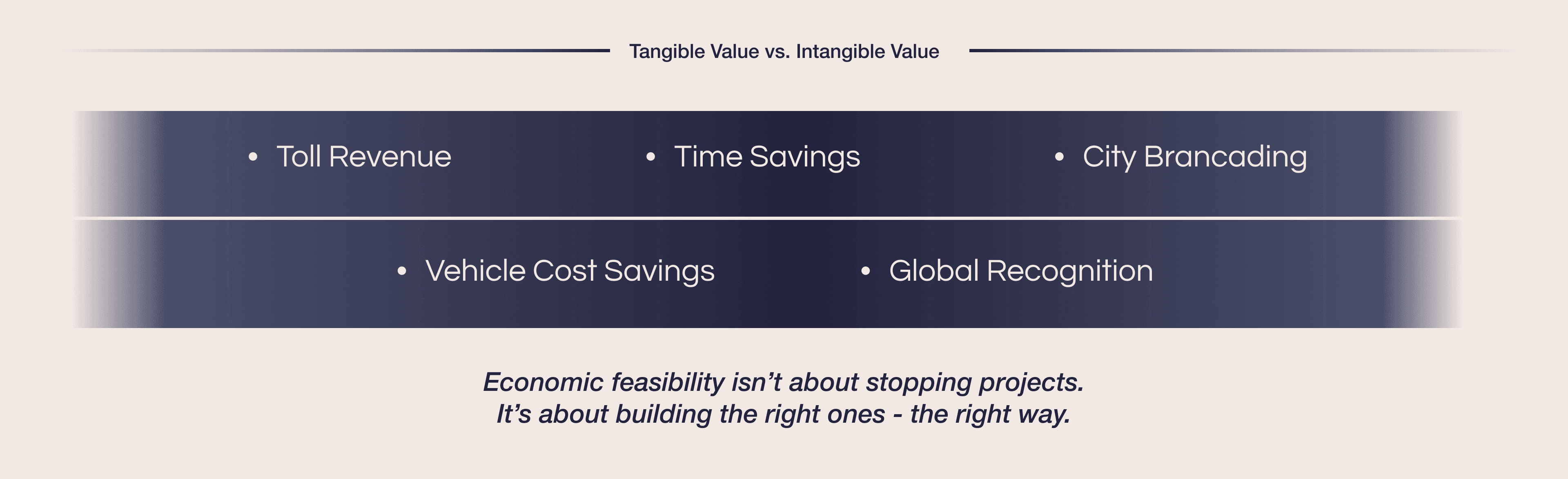
Despite financial challenges, the Bandra-Worli Sea Link created significant intangible benefits.
It enhanced Mumbai’s global image and became a symbol of modern infrastructure development.
Some benefits cannot be measured purely in toll revenue:
City branding
Investor confidence
Public pride
Long-term urban identity
Economic feasibility analysis should attempt to capture these broader societal impacts.
Is Feasibility Just a Formality?
The Bandra-Worli Sea Link demonstrates that:
Strong design is not enough
Traffic forecasting errors are costly
Funding delays increase financial burden
Institutional coordination matters
A rigorous economic feasibility study at the outset could have:
Improved revenue estimation
Structured financing more efficiently
Reduced cost escalation
Strengthened risk allocation
Feasibility is not a bureaucratic step — it is the backbone of infrastructure success.
What is the difference between financial feasibility and economic feasibility?
Financial feasibility focuses on profitability and cash flow. Economic feasibility evaluates broader societal benefits and opportunity cost.
Final Thoughts: Think First. Build Better.
Economic feasibility is not about approving or rejecting projects blindly.
It is about:
Asking the right questions early
Quantifying risks
Testing assumptions
Comparing alternatives
Maximising net social benefit
Because in infrastructure development:
The smartest project is not the biggest one.It is the one that makes economic sense — financially, socially, and strategically.