
There are two critical forces that determine whether a construction project succeeds or fails—Project Management (PM) and Construction Management (CM). While often used interchangeably, they each play a distinct role in turning plans into reality.
Construction is the execution, i.e., the physical building. But without the strategic planning and oversight of project management, it all falls apart.
That's exactly what you need to know, and we're covering it in this paper.
This paper looks at:
→ The key differences between PM and CM
→ The 5-phase framework that makes projects successful
→ Lessons from the Burj Khalifa’s incredible completion
→ Practical strategies for professionals at all levels
→ Emerging technologies shaping the industry
Whether you're an engineer moving into management or a seasoned project leader, this paper will change how you approach construction projects.
Decoding the Disciplines: PM vs CM
Project Management: The Strategic Framework
Project Management (PM) provides the overall structure for a project’s success. It sets clear objectives, defines deliverables, and manages expectations between clients, teams, and regulators.
PM has two key pillars:
Risk Management — Identifying and addressing potential issues before they become problems.
Quality Assurance — Ensuring that all deliverables meet or exceed the required standards.
Real-world application: The Delhi Metro’s Phase IV expansion is a perfect example, coordinating 45 stations across 3 corridors while managing over 22,000 stakeholders using PM principles.
Construction Management: The Tactical Execution
Construction Management (CM) focuses on turning plans into reality. It handles resource allocation, such as optimizing labor, materials, and equipment, and ensures that work stays on schedule. CM also has two key pillars:
Safety Compliance — Ensuring a safe work environment by following safety standards and regulations.
Quality Control — Testing materials and inspecting structures to maintain high construction standards.
Industry insight: L&T’s work on Mumbai’s Coastal Road shows CM in action, with daily tracking of 3 different work packages to keep things moving smoothly.
The Integration Imperative
The best projects integrate both PM and CM.
PM ensures the "what" and "why"
CM handles the "how" and "when"
Together, they ensure projects are completed on time, within budget, to specification, safely, and sustainably.
The Five Phases of the Project Lifecycle
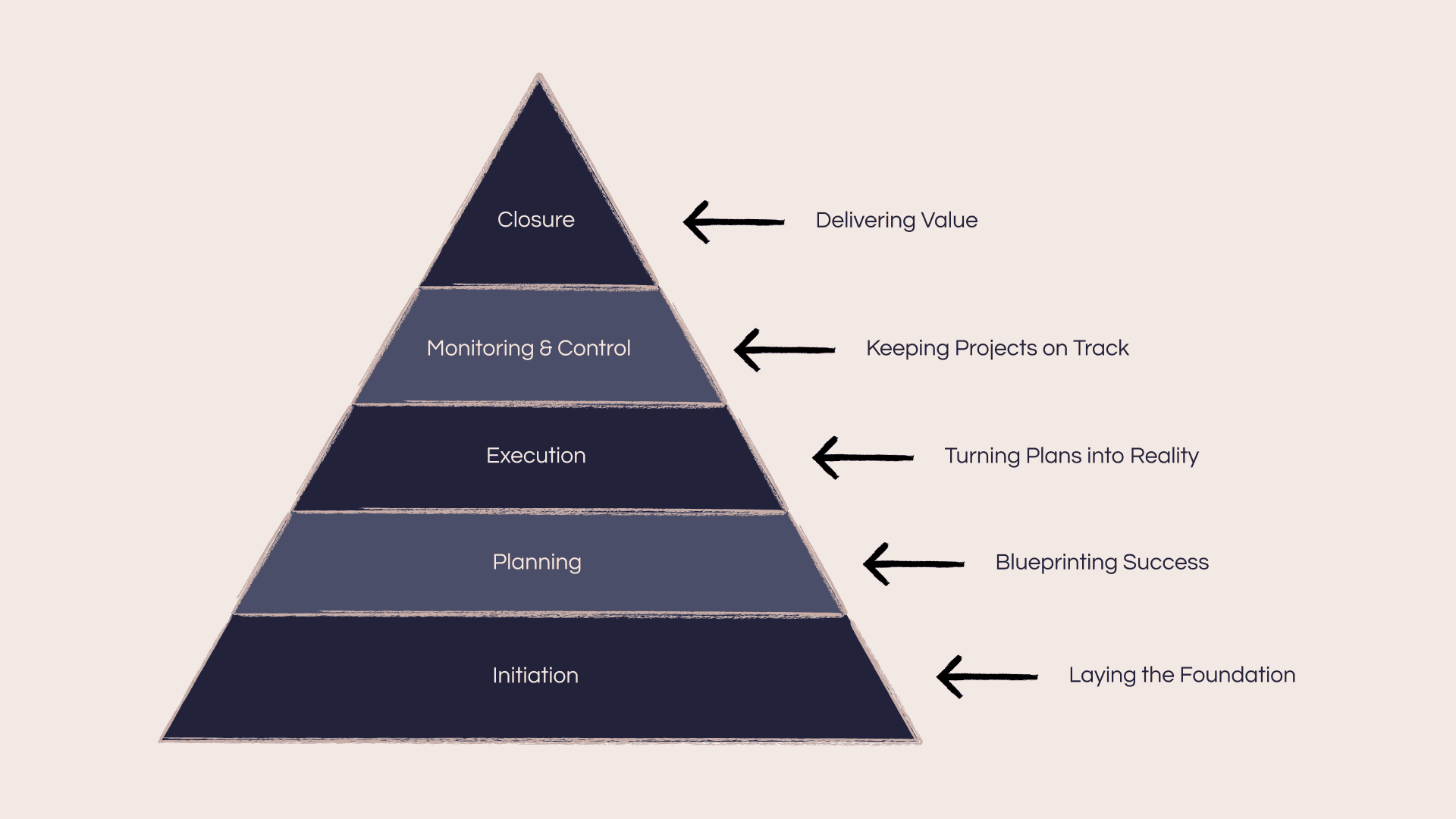
The Five-Phase Project Life Cycle provides a clear structure for successful construction projects, guiding them from start to finish:
Phase 1: Initiation - Laying the Foundation
This phase defines the project’s scope, objectives, stakeholders, and budget, ensuring alignment and setting the foundation for success.
Phase 2: Planning - Blueprinting Success
Detailed planning of timelines, resources, and risk management ensures everyone knows their role and how to execute the project smoothly.
Phase 3: Execution - Turning Plans into Reality
Construction begins, with resources allocated and teams mobilized to transform plans into actual work on the ground.
Phase 4: Monitoring & Control - Keeping Projects on Track
Ongoing tracking of progress ensures the project stays on schedule, within budget, and up to quality standards, with adjustments made as needed.
Phase 5: Closure - Delivering Value
The project is finalized, ensuring it meets objectives and requirements, with final inspections and handover to stakeholders.
To successfully deliver a construction project, it is essential to understand and implement the five key phases of the project lifecycle:
The Burj Khalifa: A Masterclass in Integrated Project Delivery

The Burj Khalifa is not just the world’s tallest building but also a prime example of integrated project delivery (IPD) in action.
From its bold inception to its successful completion, the project demonstrates how strategic planning and seamless execution can turn ambitious visions into reality.
Project Snapshot:
➔ Height: 828 meters (163 floors)
➔ Construction Period: 2004-2010
➔ Workforce: 12,000+ from 100+ countries
In this section, we’ll understand the key phases of the Burj Khalifa’s construction and insights into how project management and construction expertise come together to deliver extraordinary results.
Phase 1: Initiation — Laying the Foundation
The Burj Khalifa started with a vision to build the tallest tower in the world. Feasibility studies, stakeholder alignment, and securing funding were crucial first steps in setting the foundation for the project.
Phase 2: Planning — Blueprinting Success
Planning involved meticulous scheduling, budgeting, and risk management. The modular design allowed flexibility, even when the tower’s height increased by 128 meters midway through construction.
Phase 3: Execution — Turning Plans into Reality
With 12,000 workers from across the globe, executing the plan involved coordinating diverse teams across time zones. High-pressure concrete pumping technology was used to construct the tower’s core, overcoming engineering challenges.
Phase 4: Monitoring & Control — Staying on Track
Despite the financial challenges brought by the 2008 crisis, renegotiated contracts, local sourcing, and value engineering helped keep the project viable while maintaining schedule and quality.
Phase 5: Closure — Delivering Value
In 2010, the Burj Khalifa opened as a symbol of what integrated project delivery can achieve, proving that with strategic planning, execution, and collaboration, even the most ambitious projects can be delivered on time and to spec.
Challenge | Solution |
Budget Overruns | Renegotiated contracts, local sourcing, value engineering |
Scope Creep (Height Increase) | Modular design, additional wind tests, phased reinforcements |
Contractor Bankruptcy | Backup suppliers, redesigned installation, overtime incentives |
Heat Stress on Workers | Night shifts, AC-equipped camps, hydration monitoring |
Execution at Scale | RFID material tracking, BIM for coordination, concrete pumped 600m+ |
Professional Insights & Strategies
The Burj Khalifa’s construction offers several valuable takeaways for professionals at every level of the construction industry.
Here's how you can apply these lessons in your own work:
For engineers transitioning into management, it's essential to develop both financial literacy and scheduling skills to effectively manage budgets and timelines. Additionally, strengthening stakeholder and contract management abilities will allow you to navigate the complexities of large-scale projects more smoothly.
Construction project managers should prioritize maintaining a strong on-site presence while ensuring technical proficiency in every aspect of the project. Building strong contractor relationships and gradually implementing technology tools can help streamline operations without overwhelming the team.
Leadership teams should champion the principles of integrated project delivery (IPD), fostering collaboration across all project phases. It's crucial to maintain contingency budgets (around 15-20%) to address unforeseen challenges, and encourage a culture of collaboration. Regularly benchmarking globally will also help stay ahead of industry standards and ensure best practices are implemented.
The Future of Construction Project Management
As the construction industry evolves, emerging technologies, sustainability efforts, and workforce shifts are reshaping project management. Here’s what’s on the horizon:
Emerging Technologies
Digital Twins are enabling real-time site monitoring, while AI-powered scheduling helps predict delays before they happen. Robotics is streamlining tasks like rebar tying and 3D printing, and Blockchain ensures transparent, fraud-free procurement through smart contracts.
Sustainability Imperatives
The future is net-zero construction, with energy-efficient sites and a focus on circular economy principles. The adoption of green materials is rising, driving both sustainability and innovation.
Workforce Evolution
As digital tools take center stage, construction teams must upskill for the future. New safety technologies are improving worker protection, and global collaboration platforms are making cross-border teamwork seamless.
These advancements are setting the stage for a smarter, more sustainable, and efficient construction industry.
Conclusion
Future-defining construction projects, from India’s high-speed rail to smart cities, demand professionals who can:
Bridge engineering and management
Harness technology while valuing human expertise
Adapt to challenges with a clear vision
The Burj Khalifa proves that integrated project delivery makes ambitious projects possible. The real challenge isn’t whether obstacles will arise, but if you're ready to overcome them.
This paper has covered key project management principles, but true success lies in aligning them with engineering. In our upcoming series, we'll explore each project phase in detail, plus how BIM can enhance collaboration and outcomes.
Stay tuned to learn how smart project management drives construction success.
Written by Ojaswi Keshao Sarve - Master of Construction and Infrastructure Management