
The Power of a Project Charter in Construction
In construction project management, clarity and alignment are essential before the first brick is laid or the foundation is poured. One document plays a critical role in setting this direction—the project charter.
A project charter in construction establishes the project’s purpose, scope, authority, and strategic alignment. It acts as both a formal authorization document and a high-level roadmap, ensuring stakeholders share a common understanding of the project's objectives.
Without a well-defined project charter, construction projects risk scope creep, budget overruns, delays, and misaligned stakeholder expectations.
What is a Project Charter?
A project charter is a formal document that authorizes a project and grants the project manager the authority to allocate resources and initiate project activities.
In construction projects, the charter serves several critical functions:
Defines the project purpose and strategic justification
Establishes high-level scope and deliverables
Identifies key stakeholders and responsibilities
Sets the initial budget and timeline
Provides the foundation for project planning
Most importantly, the project charter evaluates whether the project should proceed at all, based on business needs and feasibility.
Key Components of a Construction Project Charter
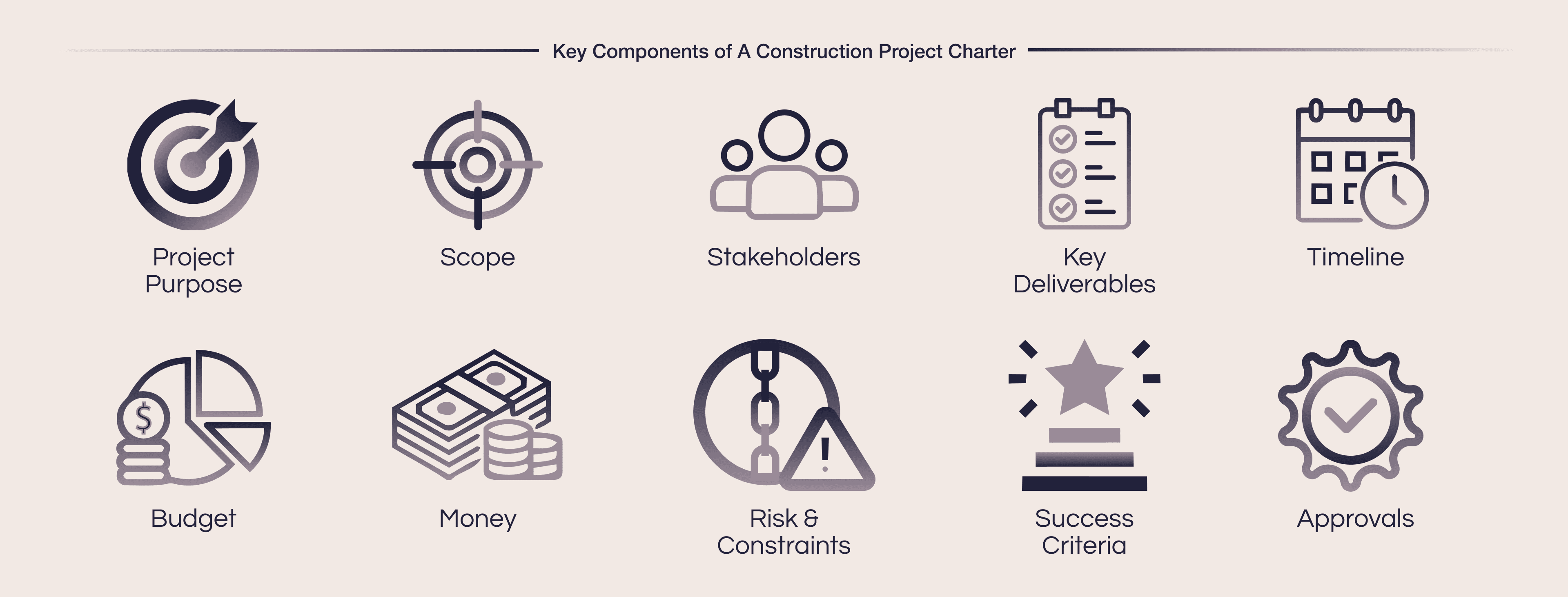
A well-structured construction project charter typically includes the following elements:
1. Project Name and Description
A concise overview of the construction project and its purpose.
2. Project Purpose and Justification
The business case explaining why the project is needed.
3. Project Objectives
Specific, measurable goals the project aims to achieve.
4. Project Scope
Defines the boundaries of work, deliverables, and exclusions.
5. Key Stakeholders and Roles
Identification of project sponsors, managers, contractors, and external stakeholders. This document acts as a blueprint for executing surveys and design activities.
6. Key Deliverables
Major outputs such as design milestones, infrastructure elements, or completed facilities.
7. Project Timeline
High-level milestones and estimated completion schedule.
8. Budget Overview
Preliminary cost estimates and funding sources.
9. Risks and Constraints
Potential project risks, regulatory constraints, or resource limitations.
10. Assumptions
Key conditions are assumed during project planning.
11. Success Criteria
Performance indicators used to measure project success.
12. Approval and Signatures
Formal authorisation from project sponsors and decision-makers.
Supporting References in a Project Charter
A construction project charter also references critical supporting documentation, including:
Business Case and Assumption Log
Organizational Process Assets (policies, templates, historical data)
Enterprise Environmental Factors, such as regulations, economic conditions, and organizational culture
These inputs ensure the project aligns with organizational strategy and external constraints.
Techniques for Developing a Project Charter
Creating an effective project charter requires structured analysis and collaboration.
Expert Judgment
Insights from experienced engineers, planners, and project managers.Brainstorming
Collaborative sessions with cross-functional teams to define project objectives.Benchmarking
Comparing similar projects to establish realistic scope, timelines, and budgets.
These techniques help ensure the project charter reflects realistic expectations and strategic priorities.
Why a Project Charter is Essential in Construction Projects
A signed project charter is a prerequisite for project initiation. Without it:
The project cannot formally begin.
The project manager lacks the authority to manage resources.
Budget allocation cannot be approved.
Project scope remains undefined.
In essence, the project operates without governance or strategic direction, significantly increasing the likelihood of failure.
How a Project Charter Prevents Scope Creep
Scope creep- uncontrolled expansion of project scope is a common challenge in construction.
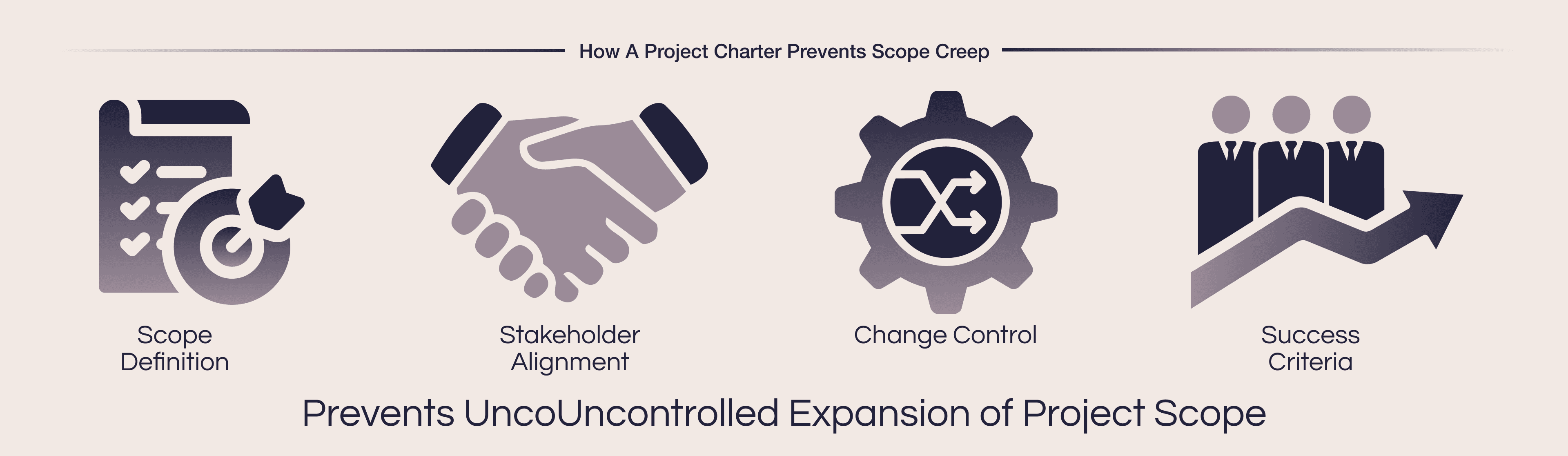
A project charter helps prevent it through the following mechanisms:
Charter Feature | Role in Preventing Scope Creep |
|---|---|
Scope Definition | Establishes clear boundaries for project deliverables |
Stakeholder Alignment | Ensures shared understanding of objectives |
Reference Document | Evaluates and approves proposed changes |
Success Criteria | Provides measurable benchmarks |
Change Management Support | Enables structured change request processes |
A well-developed charter serves as a baseline document, ensuring that additional work is formally evaluated before inclusion.
Case Study: Lessons from the Jaipur Metro
The Jaipur Metro project provides an instructive example of how weak project charter alignment can undermine large infrastructure initiatives.

The city initiated an ambitious metro development program intended to modernize urban transportation. However, the project faced major challenges and limited long-term utility.
Many analysts suggest that the project suffered from:
Weak business justification
Limited stakeholder engagement
Poor alignment with actual transportation demand
Without a robust project charter supported by strong feasibility analysis, large investments were committed to infrastructure that struggled to attract sufficient ridership.
This case highlights the risks of pursuing development projects without validated demand or strategic alignment.
Successes vs. Failures of the Jaipur Metro Project
Aspect | Successes | Failures |
|---|---|---|
Project Execution | Phase 1A completed on time | Delays and cost overruns in Phase 1B |
Infrastructure Quality | Modern stations and safety systems | Underutilized infrastructure |
Urban Development | Real estate growth near stations | Weak last-mile connectivity |
Financial Performance | Initial funding secured | Ongoing operational losses |
Strategic Relevance | Improved city image | Limited alignment with transport needs |
Could a Stronger Project Charter Have Changed the Outcome?
A stronger project charter might have significantly improved the project's trajectory.
Clearer Business Case
A deeper cost-benefit analysis could have assessed whether Jaipur’s travel patterns justified a metro system at this scale.
Stronger Stakeholder Engagement
Input from daily commuters and urban planners might have revealed more effective transport solutions.
Better Scope Definition
Realistic demand forecasts and integration planning could have prevented overestimation of ridership.
Proactive Risk Management
Early identification of risks such as low passenger demand and connectivity gaps could have guided project adjustments.
Realistic Success Criteria
Defined ridership benchmarks might have triggered early project reassessment or scaling adjustments.
Final Thoughts
A project charter is far more than a procedural document. In construction project management, it is a strategic foundation that determines whether a project is viable, aligned, and worth pursuing.
By clearly defining scope, objectives, stakeholders, and risks, the project charter ensures that construction projects proceed with clarity, accountability, and strategic direction.
The experience of the Jaipur Metro demonstrates what can happen when this foundational step is weak or overlooked.
For construction organizations and project managers, the lesson is clear:
A well-developed project charter is not optional—it is essential for successful infrastructure development.