Before a single brick is laid, the fate of a construction project is already being decided.
The initiation phase isn’t just paperwork or protocol. It’s where vision meets strategy. It’s the stage where you define what you're building, why you're building it, and who needs to be aligned before execution begins.
Get this right, and everything flows with clarity—better communication, cleaner execution, fewer surprises. Get it wrong, and you’ll spend the rest of the project firefighting issues that could’ve been avoided.
This phase answers the most important questions:
Is this project viable?
Do we have stakeholder alignment?
Are the objectives clear and achievable?
The outputs like the business case and project charter aren’t just documents. They’re the compass for every decision ahead.
Think of initiation as laying the foundation for everything else. Just like in construction, if your foundation is shaky, the entire structure suffers. But if it's solid? You’ve already won half the battle.
Smart project leaders don’t rush this phase. They build it right.
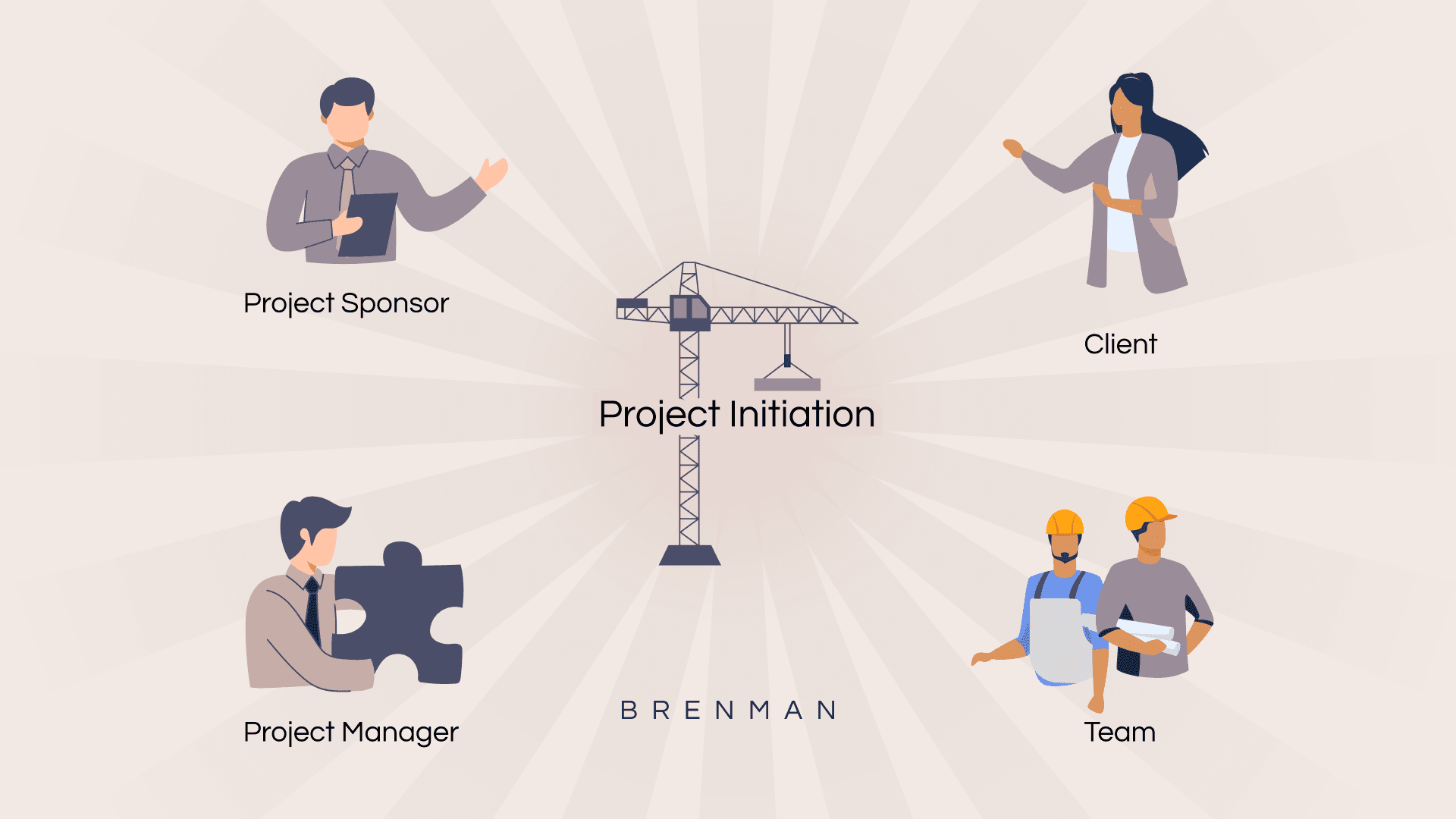
The 3 Key Roles in Project Initiation
There are three primary roles at the core of the initiation phase:
Project Manager
Plans, executes, and closes the project. They manage timelines, teams, and deliverables — essentially, the captain of the ship.
Project Sponsor
Provides funding and strategic support. They champion the project and ensure it aligns with broader business goals.
Client
The end-user or recipient of the deliverables. Their needs define the direction and success of the project.
The Business Case: Defining the ‘Why’
At the heart of initiation lies the business case, a key part of the project charter. It explains why the project should exist and whether it's worth the investment.
This document is usually created and owned by the project sponsor.
The Business Case: Defining the ‘Why’
At the heart of initiation lies the business case, a key part of the project charter. It explains why the project should exist and whether it's worth the investment.
This document is usually created and owned by the project sponsor.
it includes:
BUSINESS CASE | |
PROJECT NAME | |
PROJECT SPONSOR | |
PROJECT MANAGER | |
SCOPE | |
BUSINESS NEED | why the project is needed and when it is needed |
STRATEGIC BENEFITS | community, business, environmental benefits |
RISKS | what will happen if the project is failed/ not executed? |
ASSUMPTIONS AND CONSTRAINTS | Referring to Assumption Log |
MTHL Timeline. A Delayed Journey to Execution

The Mumbai Trans Harbour Link (MTHL) was first imagined in 1963. That was over 60 years ago. It was finally opened to the public in 2024.
The 21.8 km bridge connecting Sewri in Mumbai to Nhava Sheva in Navi Mumbai is now India's longest sea bridge. But it didn’t take six decades to build. It took six decades to start.
This delay wasn’t due to a lack of vision. It was due to a failure in execution, particularly at the initiation stage.
MTHL faced every kind of early-stage obstacle: weak demand justification, political turf wars, unclear leadership, lack of funding, investor skepticism, and shifting regulatory requirements.
Let’s break it down.
1963: A Vision Too Early for Its Time
The idea for a trans-harbour link was ambitious but poorly timed. The region beyond the proposed bridge Uran was underdeveloped. Traffic volumes were low. The project didn’t look financially viable. There was no solid case for investment. The idea remained on paper
2006: Political Turf Wars and No Clear Owner
With Mumbai growing, the project was revived under the BOOT model. But execution stalled. Two government bodies, MSRDC and MMRDA, both wanted control. This road block has created confusion. Investors needed more stability to come forward.
2011–2013: Private Investors Walk Away
A PPP model was introduced. Clearances were secured. But when bids opened, no private player showed up. The model didn’t offer clarity on risk sharing. Regulatory requirements were still shifting. Bridge height requirements changed mid-way to accommodate port access. Nobody wanted to take the gamble.
2016–2018: A Turning Point
What finally changed?
The government got serious. The MMRDA was appointed the sole authority. Environmental and coastal clearances were fast-tracked. Funding was secured through a JICA loan. The project switched from a PPP to an EPC model, shifting risk to the government and attracting contractors.
With better planning, funding, and leadership, construction began in 2018 and was completed in five years.
Year | Milestone |
1963 | First proposed as Uran Bridge |
2006 | BOOT model proposal by IL&FS (shelved) |
2011–2013 | PPP model pursued; environmental and financial clearances obtained |
2013 | No private bids; PPP model abandoned |
2016 | All clearances secured; foundation stone laid |
2017 | EPC model adopted; contracts awarded |
2018 | Construction commenced |
2023 | Construction completed |
2024 | Inaugurated and opened to public |
The MTHL story makes one thing clear. Big projects don’t fail in execution. They fail in initiation. Without clarity, alignment, and upfront planning, momentum is impossible to build.
Most delays are not caused by engineers or equipment but by indecision at the top. A lack of ownership. Poorly defined responsibilities. Incomplete risk planning. Vague business cases. All of these can stall progress before the first stone is laid.
Initiation is not about paperwork. It's about setting direction, earning trust, and removing doubt.
Key Lessons from MTHL
Projects like MTHL don’t fail because they’re hard to build. They fail because they’re hard to start.
The delays weren’t caused by engineering challenges. They were caused by:
No clear business case in the early stages
Lack of policy on value based feasibility metrics
Split leadership and unclear accountability
Investor skepticism due to poor risk modeling
Constant regulatory friction
Once these issues were resolved, execution moved fast.
A Better Model for Infrastructure Initiation
To prevent similar delays in the future, project initiation must evolve.
1. Think Beyond Financial ROI
Instead of short-term traffic or toll revenues, include long-term economic impact, urban expansion potential, and national development goals in your viability assessment.
2. Appoint One Owner
Give full responsibility to one authority. No overlaps. No confusion. MMRDA’s clear mandate helped MTHL move forward.
3. Secure Funding First
Make sure long-term, low-risk funding is locked in early. The JICA loan gave this project legs.
4. Align All Regulators Early
Regulatory changes during execution kill momentum. Secure all approvals before announcing or tendering the project.
5. Pick the Right Risk Model
PPP isn’t always the answer. For complex or sensitive projects, EPC might be more realistic. Shift risk smartly.
The Role of an Assumption Log
One way to improve initiation is to maintain an Assumption Log. Most of MTHL’s early delays stemmed from unspoken or untracked assumptions:
That traffic demand would rise
That private investors would participate
That regulatory approvals would go smoothly
None of these were validated. A live document tracking these assumptions, owners, and risk levels can surface red flags early.
Two terms you’ll hear often:
Assumptions
Things believed to be true for planning purposes.
Example: Labor and material costs will remain stable for six months.
Constraints
Limitations the project must work within.
Example: The project must finish within six months due to weather.
Date Identified | Category | Assumptions / Constraint | Responsible Party | Actions | Status |
|---|---|---|---|---|---|
Planning | Hourly wage of labourers | Project Manager |
Understanding and documenting these early on helps manage risk and ensures better alignment between all parties involved.
Final Thought: Ideas Don’t Build Bridges
You can’t execute what you don’t start right. MTHL is not just a bridge,it’s a case study in why clarity at the top determines speed at the bottom.
Every infrastructure project is a systems problem. If the system is weak at initiation, it will collapse under execution.
Fix the start. The rest follows.