India’s data-centre market has acquired a large number: 3,860 MW.
That is the capacity Cushman & Wakefield expects the country’s seven leading markets to add by 2030. It is more than twice the 1,789 MW that was operational at the end of the first half of 2026. The number makes the boom look settled.
The composition of that pipeline tells a more useful story. Only 509 MW is under construction. The remaining 3,351 MW is still in planning. In other words, about 87% of the expected supply has not yet crossed into physical delivery.
For owners, contractors and public agencies, this is the real September data-centre news. India does not have a shortage of announcements. It has a conversion problem.
A pipeline is not a construction programme
Data-centre capacity is usually reported in megawatts because power is the binding measure of the asset. But a megawatt in a planning document is not the same as a commissioned megawatt.
Before a campus can carry live computing loads, its developer must assemble land, grid connectivity, substations, backup power, cooling, water strategy, fibre routes, environmental permissions, equipment, contractors and an operating customer. Each package has its own approval path and lead time. A delay in any one of them can hold back the whole campus.
This is why the 509 MW already under construction matters more than the 3,351 MW on drawing boards. It is the part of the pipeline where land has started becoming an engineered asset. It is also where assumptions about transformer availability, cooling design, rack density and customer demand begin to face site conditions.
The government’s September backgrounder says installed capacity increased from around 375 MW in 2020 to 1.57 GW in August 2026. It projects nearly 8 GW by 2030. Cushman & Wakefield uses a slightly different market set and reports 1,789 MW across the top seven markets. The totals are not directly interchangeable, but both point in the same direction: delivery must accelerate sharply over the next four years.
The market is spreading, but the constraints travel with it
Mumbai remains the anchor with 890 MW operating and 1,726 MW in its future pipeline. Hyderabad has 151 MW operating and 710 MW upcoming. Chennai has 214 MW operating and 368 MW upcoming, while Delhi NCR has 183 MW operating and 387 MW planned.
That geographic spread is healthy. It gives operators more options for latency, resilience, land and customer proximity. It does not remove the delivery constraints. Each new hub still needs firm power, transmission capacity, construction labour, specialist mechanical and electrical contractors, commissioning teams and a credible environmental plan.
September’s project announcements show how large the next generation may become. TCS subsidiary HyperVault said it secured 264 acres in Hyderabad for a phased AI campus of up to 1 GW, with investment of up to ₹70,000 crore. The proposal includes high-density GPU infrastructure, liquid cooling, green energy and water-neutral design principles.
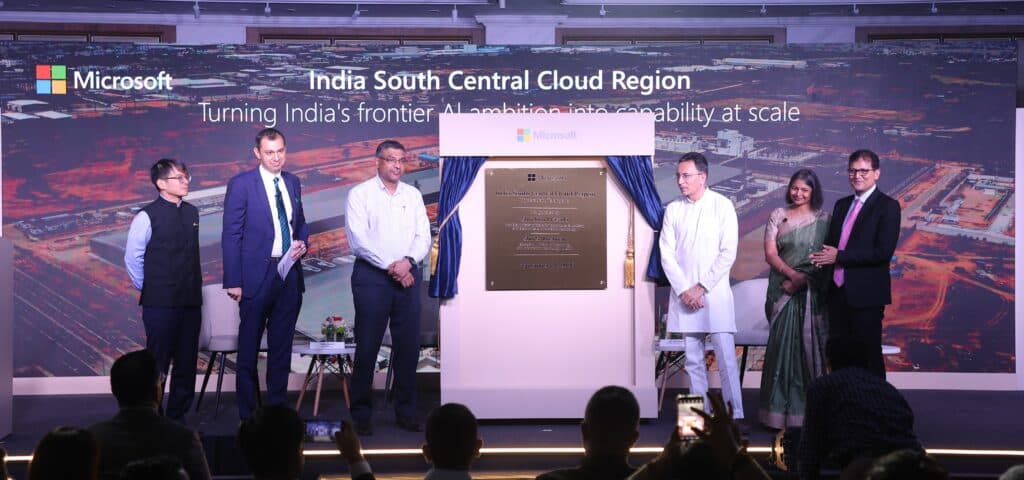
Microsoft, meanwhile, said its India South Central region in Hyderabad is live with a three-zone architecture and high-efficiency mechanical cooling that effectively uses no water for cooling. These projects are different in status and scale, but both show the technical brief changing. AI-ready facilities need denser power blocks, different cooling systems and more exact commissioning than many conventional enterprise data centres.
The first question is no longer land
Land remains essential, but it is increasingly the easiest part of the story to announce. The harder questions begin after acquisition.
How much firm power is available at the site, and by what date? Which substation and transmission works sit outside the developer’s direct control? What demand profile has the utility approved? Can the design adapt if rack densities rise before later phases begin? Which cooling system is being specified, and what does it require from the local water and energy network? What proportion of capacity has a committed customer?
These questions should sit in the board pack before construction starts. They should also sit in the monthly controls report after award. A data-centre schedule that tracks the building shell but treats utility energisation, long-lead electrical equipment and integrated systems testing as separate notes is not a reliable schedule.
Capital will follow projects that can prove readiness
Cushman & Wakefield estimates that India will need about US$29.9 billion in data-centre development capital through 2030. Infrastructure status and the Union Budget’s tax treatment for eligible foreign cloud providers can improve financing conditions. They cannot make an unready site buildable.
The next competitive advantage may therefore belong to projects that make their dependencies visible. A credible readiness ledger would show land control, grid milestones, statutory approvals, design freeze, procurement of long-lead equipment, water strategy, fibre connectivity, customer commitment and commissioning sequence. It would state what is secured, what is conditional and who owns each unresolved interface.
This is also the test for city and state policy. Incentives can attract proposals. Delivery requires coordination between industrial development agencies, distribution companies, transmission utilities, urban authorities and environmental regulators. A single-window announcement is useful only if the interfaces behind the window move on a shared programme.
What to watch next
The strongest signal will not be another gigawatt announcement. It will be movement from planning to construction, and then from construction to energised capacity.
Watch the share of the 3,351 MW planned pipeline that secures power and breaks ground. Watch whether new hubs outside Mumbai build specialist contractor and commissioning capacity. Watch whether operators disclose water and energy performance in terms that can be compared across projects. And watch whether phased campuses add supply in line with signed demand rather than headline capacity.
India’s data-centre opportunity is real. September’s numbers show both its scale and its vulnerability. The country has enough proposals to describe a boom. It now needs enough coordinated projects to build one.