
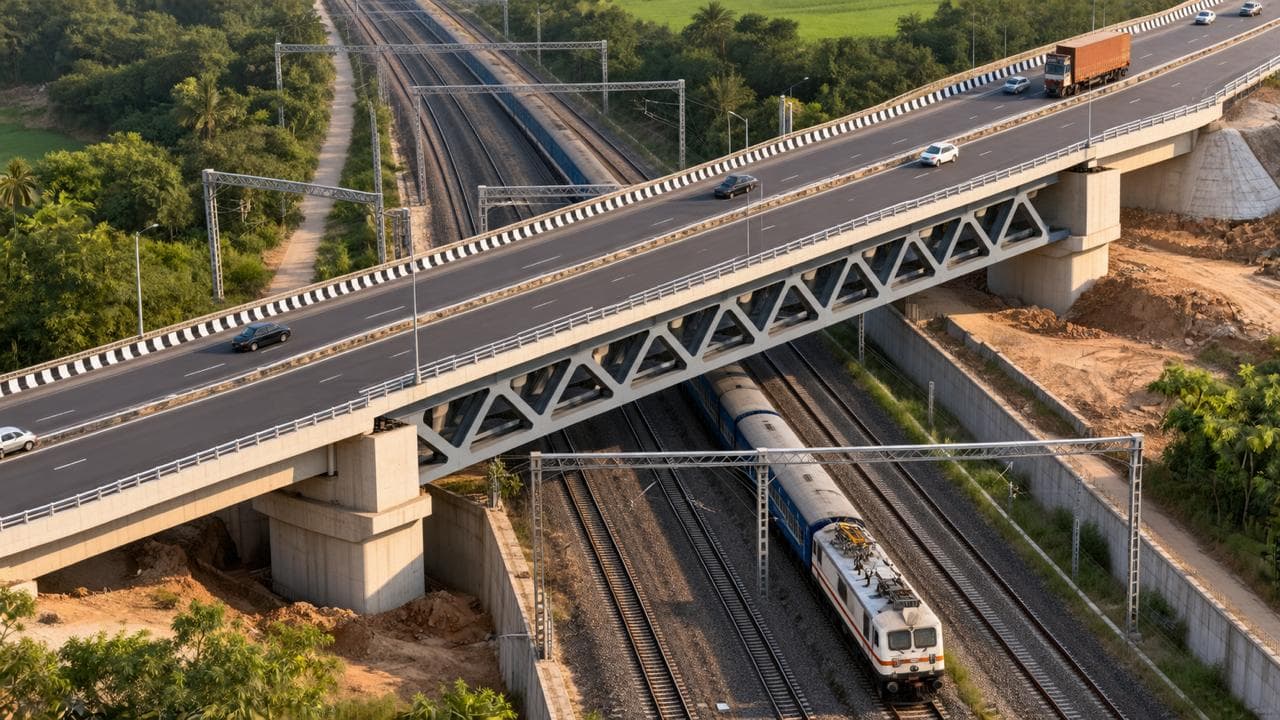
A 62% skew, a ₹91.60 crore railway bridge and more than 835 metres of viaduct and approach works define the engineering and cost baseline for the new four-lane ROB at LC 53.A ₹133.2295 crore four-lane Road Over Bridge will replace Level Crossing No. 53 at Km 62/2-4 on the Udhna–Ukai Songadh section of Western Railway. The railway bridge will use an Open Web Girder (OWG) estimated at ₹91.60 crore, while the project includes a 311.58-metre viaduct costing ₹19.98 crore and a 524.32-metre Railway Approach estimated at ₹10.25 crore. The crossing has a reported 62% skew, making the geometry of the railway interface a defining feature of the project.
Indian Railways' bridge-planning guidance specifically addresses skew ROBs. Skewed arrangements alter the load path through the girder and can produce additional torsional and bending effects, making the structural arrangement and construction methodology important parts of the design.
For ROBs, the General Arrangement Drawing establishes the relationship between the road and railway alignments, structural dimensions, elevations and sections. Indian Railways' Construction Manual requires the skew angle between the existing railway track and the proposed ROB to be shown in the key plan, together with the relevant square and skew dimensions.
At LC 53, the 62% skew therefore becomes a direct design parameter for the railway crossing. The eventual structural arrangement will determine how the OWG connects the approaches across the railway alignment and how the bridge can be erected while maintaining railway operations.
₹91.60 crore sits in the railway bridge
The OWG represents the largest individually disclosed component of the project at ₹91.60 crore. The viaduct accounts for another ₹19.98 crore and the Railway Approach for ₹10.25 crore. Together, these three components account for ₹121.83 crore of the ₹133.2295 crore sanctioned cost.The physical quantities provide corresponding benchmarks. The viaduct is 311.58 metres and the Railway Approach is 524.32 metres. The remaining ₹11.3995 crore of the total sanction is not separately allocated among the published component figures.These figures establish a cost-and-quantity baseline against which procurement and construction can subsequently be measured. The railway bridge component is particularly significant because its ₹91.60 crore estimate represents the largest single disclosed element of the work.
The project has an earlier two-lane record
The current four-lane proposal follows an earlier project record for the same level crossing.Western Railway's 2025–26 works programme described LC 53 at Km 62/2-4 as a proposed two-lane ROB, with ₹11.15 crore shown in the relevant sanctioned-cost column. An earlier Indian Railways project-status record places the sanction in 2020–21 and records zero expenditure and zero progress for the railway and approach portions in the 2022–23 reporting period.The current sanction changes the documented configuration to four lanes and raises the sanctioned cost to ₹133.2295 crore. The project history therefore provides two separate baselines against which the present work can be assessed: the earlier two-lane proposal and the current four-lane sanction.
The funding structure is nearly equal
The project is being funded through an almost equal contribution from Indian Railways and the Gujarat government. Railways will contribute ₹66.6147 crore, while the State Government's share is ₹66.6148 crore.The arrangement places the road-rail project within a joint funding framework. The state contribution and railway contribution together cover the full sanctioned cost of ₹133.2295 crore.The sanction itself represents the approved project cost. Subsequent expenditure, procurement and construction constitute separate stages of delivery.
Execution depends on design, alignment and site readiness
Indian Railways' broader ROB/RUB execution framework identifies several elements that determine whether sanctioned works progress to completion, including General Arrangement Drawing approval, approach alignment, land acquisition, removal of encroachments, utility shifting, statutory clearances and coordination with state governments. Railways has also prescribed joint surveys with the concerned state government or road-owning authority before finalising ROB GADs.
For LC 53, these stages connect directly to the physical configuration of the proposed bridge. The 62% skew, the OWG railway portion and the 311.58-metre viaduct and 524.32-metre approach establish the principal engineering parameters around which the alignment and construction programme will have to be developed.
The railway crossing itself is the critical interface. Indian Railways' technical guidance notes that construction at constrained railway locations can require additional attention to site safety, working blocks and construction methodology, while steel girder fabrication can be undertaken alongside foundation and substructure work where the design permits.
From approval to construction
The project can therefore be followed through a defined sequence: design and GAD approval, alignment and site preparation, funding and procurement, fabrication and erection of the railway bridge, construction of the viaduct and approaches, inspection and commissioning.
The cost structure provides the financial baseline. The ₹91.60 crore OWG, ₹19.98 crore viaduct and ₹10.25 crore Railway Approach can be tracked against subsequent procurement and expenditure records. The 311.58-metre viaduct and 524.32-metre approach provide physical quantities against which construction progress can be measured.
The 62% skew provides the key engineering baseline. Its treatment in the final bridge geometry and the construction arrangement across the railway will determine how the approved structure is translated into a functioning road connection.The earlier two-lane proposal provides a project-history baseline, while the current four-lane sanction establishes the present scope. The nearly equal Railways-Gujarat funding arrangement establishes the financial framework.The ₹133.2295 crore approval is therefore the starting point of the delivery chain, not its endpoint. The project moves from sanction through design, procurement and construction before the four-lane ROB becomes an operating replacement for LC 53.


