
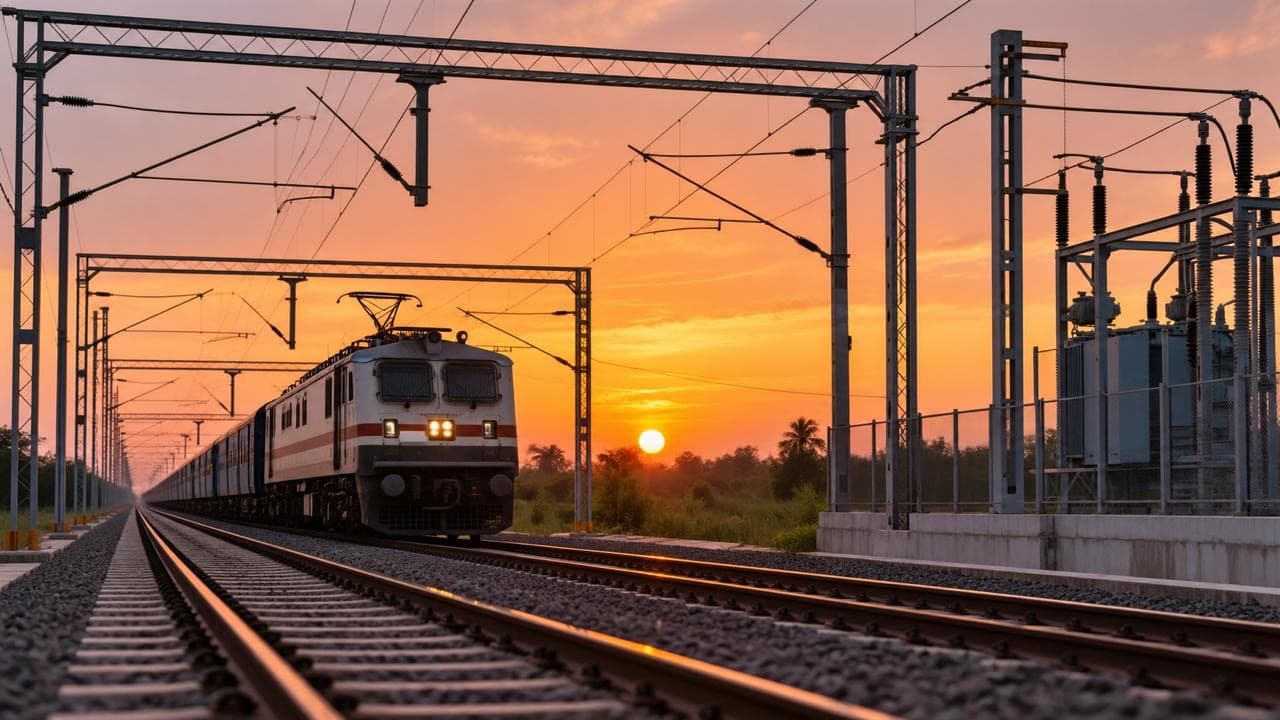
Indian Railways has sanctioned ₹142 crore to upgrade the electric traction system on the 73-route-kilometre Savalyapuram-Guntur section of South Coast Railway from 1×25 kV to 2×25 kV. The project covers 146 track kilometres and forms part of HUN Route 8, which runs from Vasco through Gadag, Guntakal, Nandyal, Savalyapuram and Guntur to Vijayawada. According to the Press Information Bureau, the upgrade is intended to strengthen traction infrastructure and support growing railway operations on the route.
The central question is what additional electrical capacity the change is intended to provide, and whether the traffic planned for the corridor supports that intervention. It also has an execution dimension: the conversion is being proposed on an already electrified railway, so the eventual package and commissioning arrangements matter to how that capacity reaches the operating network.
What 2×25 kV Changes
The capacity at issue is the amount of traction power the electrical system can reliably supply to trains as demand increases. In a conventional 1×25 kV arrangement, locomotives receive power through the overhead catenary at 25 kV. Under a 2×25 kV autotransformer system, power is transmitted at 50 kV between the catenary and a parallel feeder, while autotransformers provide the 25 kV supply required by locomotives. The higher transmission voltage reduces the current required for a given load, limiting voltage drop and electrical losses.
RDSO identifies reduced voltage drop and greater feeding capacity as advantages of the autotransformer configuration. The relevance to Savalyapuram-Guntur is therefore the traction-power demand generated by trains on the section, rather than a standalone increase in train paths. A 2×25 kV system can improve the electrical margin available to trains, but the number of trains that can actually be operated depends on how traction power interacts with the railway’s wider operating capacity. The available traffic data therefore provides context for the electrical intervention without proving that the section is currently traction-power constrained at a quantified level.
Traffic Demand
The traffic case for additional traction-power capacity is visible in Guntur Division’s operating projections. On the Nallapadu–Diguvametta section, average train services are projected to increase from 35.5 each way in 2024–25 to 42.6 by 2029–30, with goods services rising from 20 to 24 each way. Over the same period, projected line-capacity utilisation rises from 56.3% to 67.6% without a maintenance block, and from 61.2% to 73.4% with one.
The figures indicate rising traffic demand on the wider corridor, particularly from goods trains. That provides the measurable operating context for strengthening the traction system, even though the available data does not provide a separate traction-load forecast for Savalyapuram–Guntur.
The Infrastructure Behind Conversion
A 2×25 kV conversion involves more than changing the feeding voltage. It can require modifications to the overhead system and feeder arrangement, autotransformer equipment, switching and earthing systems, and associated traction-power infrastructure. A previous South Central Railway package for Krishna Canal–Guntur–Tenali, for example, included OHE conversion to 2×25 kV AT feeding, feeder and earthing works, and design, erection, testing and commissioning.
Comparable SCR packages also show that conversion is not limited to a single item of traction equipment: the electrical feeding arrangement, existing OHE and associated protection, switching, testing and commissioning all have to work as one system. For Savalyapuram-Guntur, however, the public approval does not enumerate the project’s substation, feeder or equipment configuration.
APTRANSCO records an existing 132 kV railway traction substation at Savalyapuram supplied through the Vinukonda network, establishing an existing power-supply interface. It does not, by itself, establish how that interface will be modified for the new 2×25 kV system. The eventual technical package is therefore important for determining where the additional electrical capacity will come from and how it will be distributed..
Executing the Conversion
Because the Savalyapuram-Guntur section is already electrified, the upgrade involves converting an existing 25 kV traction network rather than installing an entirely new electrification system. In a 2×25 kV arrangement, the existing overhead equipment is integrated with a parallel feeder and autotransformer network so that power can be transmitted at 50 kV while the locomotive continues to receive 25 kV. The conversion therefore involves coordinated changes to the feeding arrangement, OHE and associated traction equipment rather than a simple change in supply voltage.
South Central Railway’s 2×25 kV conversion packages on other sections illustrate the work involved: OHE modifications, feeder arrangements, traction equipment, switching and earthing works, followed by testing and commissioning. These activities are significant on an operating railway because the upgraded equipment has to be integrated into the existing traction network before the new system can be energised.
For Savalyapuram-Guntur, the engineering objective is consequently to bring the higher-capacity feeding system into service across the existing 73-km section while maintaining the electrical and operational integrity of the railway. The effectiveness of the investment will ultimately be determined not by the conversion itself, but by whether the completed system delivers the additional traction power capacity required for the traffic planned on the route.
The Savalyapuram-Guntur project is therefore best understood as an effort to expand the electrical capacity available to an increasingly busy railway corridor. The traffic projections establish the demand context, while the 2×25 kV configuration provides the mechanism for carrying higher traction loads with lower voltage drop. The investment’s significance ultimately lies in whether that additional electrical capacity can support the railway’s planned growth in actual operation.


