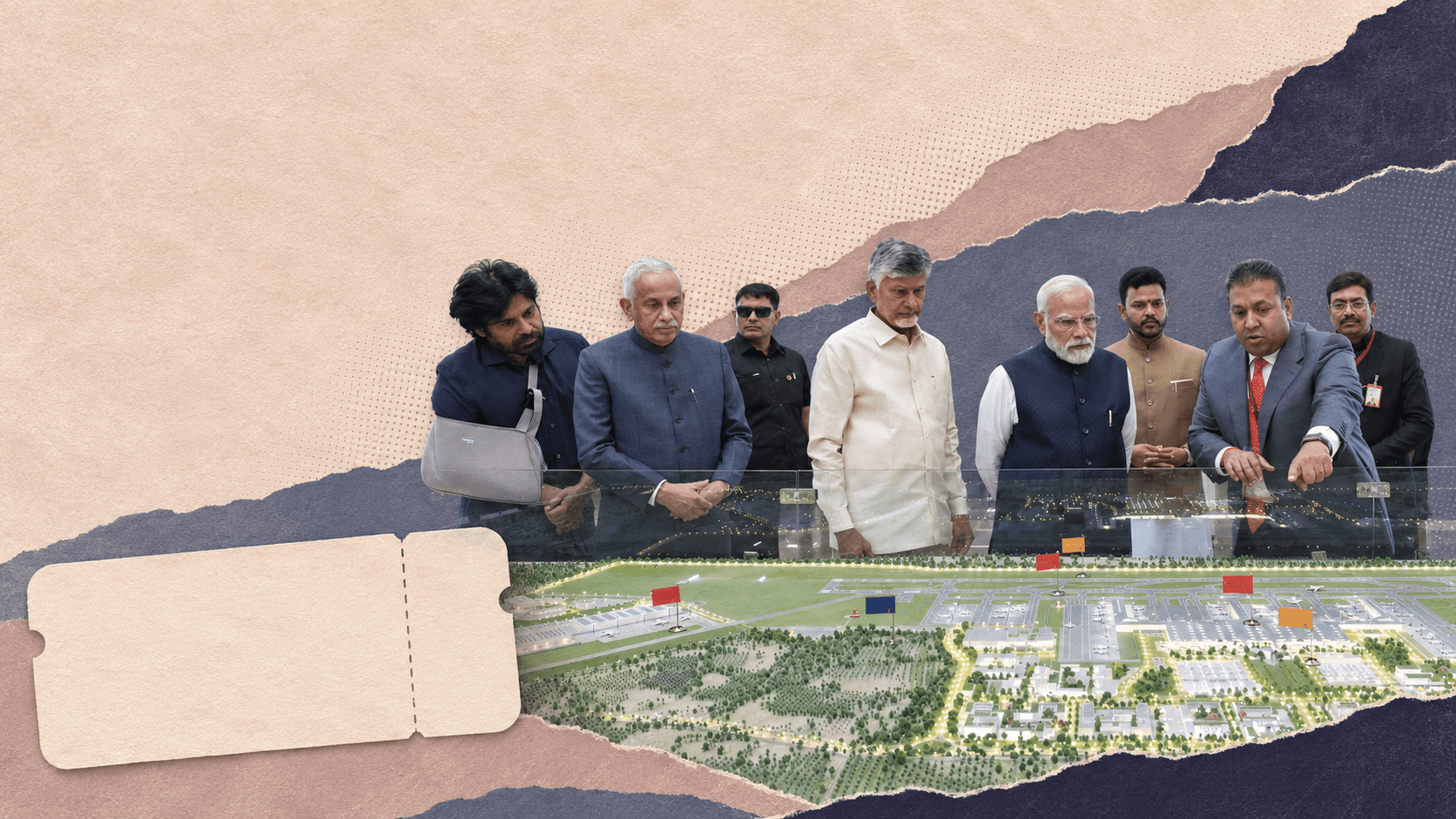
A domestic passenger taking a return journey through Bhogapuram will face up to ₹1,335 in user development fees attributable to that airport alone, before applicable taxes, under the opening rates in its new tariff order. The arithmetic is ₹445 on arrival plus ₹890 on departure. It excludes the airline fare and charges at the other airport.
The Airports Economic Regulatory Authority of India issued Order No. 23/2026-27 on 20 November, setting charges for Alluri Sitarama Raju International Airport at Bhogapuram through March 2031. The initial rate card covers travel from 1 December 2026 to 31 March 2027, and its note makes the new UDF applicable to tickets issued on or after 1 December.
Passengers therefore need to check both the ticket-issue date and the travel period. A journey after 1 December does not, by itself, establish that an older ticket falls under the new rates.
Behind the passenger fee is a financing decision. AERA has spread part of the airport’s approved revenue recovery into the next regulatory period to moderate the charges during its early years. That leaves a later recovery requirement alongside a scheduled increase in the fees passengers pay now.
What passengers will pay
The following amounts are per passenger. They are the approved ceilings, excluding applicable taxes, rather than an all-inclusive ticket price. The complete schedule appears in Annexure I, page 335 of the order.
1 Dec 2026–31 Mar 2027: domestic departure ₹890; domestic arrival ₹445; international departure ₹1,395; international arrival ₹698.
1 Apr 2027–31 Mar 2028: domestic departure ₹1,040; domestic arrival ₹520; international departure ₹1,495; international arrival ₹748.
1 Apr 2028–31 Mar 2029: domestic departure ₹1,140; domestic arrival ₹570; international departure ₹1,745; international arrival ₹873.
1 Apr 2029–31 Mar 2030: domestic departure ₹1,240; domestic arrival ₹620; international departure ₹1,945; international arrival ₹973.
1 Apr 2030–31 Mar 2031: domestic departure ₹1,325; domestic arrival ₹663; international departure ₹2,195; international arrival ₹1,098.
By FY31, the domestic departure ceiling is about 49% above the initial ₹890 rate. International departures rise by about 57%. These percentages compare the approved endpoints; they do not predict a passenger’s total fare increase.
The order also provides exemptions, including for children under two and specified other categories. Airlines and booking platforms will need to apply the relevant eligibility and ticketing rules when collecting the fee.
How Bhogapuram compares with Jewar and Navi Mumbai
Bhogapuram’s initial domestic UDF exceeds the FY27 rates reported for the other two airports. The following comparison uses earlier tariff reporting for Noida International Airport at Jewar and Navi Mumbai International Airport.
Bhogapuram: domestic departure UDF ₹890; domestic arrival UDF ₹445; basis AERA’s 20 November order, initial period to 31 March 2027.
Jewar / Noida: domestic departure UDF ₹490; domestic arrival UDF ₹210; basis FY2026–27 rates reported by PTI in May.
Navi Mumbai: domestic departure UDF ₹620; domestic arrival UDF ₹270; basis FY2026–27 rates reported by PTI in May.
Bhogapuram’s departure fee is about 82% above Jewar’s and 44% above Navi Mumbai’s. Its arrival fee is more than double Jewar’s and about 65% above Navi Mumbai’s. The comparator figures are earlier FY27 tariff reporting, not newly issued November orders.
This comparison covers one passenger charge. It cannot rank construction efficiency, overall airport costs or the total price of flying. AERA’s Bhogapuram order specifically cautions that comparisons between greenfield airports must account for their revenue requirements, traffic and mix of tariffs.
For an infrastructure reader, the useful follow-up is to reconcile the fee with the assets and demand it supports. A high charge spread across a smaller passenger base can produce a very different business outcome from a lower charge at a busier airport.
Why ₹916.62 crore has been pushed into the next period
AERA approved an aggregate revenue requirement of ₹3,542.63 crore in net-present-value terms for the first control period. The corresponding projected aeronautical revenue under the approved charges is ₹2,626.01 crore. The ₹916.62 crore difference, or 25.87% of the approved requirement, is carried into the next control period. These are regulatory present values, not cash expenditure, construction outlay or a government budget allocation.
The regulator is balancing two pressures. Recovery concentrated in the opening years would put more pressure on passenger and airline charges while traffic is still developing. Deferral eases that pressure, but leaves part of the recovery for a later tariff determination.
AERA also declined to exclude completed operational assets from the regulated asset base simply because the airport was building traffic. Its approach allows the capital costs into the regulatory calculation while spreading a portion of the resulting recovery over time.
Deferral should therefore be read as a change in timing. The order does not establish that ₹916.62 crore has been waived. Nor does its presence prove that airport passengers will eventually pay that amount through UDF alone: the future revenue mix and regulatory true-up still matter.
The traffic assumption needs watching
The demand starting point is weaker than the original forecast. The order records FY26 traffic at the predecessor Visakhapatnam airport of 2.97 million passengers against a forecast of 3.26 million, a shortfall of roughly 9%. That historical number belongs to the older airport; it must not be presented as a full year of Bhogapuram operations.
The order records Bhogapuram’s commercial-operation date as 17 August 2026. Its opening period is consequently shorter than a full financial year. Comparisons between FY27 and later years need to account for that partial year before attributing growth to better demand or new routes.
If traffic grows more slowly than assumed, there will be fewer passengers across whom to spread the recovery requirement. The fee schedule alone cannot establish whether that will happen. Published traffic, airline capacity and actual revenue will provide the evidence.
Airlines have incentives to add services
AERA has rejected distance-based domestic UDF and approved a single domestic departure rate and a lower arrival rate. Its reasoning includes the additional collection and audit complexity that distance bands would introduce.
The order separately permits incentives on qualifying airline landing charges. Those incentives should be assessed against genuinely additional routes and frequencies, rather than flights transferring from the old airport. Discounting airline charges is an attempt to attract services; its effectiveness requires operating evidence.
The operator should be able to show which services qualified, how long they continued, what incentives were granted and what additional traffic followed. AERA has directed it to maintain records for the subsequent review. Until that evidence is available, a tariff incentive remains a delivery mechanism rather than a demonstrated connectivity gain.
The dates that change the passenger bill
17 August 2026: Commercial-operation date recorded in the AERA order.
20 November 2026: AERA issues the first-control-period tariff order.
1 December 2026: New charges take effect, with the UDF ticket-issue condition applying from this date.
1 April 2027: The next scheduled domestic departure ceiling becomes ₹1,040.
31 March 2031: The first control period ends; deferred recovery enters the next-period determination, alongside the applicable review of actual results.
The first checks are practical: whether newly issued tickets show the correct fees, and whether the airport’s subsequent operating disclosures separate traffic transferred from Visakhapatnam from services added after the move. The later test is whether actual demand and revenue support the approved recovery path without another escalation in the burden on passengers.