Consider a bid like the one for the Rahatgarh to Berkhedi four-laning in Madhya Pradesh: ₹324 crore against NHAI's estimate of ₹627 crore, a discount of about 48%. Times of India reported it in January as one of several highway bids that came in 41% to 48% below estimate. Had a procurement covered by the new rule drawn a bid like that, it would have to be examined before it could be accepted. Whether NHAI's own tenders are covered is unconfirmed, as discussed below.
The memorandum, issued by the Department of Expenditure (No. F.2/22/2026-PPD), says a bid more than 30% below the estimated cost "shall mandatorily be examined" as a potential abnormally low bid. The earlier position was softer. The Works Manual, Second Edition, issued on 23 December 2025, said the buyer "may" seek clarification and held that "it would not be advisable to fix a normative percentage below the estimated cost, which would automatically be considered as an abnormally low bid."
A note on sourcing. The Department's own copy of the memorandum was not available. The text used here is as reproduced by StaffNews and is consistent with reporting such as Business Standard/PTI of 15 November. Readers who need the exact wording should check the original.
What the rule does, and does not do
The 30% line triggers an examination, not a rejection. The buyer asks for a written clarification and a detailed price analysis of the bid in relation to scope, schedule, allocation of risks and responsibilities, and any other requirements of the tender document. The Works Manual adds resource mobilisation. A bid can be rejected only if the bidder fails to show it can deliver at its price. In that case the buyer may move to the next bidder and evaluate it at its own price, not by asking it to match the lowest figure.
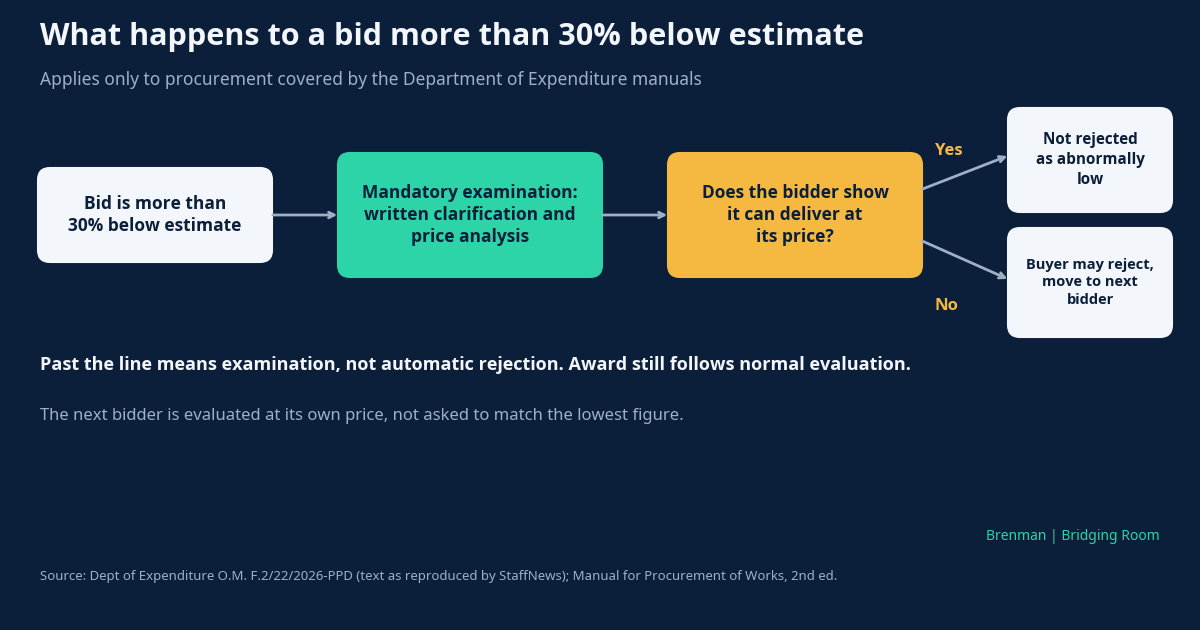
How the examination works for procurement covered by the new rule. Clearing it means a bid is not rejected as abnormally low. Award still follows normal evaluation.
The test is "more than" 30%. On a work estimated at ₹100 crore, a bid of ₹70.5 crore is 29.5% below and escapes the mandatory trigger. A bid of ₹69 crore is 31% below and must be examined. A bid of exactly ₹70 crore sits on the line without crossing it.
The memorandum amends the abnormally low bid paragraph in the Manual for Procurement of Goods (para 7.6.7) and says the change applies equally to the paragraphs in the manuals for Works (6.4.8), Consultancy Services (8.5.7) and Non-Consultancy Services (7.4.8).
How deep bids actually go
Deep discounts are not hypothetical. Beyond the Madhya Pradesh case, the January Times of India report cited Dareota to Kalar Bala in Himachal Pradesh at ₹435 crore against ₹734 crore, about 41% less, and a Pune-Satara urban stretch at ₹321 crore, about 46% below the authority's estimate as the report puts it. The estimate for that stretch was not given. The report covers bids since 2023-24 and does not say all were awarded. It also records that the road ministry cancelled a Manipur tender after the lowest bidder quoted 47% under the estimate. The contractor went to the Gauhati High Court, which ordered an interim stay.
The pattern is not confined to highways. A Parliamentary Standing Committee on PMGSY noted in August 2025 that contractors often quote 25% to 30% below the minimum bidding amount, and recommended retaining the difference as security, to be released if the road meets quality norms (PRS summary). In Chennai, councillors told a Greater Chennai Corporation meeting on 26 September that bids were coming in 25% to 38% below estimate. A zonal chairman cited drain desilting awarded about 35% below and road patchwork about 37% below, and claimed silt yields of 8 bags against an expected 10. That is his claim, not a measured finding. The commissioner said the corporation owed contractors nearly ₹2,300 crore (New Indian Express).
These are selected cases from press reports, not a sample of all tenders. They show that bids beyond the line occur in road and civic works. They do not show how often. None of the sources reviewed gives the share of bids that fall below 30%.
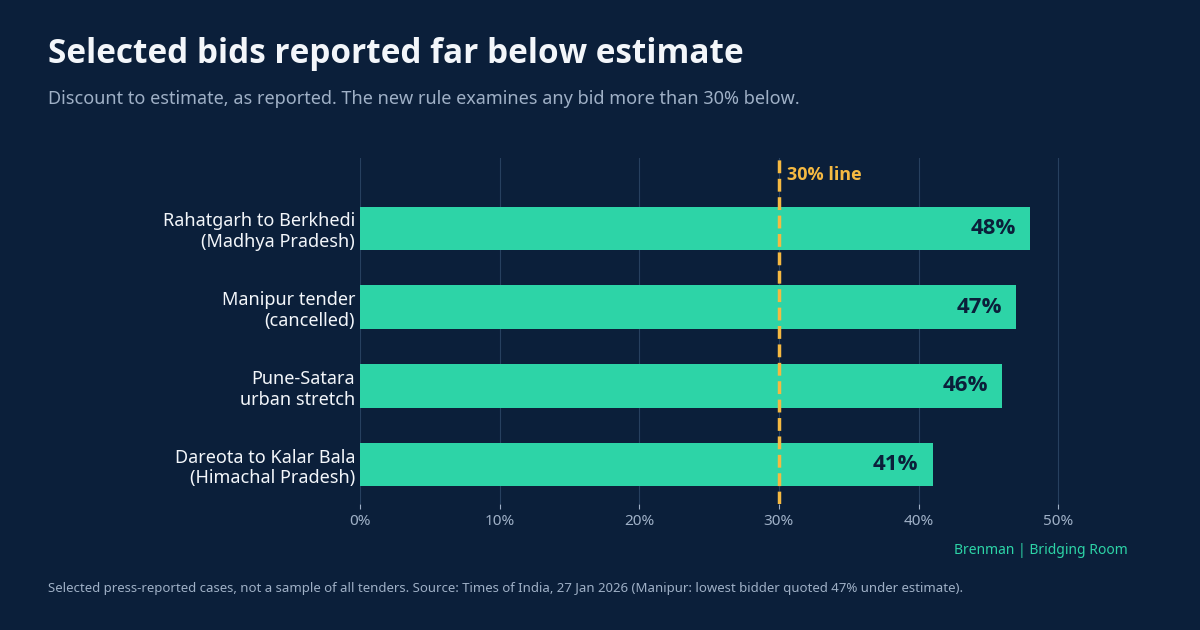
Approximate discounts to estimate in selected historical press reports, mostly from before the new rule. This is not evidence that these buyers are covered by it.
Buyers were already improvising
The memorandum arrives after several buyers wrote their own rules, and the measures do different jobs. NHAI chose oversight. On 30 September it announced special quality inspections of 17 ongoing projects selected on three criteria: cost above ₹500 crore, tender discount above 15%, and physical progress between 35% and 80%. Teams led by 39 retired engineers will work across nine states, with a first round due by December and re-inspection after six months (PIB).
Others chose money. Goa's PWD withdrew a circular in May 2025 that rejected every bid 20% or more below estimate, and moved to a performance guarantee that rises as the bid falls (Times of India). For its 2026-27 road tenders, the Greater Chennai Corporation takes additional security only from the lowest bidder, within two days of first negotiation, and retains 2.5% of the contract amount for a three-year defect liability period. An official told The Hindu on 22 November that this guards against contractors quoting steep discounts and not finishing.
The memorandum asks for neither inspection nor extra deposit. It requires the buyer to examine the bid and the bidder to explain it.
Who is covered
This is the least settled point. The Works Manual is addressed to Ministries and Departments, their attached and subordinate offices, and some autonomous bodies. It excludes larger works procured by organisations with their own detailed guidelines, naming CPWD, MES, BRO and the Ministry of Railways. Another paragraph extends the guidelines to CPSEs, public sector banks, and constitutional or statutory bodies substantially owned, controlled or financed by the Centre, subject to deviations approved by their competent authority such as a board.
The manual does not mention state governments or municipal bodies. Whether the 30% trigger governs NHAI, CPWD, the Railways, state PWDs or the Chennai corporation is not stated in the memorandum or the manual, and no official statement settling it was found. Each should be treated as unconfirmed until the agency or the Department says so.
The estimate is the weak point
A discount is only as meaningful as the number it is measured against, and the estimate can be wrong in three directions.
If the estimate is too low, a bid 30% under it is a stronger warning than the percentage suggests. Estimates in public works are often optimistic by design, as the earlier Bridging Room piece on project delays argued. If the estimate is too high, a deep discount may reflect competition rather than risk. The Works Manual itself warns of cartels and "pool rates" and encourages bringing in new firms, so a new entrant undercutting a closed market may be doing exactly what the system wants. And if the estimate is out of date, honest bids will be mislabelled. A Chennai official told The Hindu that tenders once drew bids above estimate but recent ones sometimes come 20% to 30% below, which is what a stale schedule of rates would produce.
The manual's answer is process, not arithmetic: prepare drawings and specifications with care, and ask the bidder to show its working. The 30% trigger makes that conversation mandatory. It does not make the estimate better.
The bidder's burden of proof
The memorandum does not list documents. For a civil package, the wording points to a rate analysis for major items, the source and cost of materials, a plant and labour plan, and a programme consistent with the quoted period. Which of these a buyer asks for is its call. That list is a reading of the manual's wording, not text from the memorandum.
Likely effects on tender evaluation
What follows is analysis, not reported outcome. Every covered tender that draws a bid below the line now needs a documented clarification round, which committees that skipped it can no longer do. A written price analysis and a stated test also give the buyer something to defend if a rejection is challenged, as the Manipur case shows, though a reasoned rejection can still be contested in court, as procurement law scholars at NLIU have noted.
A hard line invites shading. A bidder who knows the threshold exists can price just above it, leaving a cliff at around 29%. Nothing in the reports shows this happening yet, and the manual still permits scrutiny below 30% where the buyer chooses to apply it. If a large share of bids does fall under the line, buyers will have to ask whether their schedule of rates is wrong. And agencies that already take additional security will have to decide how it sits beside the explanation step, if the rule applies to them at all.
What to watch
The original memorandum and any follow-up on scope: does it reach NHAI, CPWD and the Railways?
Whether road agencies that take additional performance security keep it alongside the 30% examination.
Results of NHAI's inspection round due by December 2026, and the six-month re-inspection.
Whether low-bid cancellations rise, and how courts treat them.
The Delhi-Mumbai Expressway package 8 tender (Jujuwa-Gandeva, 35.4 km). The Indian Express reported on 20 October that the lowest bidder, which it learnt had quoted over 10% under the ₹1,476 crore estimate, declined the letter of award, and NHAI encashed the ₹14.76 crore bid security. That deposit is tied to the bid and is separate from performance security taken from a winner. An NHAI official said a 15 July circular asked for additional performance guarantees to curb aggressive bidding. This is the fourth time bids were invited for the package. The lowest bidder's reasons were not given.