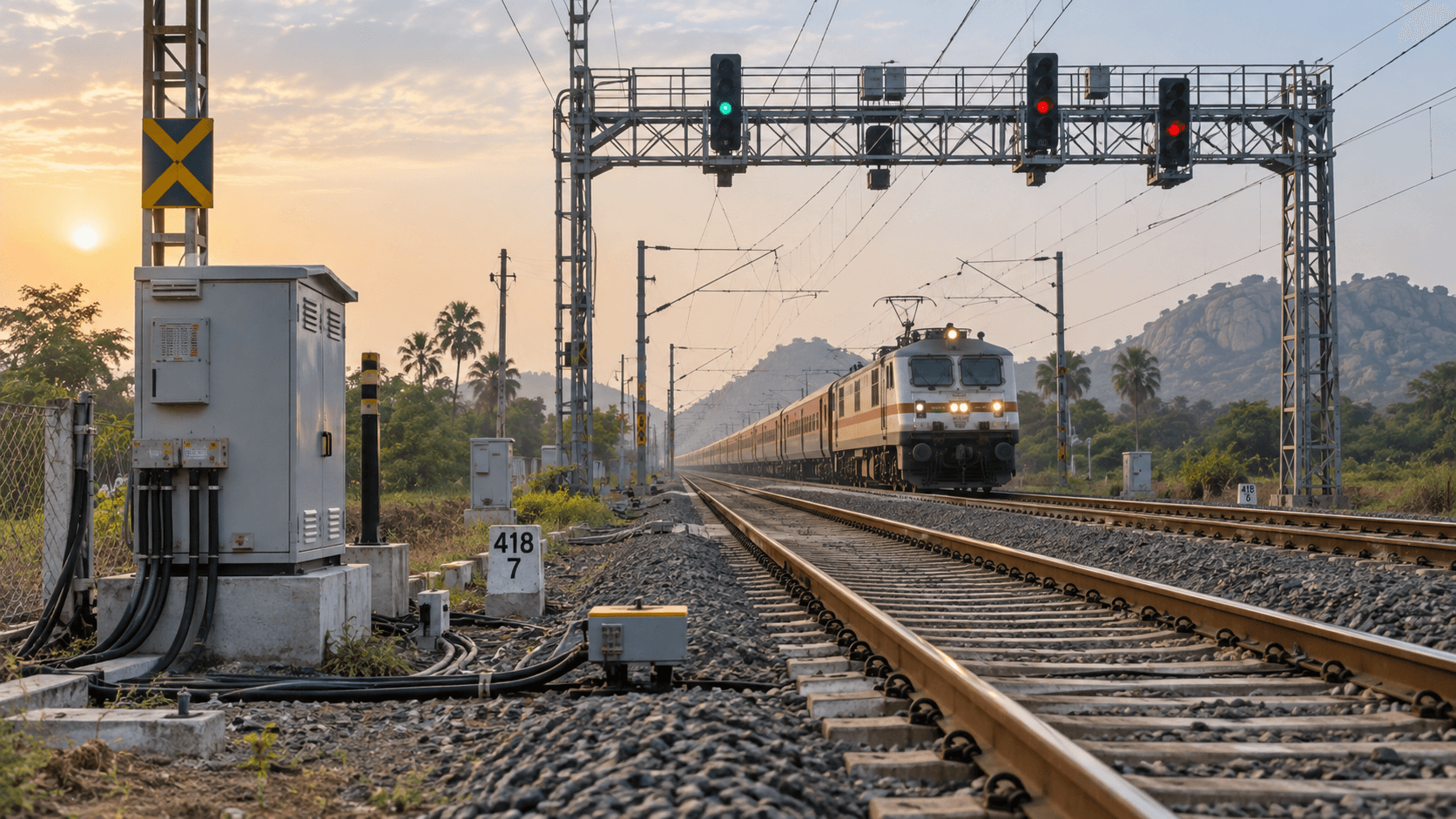
On 23 September, Indian Railways said Kavach Version 4.0 had been commissioned across 108 route kilometres between Malkajgiri and Kamareddi in Telangana. It is the first such commissioning on South Central Railway. The announcement is easy to read as a technology milestone. For project teams, it is better understood as the start of an operating test.
A protection system earns its value after the ceremony. It must work across stations, block sections, locomotives, optical-fibre links, radio equipment and electronic interlocking. It must remain available through heat, rain, maintenance blocks and daily operating pressure. It must intervene when required without becoming so unreliable that operators learn to work around it.
That is why the next set of numbers matters more than the headline.
What changed on the corridor
The Ministry of Railways says the section has moved from Kavach Version 3.2 to Version 4.0. The new version is intended to improve train location accuracy, show signal information more reliably in larger yards, connect stations through optical fibre and interface directly with existing electronic interlocking systems.
Each improvement closes a different gap. Better location data helps the system know where a train is. Better yard information addresses places where several signals and routes sit close together. Station-to-station connectivity carries information across the corridor. The direct interlocking interface ties the protection layer to the signalling logic that controls routes and points.
None of these is a stand-alone installation. Kavach needs station equipment at stations and block sections, RFID tags along the track, telecom towers, optical fibre and onboard equipment in locomotives. The corridor functions only when those parts speak to each other consistently.
Commissioning is an integration claim
Infrastructure reporting often treats commissioning as the final verb. In systems projects, it is a more specific claim. It means the installed system has passed a defined set of checks and has been accepted for use. It does not mean that every locomotive is fitted, every operating pattern has been tested over a long period, or every maintenance weakness has already appeared.
The Malkajgiri-Kamareddi section therefore offers a useful way to examine systems integration. Trackside equipment may be complete while fleet fitment remains partial. Station equipment may be available while a telecom fault reduces coverage. A new software version may perform as designed while operators still need time to adapt procedures.
The key project question is not simply whether 108 route kilometres are commissioned. It is whether the whole protection chain remains available for the trains that actually use the route.
What evidence should come next
Four measures would make the commissioning claim easier to assess.
First, coverage. How many stations, block sections and locomotives are equipped and active on the corridor? Route kilometres describe geography, but they do not describe the share of train movements protected.
Second, availability. How many hours is the system available, and what causes downtime? A protection system can be technically commissioned yet suffer from telecom faults, equipment isolation or maintenance interruptions.
Third, interventions. How often does Kavach warn the driver or apply brakes, and under what operating conditions? Counts need context because an intervention may reflect genuine risk, a restrictive signal, a speed-control event or a test.
Fourth, overrides and failures. How often is equipment isolated, bypassed or reset, and how quickly is service restored? These figures reveal whether the system is becoming routine operating infrastructure or remains a specialist layer that demands exceptional support.
The maintenance model is part of the safety case
Kavach combines civil access, signalling, telecom, electrical supply, software and rolling-stock equipment. That makes maintenance ownership a central project-control issue. A fault may sit with the station unit, an RFID tag, the fibre network, a radio link, the interlocking interface or the locomotive.
Fast restoration depends on clear responsibility. The operating railway needs diagnostic data, spare parts, trained staff and escalation rules. Contractors and equipment suppliers need defined response times. Software and configuration changes need traceability because a fix in one part of the network can affect another.
This is where a safety system becomes an asset-management system. The installation programme creates the equipment. The maintenance programme preserves the protection function.
What the announcement does and does not prove
The official release establishes a real milestone: Kavach 4.0 has been commissioned on a named 108 route-kilometre section. It also identifies the main technical improvements and the infrastructure required for deployment.
It does not provide a commissioning certificate, detailed test results, fitted-locomotive counts, system availability, intervention records or a maintenance performance baseline. It also does not establish a measured reduction in incidents on this section. Those are follow-up questions, not reasons to dismiss the milestone.
The distinction matters because safety technology is often judged at two unhelpful extremes. One view treats installation as proof of the outcome. The other waits for a failure before examining how the system works. A stronger approach follows the operating evidence from the first day.
The next test
South Central Railway already had substantial experience with Kavach Version 3.2. The Version 4.0 commissioning now creates a practical comparison. Did the upgrade improve location performance in complex areas? Did the direct electronic-interlocking interface reduce integration problems? Has station-to-station fibre connectivity improved reliability? How quickly are faults detected and restored?
Answers will require operational data rather than another launch announcement. The most useful next update would publish coverage by station and locomotive, monthly availability, the number and type of interventions, override periods, failure categories and restoration times.
Kavach is designed to prevent dangerous operating conditions from becoming accidents. Its success will be quiet by design. That makes disciplined measurement essential. The 108 route kilometres between Malkajgiri and Kamareddi are now more than a deployment statistic. They are a live test of whether India can operate, maintain and scale a complex railway safety system with the same seriousness used to build it.