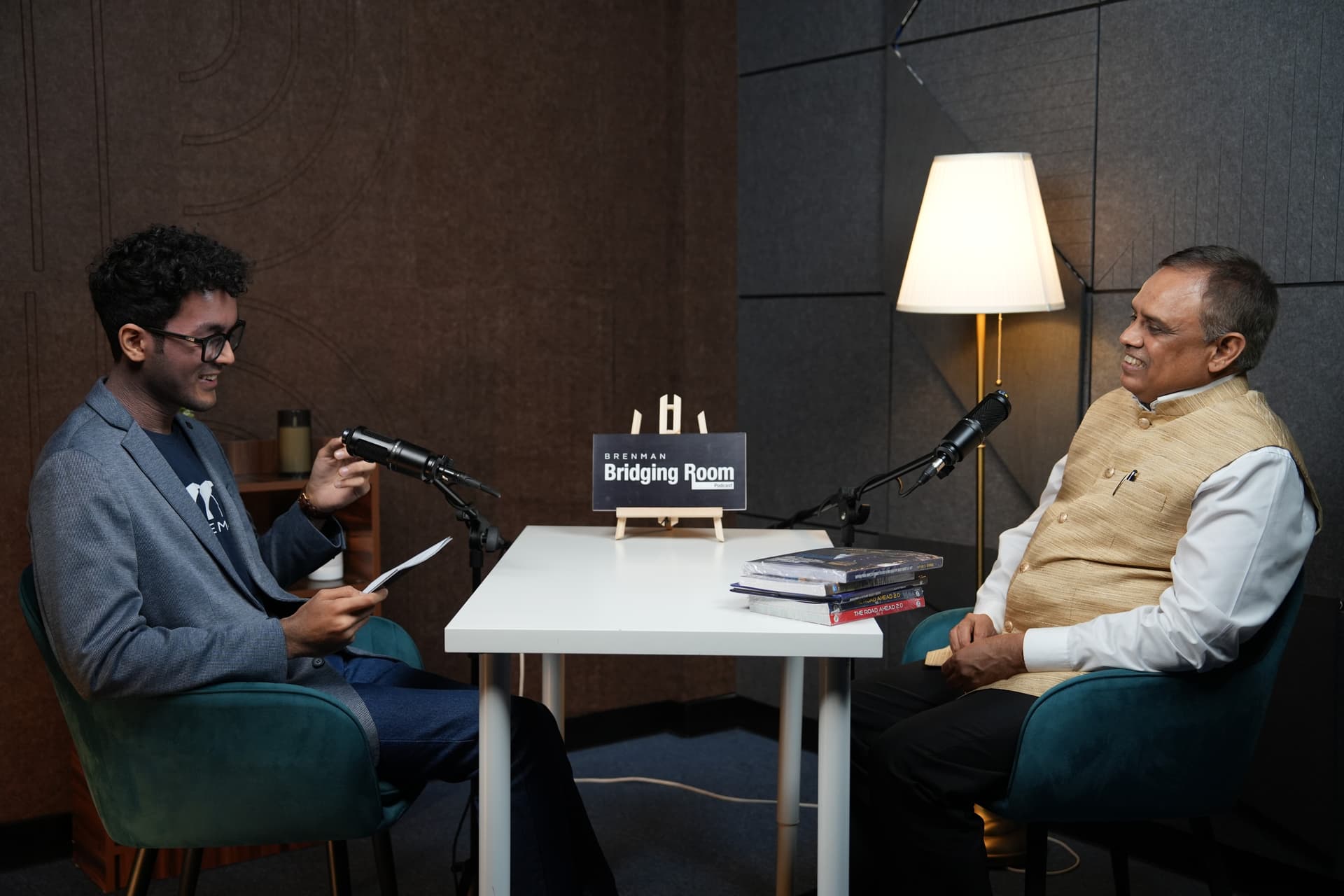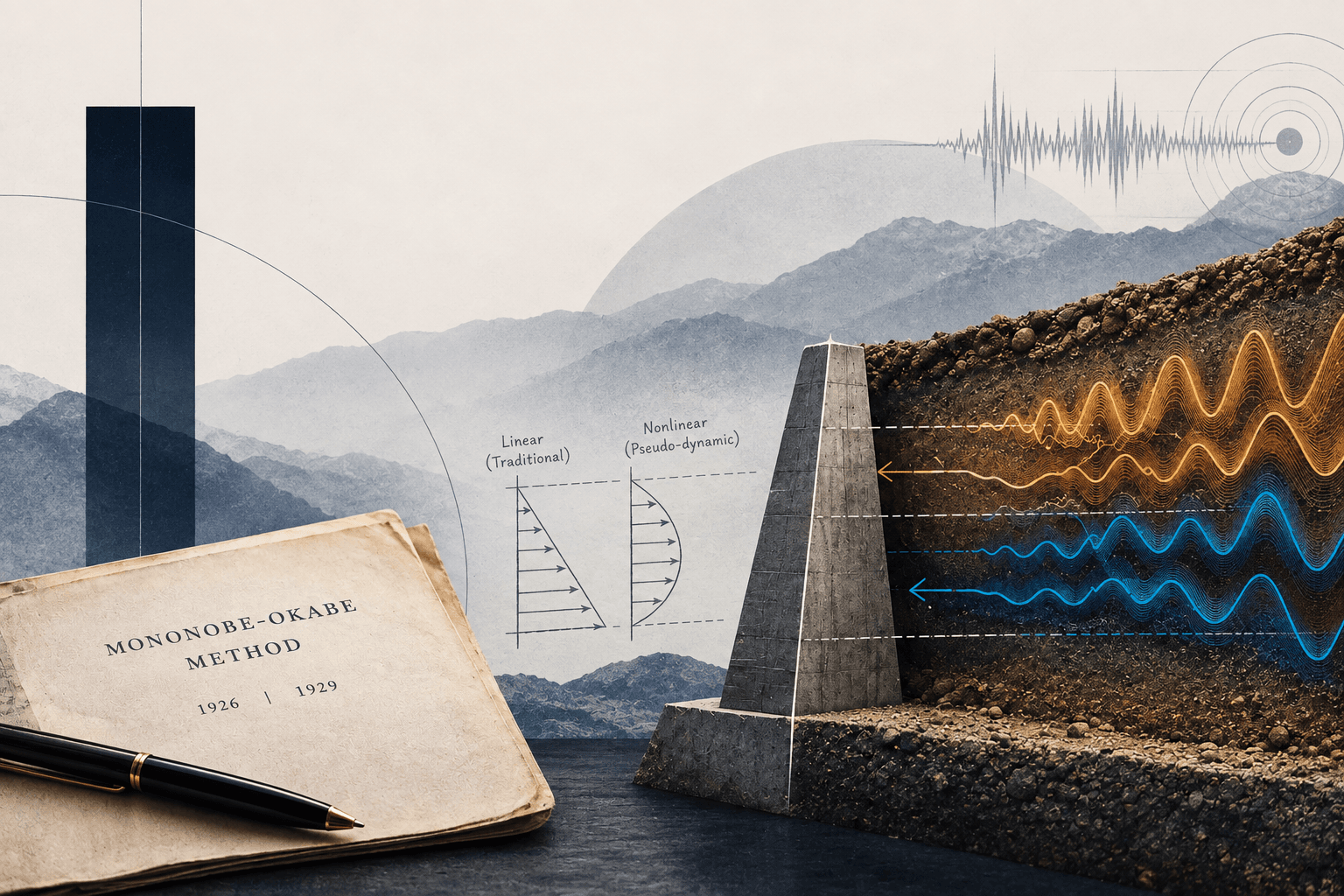
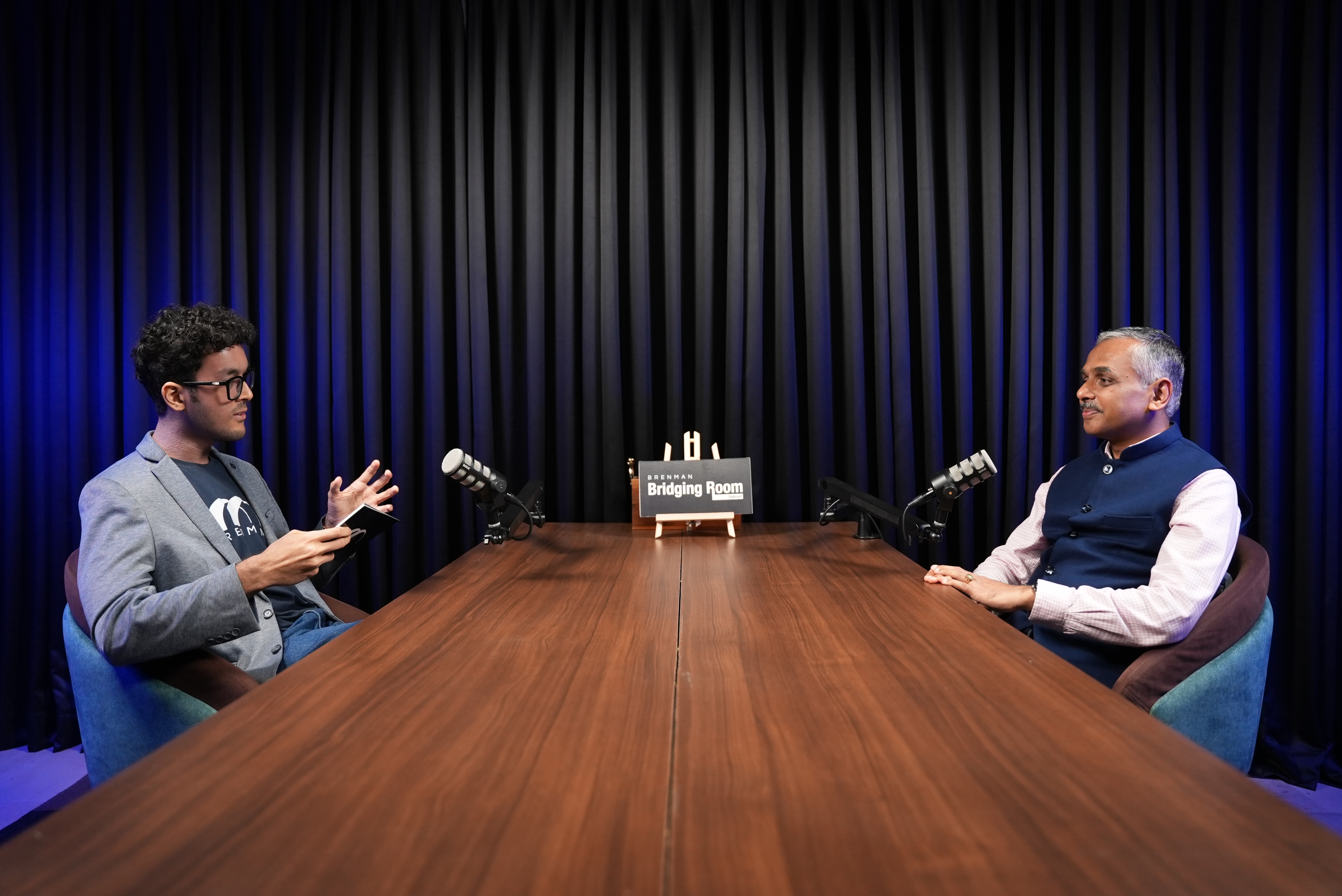
We had the opportunity to sit down with Prof. Deepankar Choudhury, Chair Professor (HAG) at IIT Bombay and former Head of Civil Engineering, for an episode of the Bridging Room Podcast.
And as I was preparing for the conversation, I spent some time reading about his research and the problems he had worked on throughout his career.
One discussion point that caught my attention was his work on the Mononobe-Okabe approach.
I am not from an engineering background, so I was not looking at it from the perspective of whether one method was technically better than another. What interested me was something much simpler.
Why would an engineer go back and question an approach that had already been around for almost a hundred years?
To understand that, I had to first understand what the Mononobe-Okabe approach was trying to solve.
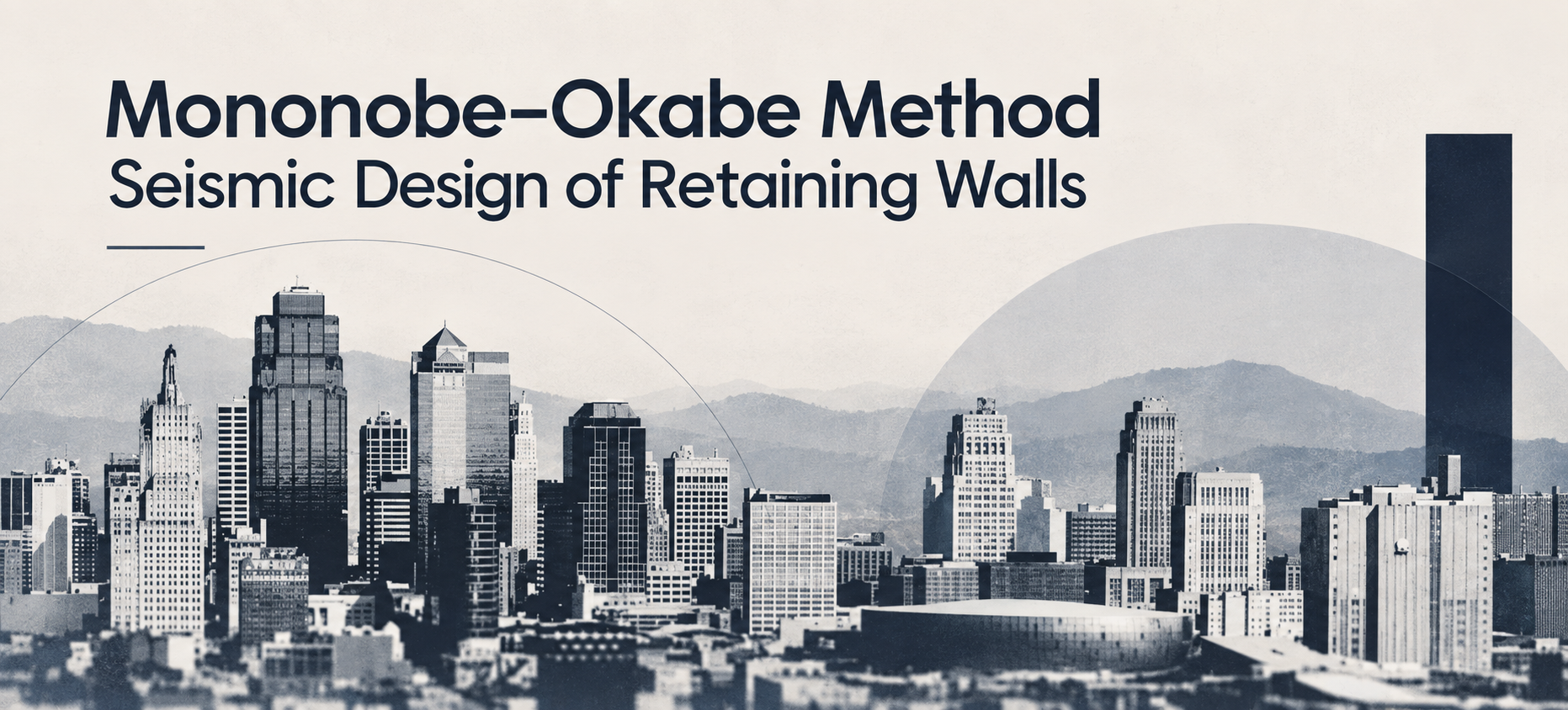
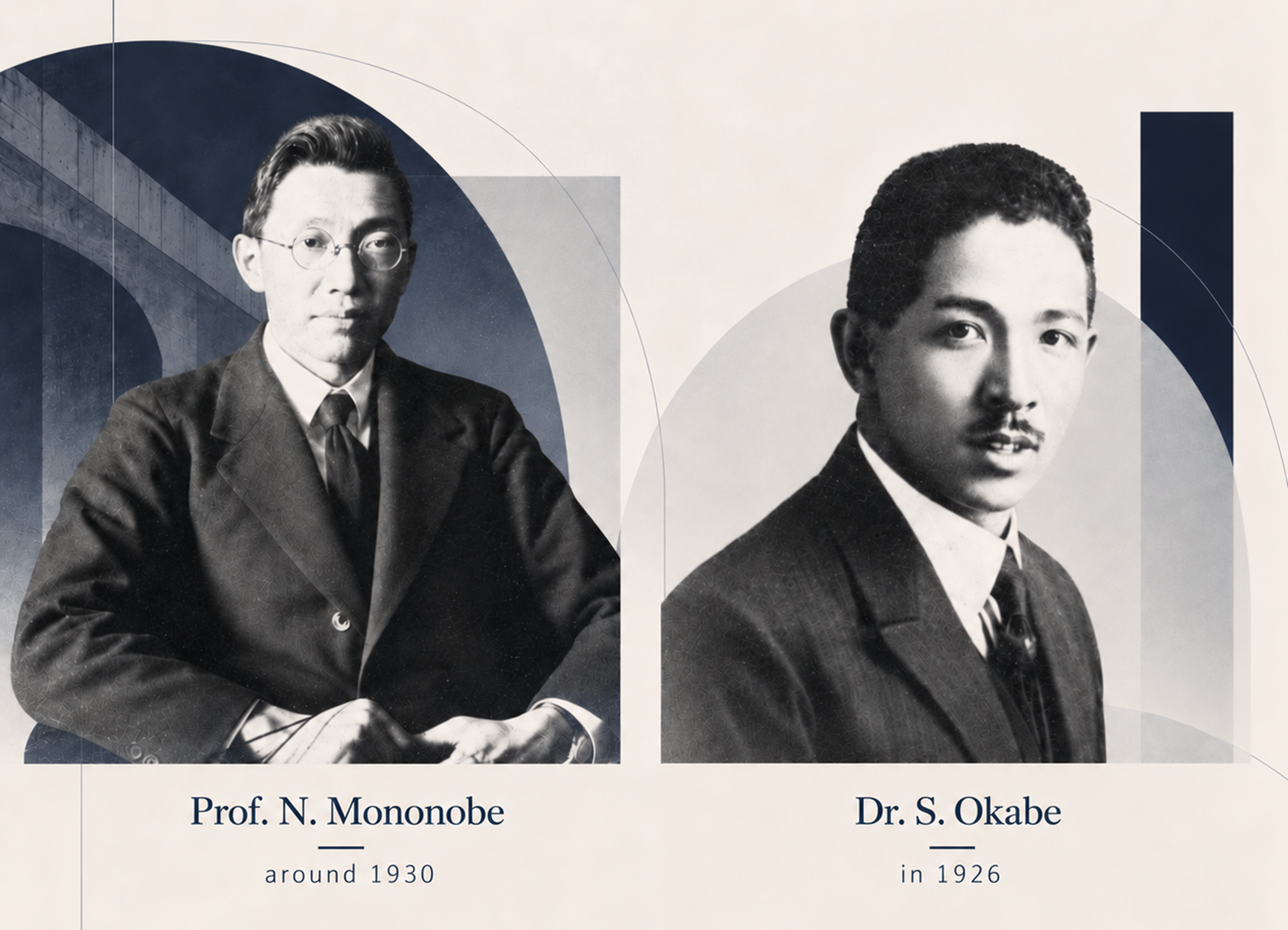
The story goes back to 1926, when Okabe published his work on the seismic stability of retaining walls, followed by the work of Mononobe and Matsuo in 1929. Their work eventually became the basis of what engineers know as the Mononobe-Okabe method, a widely used approach for estimating the pressure that soil exerts on a retaining wall during an earthquake.
The problem itself is easier to picture than it sounds.
Imagine a wall holding back a mass of soil. Under normal conditions, the soil already exerts pressure on the wall. During an earthquake, the movement of the ground creates additional forces within that soil, which can increase the pressure acting on the wall.
Engineers therefore need a way to estimate how much that pressure could increase during seismic loading.
The Mononobe-Okabe approach gave them a practical way to do that.
Instead of trying to model the entire movement of an earthquake through the soil, the method represented the seismic effect as an equivalent static force. It turned a complicated dynamic problem into something that could be calculated and used in design.
That simplification was useful, which is one of the reasons the approach remained relevant for decades and became part of engineering practice and codes around the world.
But there is something about that simplification that stayed with me.
An earthquake is not static. The ground moves. Seismic waves travel through the soil. And they take time to travel. That was the discussion point I wanted to bring up with Prof. Choudhury.
In our conversation, I learnt that he had worked with Sanjay Nimbalkar on developing a pseudo-dynamic approach to seismic earth pressure.
The idea, in simple terms, was to bring the movement of seismic waves into a problem that had traditionally been treated through an equivalent static approach.
Instead of assuming that the entire backfill responds in the same way at the same time, the formulation considered things such as shear and primary wave velocities, the time taken for waves to travel through the backfill and the difference in phase of the movement at different depths.
The result was a different way of representing the pressure acting along the wall.
The traditional Mononobe-Okabe approach assumes a linear pressure distribution. The pseudo-dynamic formulation produced a nonlinear pressure distribution by accounting for the propagation of waves through the backfill.
I found this interesting not because I could fully appreciate the mathematics behind it, but because of the question that came before the mathematics.
What makes someone look at a method that has been used for generations and decide that there might be another way to understand the same problem?
That question becomes even more interesting when you look at when the work was done.
Prof. Choudhury and Sanjay Nimbalkar published their work on seismic passive resistance using the pseudo-dynamic method in 2005, followed by their work on seismic active earth pressure behind retaining walls in 2006.
The approach was later extended to other areas, including rotational displacement, sliding stability and the effects of body waves.
What I took away from this was not that the Mononobe-Okabe method was somehow wrong.
It had solved an important engineering problem in a practical way, and its continued use reflects its value.
The interesting part was that someone was willing to look at the assumptions behind it and ask whether the physical behaviour could be represented differently.
That, to me, is where the story becomes bigger than one engineering method.
A lot of what we use in engineering today comes from things that someone else established before us. We inherit equations, standards, models and ways of approaching problems. They become familiar, and familiarity can sometimes make us forget to look at the assumptions underneath them.
But research keeps that questioning alive.
It asks whether our understanding can be made closer to reality, even when the existing approach is already useful.
And perhaps that is what stood out to me most while preparing for this conversation.
You do not necessarily have to reject what came before to improve it. Sometimes, you simply have to ask a different question.
That was one of the many things we spoke about with Prof. Deepankar Choudhury on the Bridging Room Podcast.
Our conversation went well beyond the pseudo-dynamic approach. We spoke about his work in geotechnical and earthquake engineering, complex foundation problems, Atal Setu, Mumbai's ground conditions, disaster resilience, research and the role of engineering in some of India's most challenging infrastructure projects.
For me, the Mononobe-Okabe discussion was one of those moments where a technical research topic opened up a much broader conversation about how engineers think, how established ideas evolve and what it takes to challenge an assumption that has been around for generations.
The full conversation with Prof. Deepankar Choudhury is now live on the Bridging Room Podcast.
If you want to hear Prof. Choudhury talk about the thinking behind his research and the experiences that shaped his work, watch the full episode.