
How this used to work
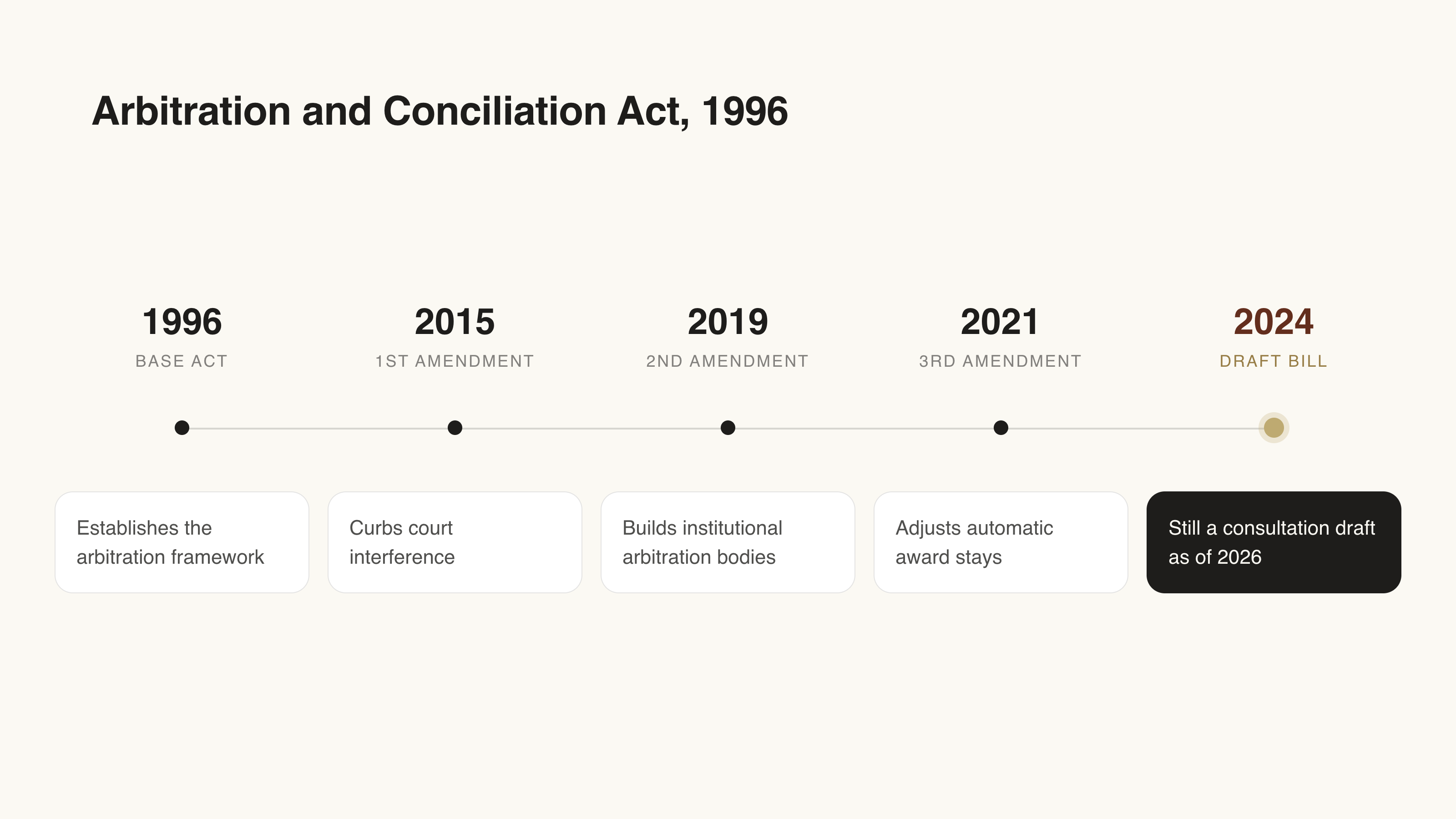
The Arbitration and Conciliation Act, 1996 is the backbone of nearly every dispute resolution clause in Indian construction and infrastructure contracts. It has already been amended three times, in 2015, 2019, and 2021, each round aimed at cutting down court interference and making arbitration faster and more reliable.
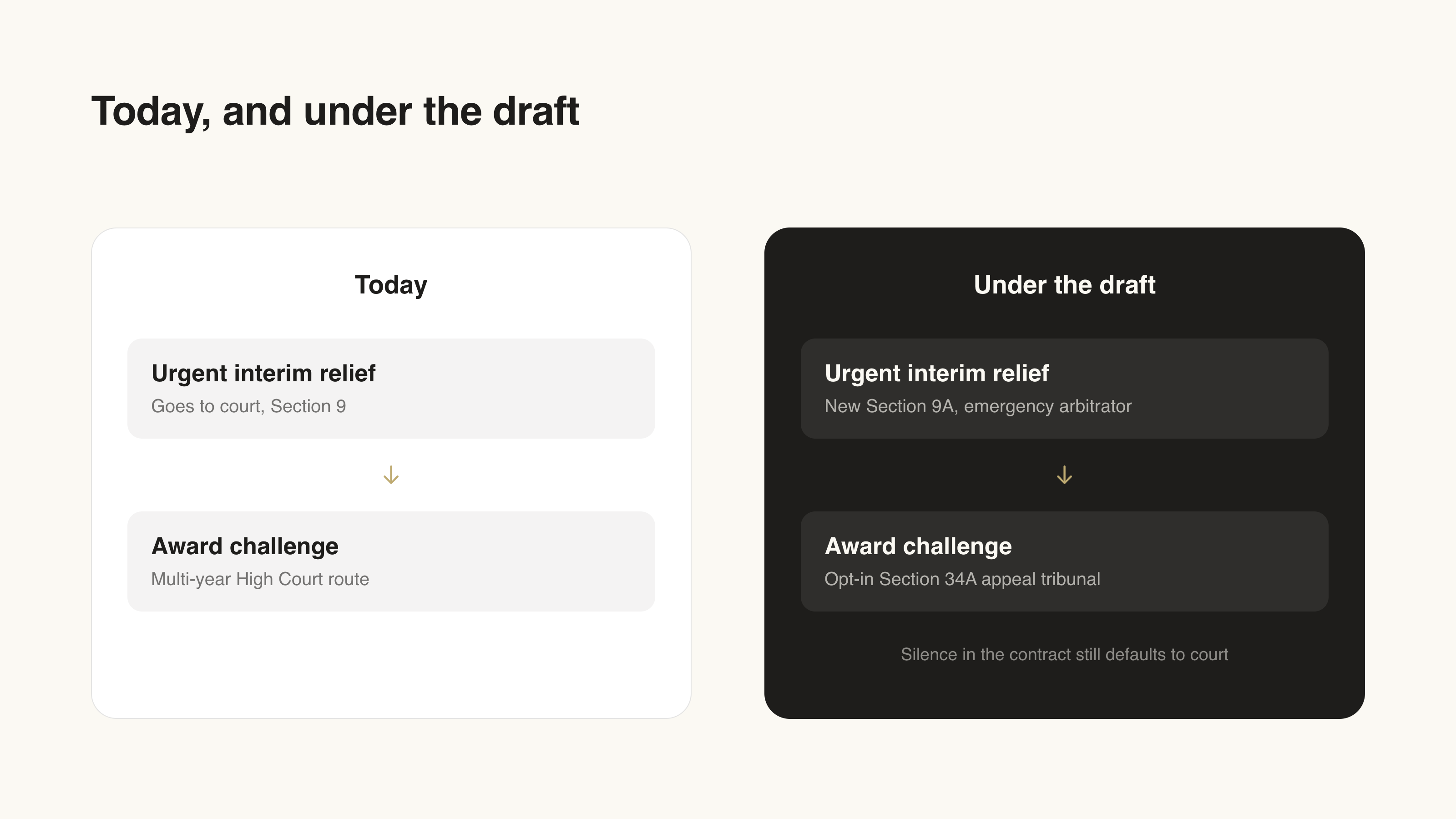
Those amendments helped, but they didn't fully solve the problem. Interim relief before a tribunal is even constituted still routinely sends parties straight to court under Section 9. Award challenges under Section 34 remain a multi-year detour through the High Courts and, in rare cases, the Supreme Court.
What just changed
In October 2024, the Department of Legal Affairs published the Draft Arbitration and Conciliation (Amendment) Bill, 2024 for public consultation, built on recommendations from a 16-member expert committee led by former Law Ministry secretary Dr. T.K. Viswanathan. As of mid-2026, it remains exactly that, a consultation draft. It has not been introduced in Parliament, and the current three-times-amended 1996 Act still governs every arbitration clause signed today.
The draft itself is substantial. A new Section 9A would give emergency arbitrators statutory recognition, closing the gap that currently sends urgent interim relief requests to court. A new, opt-in Section 34A would create an appellate arbitral tribunal, letting parties agree in advance to a second look at an award by another arbitral body instead of a court. The draft also expands the role of institutional arbitration and the Arbitration Council of India, tightens timelines for appointing arbitrators and deciding jurisdiction, gives audio-visual hearings explicit recognition, and renames the statute simply the "Arbitration Act", dropping "Conciliation" now that the separate Mediation Act, 2023 covers that ground.
Why now
Three goals run through almost every proposal in the draft: push more disputes toward institutional rather than ad hoc arbitration, reduce the level of court intervention that has long undermined confidence in Indian arbitration, and shorten the time an arbitration takes from start to enforceable award.
An award can survive arbitration, a Section 34 challenge, a Supreme Court appeal, and a review petition, and still get unwound years later through a rarely used curative petition. That kind of outcome is precisely what the government's ease-of-doing-business argument for institutional arbitration and reduced court intervention is trying to prevent, even if this particular draft would not itself have changed how that case turned out.
How this plays out in the construction industry
Construction and infrastructure disputes are exactly the high-value, technically complex, multi-year disputes this draft is aimed at. Emergency arbitrator recognition would matter most in mid-project standoffs, a contractor threatening to down tools, or an employer threatening termination, where today the only real option is an urgent court application.
The appellate arbitral tribunal is opt-in, which means it has to be drafted into the contract. Standard-form agreements and Model Concession Agreements updated after this Bill passes will need to explicitly decide whether to include a Section 34A appellate mechanism; silence would default back to the existing Section 34 court-review route.
Faster, statutorily timed appointment of arbitrators would cut against a recurring contractor complaint, that an employer-controlled appointment process itself becomes a stalling tactic in disputes over payment or extension of time.
What to watch next
Understand the basics- https://www.brenmanconsulting.com/programs/construction-law
Whether the Draft Bill is actually introduced in Parliament this year, or remains a consultation draft into 2027.
How the Arbitration Council of India's expanded role gets operationalised, and whether institutional arbitration centres see a real uptick in construction and infrastructure cases as a result.
Whether Model Concession Agreements for HAM and EPC contracts start building in the opt-in Section 34A appellate mechanism ahead of the Bill actually becoming law.
How quickly emergency arbitrator provisions, if enacted, get tested in a live construction dispute, since that is where the practical difference from today's Section 9 court route would show up first.
Sources: iPleaders blog on Arbitration (Amendment) Bill 2024 status; Global Arbitration Review, Asia-Pacific Arbitration Review 2027; Lexology (Anhad Law) commentary; Law.asia coverage; White & Case LLP client alert; Pinsent Masons Out-Law; Majmudar & Partners review of the Draft Amendment Bill.


