
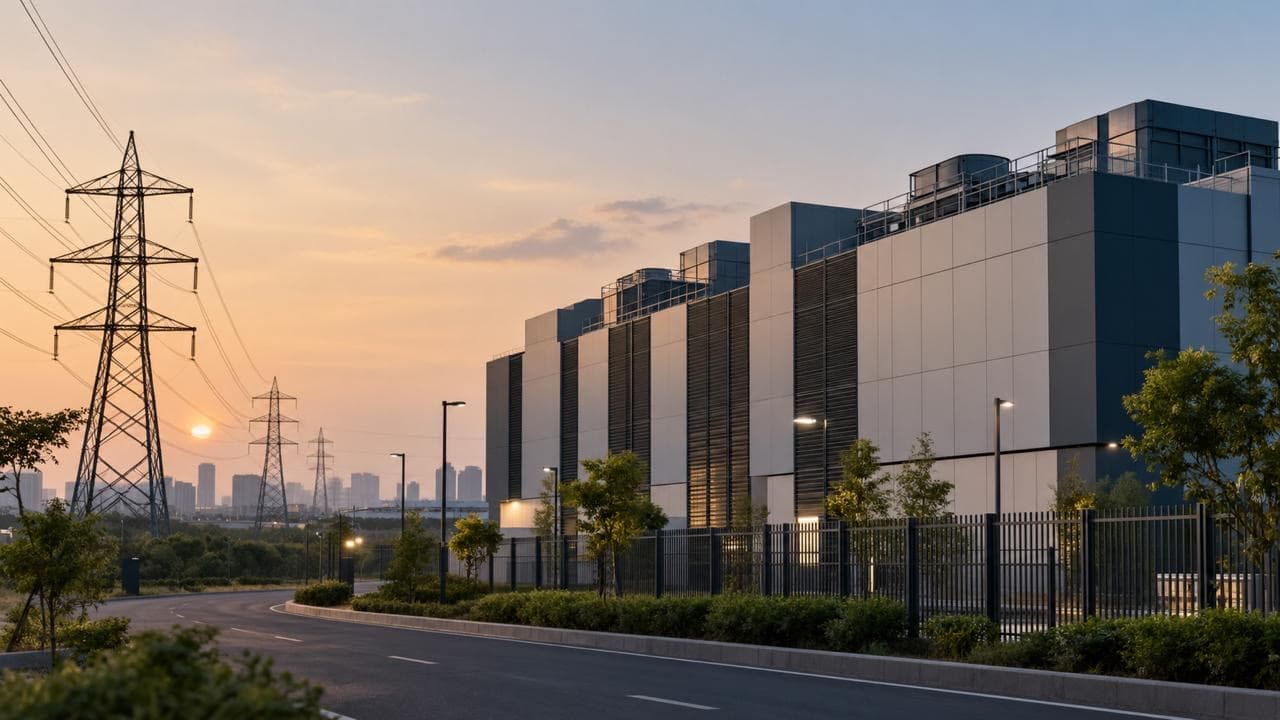
India’s next wave of data-centre development will depend on more than land acquisition and architectural design. Reliable electricity, cooling requirements, water availability and approval timelines are becoming central to decisions about where campuses can be built and how quickly they can become operational.
At a CEO roundtable on 2 September 2026, Union Commerce and Industry Minister Piyush Goyal highlighted the potential for around US$200 billion in investment in India’s data-centre industry. Hyperscalers accounted for more than 80% of data-centre absorption in the first half of 2026, reflecting the growing demand for infrastructure supporting cloud computing and artificial intelligence (AI). The investment figure represents potential, not capital already committed or spent.
India’s installed data-centre capacity stood at approximately 1,575 MW in August 2026, while electricity demand from data centres is estimated at around 17 GW by 2031–32. These are different measures: installed capacity describes the existing data-centre base, while the 2031–32 figure is an estimate of electricity demand. They should not be treated as interchangeable.
Power must be planned before capacity
Data centres require reliable electricity to run servers and cooling systems continuously. Their development therefore depends not only on whether a site is available, but also on whether sufficient electrical capacity can be delivered when the facility is ready.
Proposed measures include cluster-based transmission and substation planning, sanctioned load available from the first day of operations, dual power feeders and arrangements for procuring renewable electricity across state boundaries. The government has also called for land parcels identified in advance as suitable for data-centre development and supported by power infrastructure.
These measures address different stages of project readiness. A parcel may be allocated and construction planned, but the project still depends on grid connectivity, transmission capacity and supporting electrical infrastructure. A study by the Council on Energy, Environment and Water (CEEW) and SYSTEMIQ identified grid connectivity, land acquisition, building approvals and fire-safety clearances among the challenges reported by stakeholders, despite single-window clearance provisions.
The distinction is important: a planned campus capacity does not establish that the required power connection is available. Public national announcements provide demand estimates and proposed measures, but do not establish the connection status of every individual campus. Project readiness must therefore be assessed against the infrastructure and approvals actually secured.
Cooling makes water a site-selection issue
Electricity is only one part of a data centre’s infrastructure requirements. Servers generate heat during operation, and cooling systems influence both power consumption and water demand. The choice of technology depends on the facility’s design and operating conditions, so water requirements cannot be inferred from announced capacity alone.
Data centres can use technologies such as direct-to-chip liquid cooling, adiabatic cooling, immersion cooling and closed-loop liquid cooling systems. High-density server racks can accommodate more computing capacity within a given space, but their cooling requirements depend on the configuration and workload of the facility.
Water availability also affects site selection and environmental assessment. AI data centres do not automatically require environmental clearance simply because they use AI. However, projects falling within specified building-and-construction or township-and-area-development categories must obtain prior clearance under the applicable environmental notification. This includes qualifying building and construction projects with a built-up area exceeding 20,000 square metres, as well as qualifying township and area-development projects. Appraisal can consider freshwater availability, particularly in water-stressed regions, water-balance reports, and the recycling and reuse of greywater. Groundwater extraction is separately regulated. A campus’s water strategy therefore needs to account for its cooling system, water source, expected consumption and opportunities to reuse treated wastewater.
Land readiness and approvals
The government has called for data-centre-ready land banks and pre-identified parcels with power infrastructure, alongside streamlined single-window approvals and appropriate building regulations. The distinction between land availability and land readiness is important: a site may be available for development but still require supporting utilities, access and statutory approvals before construction or commissioning can proceed.
India’s building-energy framework includes the Energy Conservation Building Code (ECBC 2017) and the Energy Conservation and Sustainable Building Code (ECSBC 2024). These frameworks address energy efficiency and resource conservation in buildings. Their application to a particular data-centre project depends on the applicable provisions and regulatory requirements.
The CEEW–SYSTEMIQ study, based on a review of literature and consultations with 24 stakeholders across the data-centre ecosystem, also found that only five of the 15 state policies it reviewed explicitly included sustainability provisions. These findings point to differences in policy coverage and implementation, rather than a uniform development environment across India.
The environmental cost of building more
The expansion raises questions about the environmental performance of new facilities. For data centres, electricity sourcing and cooling design are central to operational performance. The availability of renewable electricity, the efficiency of cooling systems and the design of the building can influence the facility’s environmental footprint over time.
India’s data-centre expansion will therefore depend on more than the amount of investment announced or the number of campuses proposed. For project teams, the practical assessment begins with confirming the sanctioned electrical load, the timeline for grid connection and substation works, the source of water and the cooling system’s requirements, and the applicable environmental, building-plan and fire-safety clearances. These dependencies need to be mapped against the construction and commissioning schedule, with responsibility for outstanding works and approvals clearly established. Establishing these requirements early in project planning will be central to determining how quickly new capacity can be delivered and how efficiently it can operate.


