
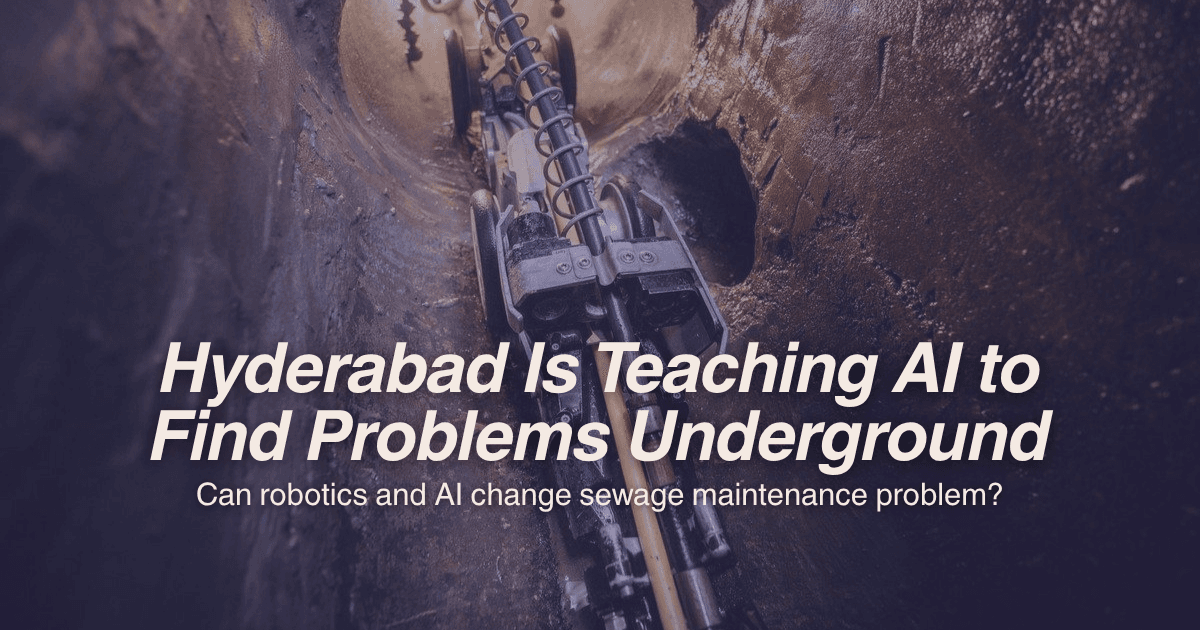
A blocked sewer is usually discovered in the least sophisticated way possible: sewage appears where it should not.
It overflows through a manhole, backs up into a street, or generates a complaint from a resident. A maintenance team is then dispatched to find the blockage, clear it and restore the network.
Hyderabad is now testing a different approach. Instead of waiting for a sewer to fail, Project SHUDH is being developed to monitor underground infrastructure, identify problems and use data to predict where intervention may be required.
Launched in July 2026 by the Telangana government, SHUDH combines robotics, artificial intelligence, GIS mapping, satellite-based monitoring and predictive analytics. The platform was developed by Hyderabad-based deep-tech company The Bot Factory under the guidance of the All India Robotics Association.
The idea is relatively simple. The difficult part is making it work across an entire city.
Hyderabad has a very large system to manage
Sewage infrastructure is easy to overlook because most of it is underground.
But Hyderabad's network is substantial. HMWSSB currently manages more than 9,000 km of sewerage network across the city and its peripheral areas, along with more than 500,000 manholes.
An earlier HMWSSB infrastructure presentation recorded approximately 10,057 km of sewer network and 582,500 manholes, illustrating the scale of the system. It also recorded 25 sewage treatment plants with a combined treatment capacity of 772 million litres per day at the time.
Maintaining a network of this scale through periodic physical inspection is expensive and difficult.
More importantly, not every part of the network requires attention at the same time.
The engineering problem is therefore partly one of prioritisation: which manhole should be inspected, which pipe is developing a problem, and where is a blockage most likely to occur next?
The city already has data on where things go wrong
Hyderabad's recent sewer-cleaning programme provides an indication of the problem.
Between October 2024 and March 2025, HMWSSB carried out a 180-day special drive covering 3,185 km of sewer pipelines and 250,000 manholes across 24,146 areas. The exercise reduced daily sewage complaints by approximately 20–30%.
The interesting part was not only the cleaning itself. Before the programme began, officials analysed three years of sewerage complaints.
They found that blocked household drains and sewage overflow on roads accounted for around 60% of daily complaints. A dashboard was then created to map complaints using GPS and Google Maps, allowing officials to prioritise areas according to the frequency and severity of problems.
This is essentially the first step towards predictive maintenance.
The city already knows where failures have happened before. The next step is to determine whether those patterns can be used to identify failures before they happen.
That is where SHUDH changes the model
Traditional sewer maintenance is largely reactive.
A problem is reported. A crew is sent. The obstruction is located. The pipe or manhole is cleaned. The problem is closed.
SHUDH is intended to connect several stages of this process into one digital system.
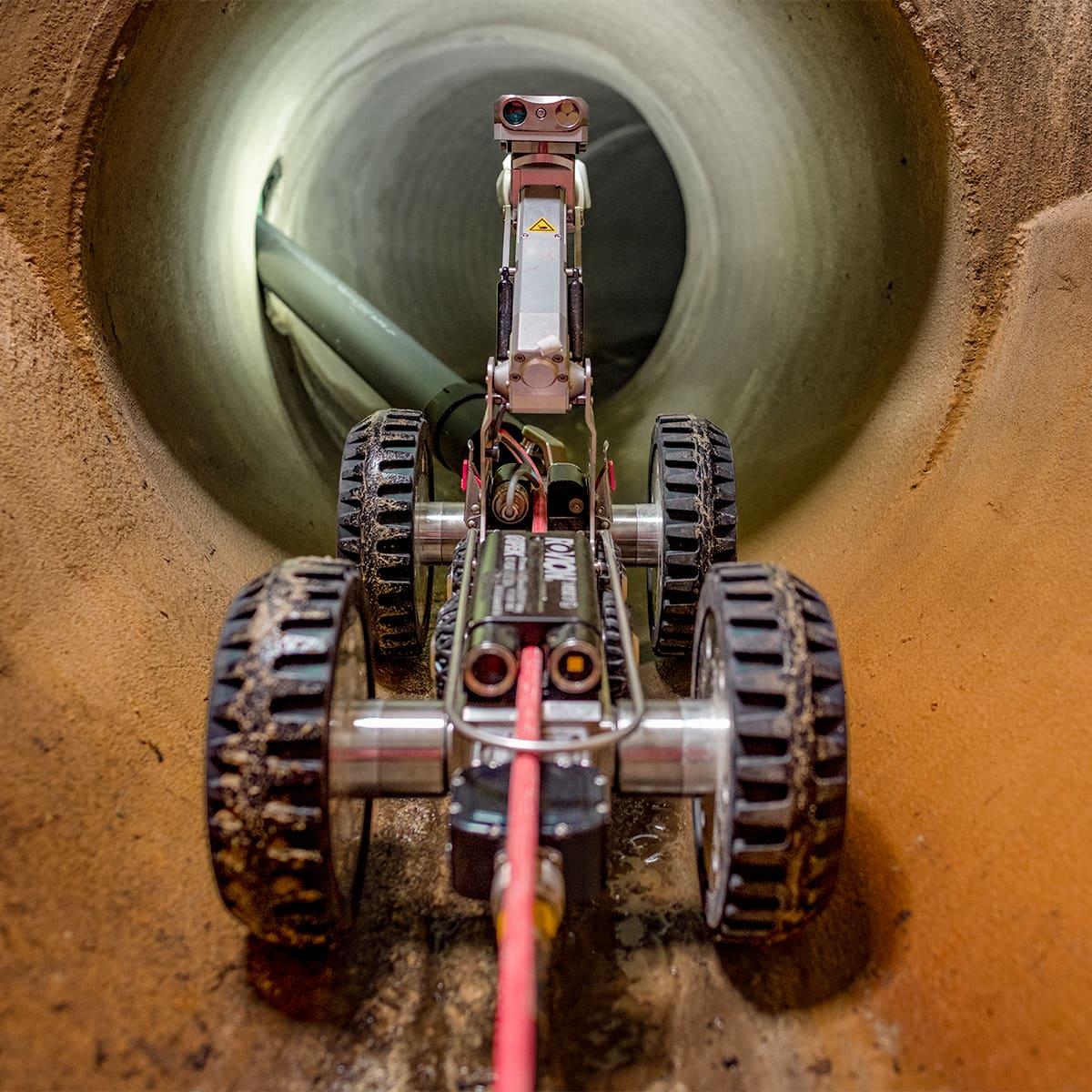
According to The Bot Factory, the platform combines vertical and horizontal robotic cleaners with a digital dashboard that can inspect, track and manage sewer infrastructure. The system is designed to reduce the need for workers to enter manholes and to provide greater visibility into underground networks.
The robotics component is important because the system needs physical information from the infrastructure.
A GIS map can tell an operator where a sewer is located. A complaint database can show where problems have occurred. But neither can tell you precisely what is happening inside a particular pipe.
That requires inspection.
Robots can enter the infrastructure, collect information and perform certain cleaning operations without requiring a worker to enter the sewer directly. Earlier demonstrations of SHUDH showed robotic systems operating in both vertical manholes and horizontal pipelines, including difficult corner sections.
The objective is therefore not simply to put a robot underground.
It is to create a feedback loop:
Inspect → collect data → identify patterns → predict risk → intervene → record the result.
Over time, that creates a much more detailed picture of how the network behaves.
The safety problem is just as important
There is another reason mechanising sewer maintenance matters in India.
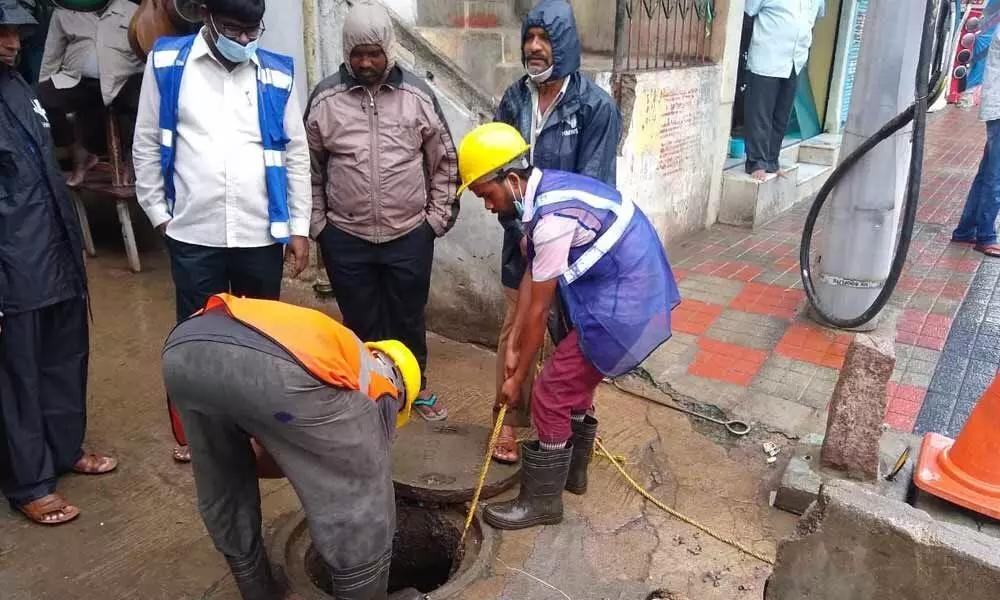
Hazardous sewer and septic-tank cleaning remains a serious safety issue despite legal prohibitions on manual scavenging and hazardous cleaning.
In July 2026, the Government of India reported that 332 sanitation workers had died in 18 states and Union Territories between January 2021 and June 2026 while undertaking hazardous cleaning of sewers and septic tanks. The government has been expanding the NAMASTE programme to promote mechanised sanitation and eliminate direct worker contact with hazardous waste.
The technology therefore addresses two problems simultaneously.
For the infrastructure operator, robotics can improve inspection and maintenance. For workers, reducing the need to enter confined underground environments can substantially reduce exposure to hazardous conditions.
The National Human Rights Commission itself called in 2025 for pilot projects using technology and robots for sewer and septic-tank cleaning, with the intention of replicating successful systems across states.
Predictive maintenance is harder than robotic cleaning
The more ambitious part of SHUDH is not the robot.
It is the data system around it.
A city sewer network has thousands of interconnected assets. Blockages can depend on pipe geometry, age, sediment accumulation, household connections, rainfall, local drainage conditions, previous maintenance and the behaviour of the surrounding catchment.
A useful predictive system would need to combine these variables and continuously update its assessment as new information becomes available.
That is fundamentally different from installing a sensor or sending a robot down a pipe.
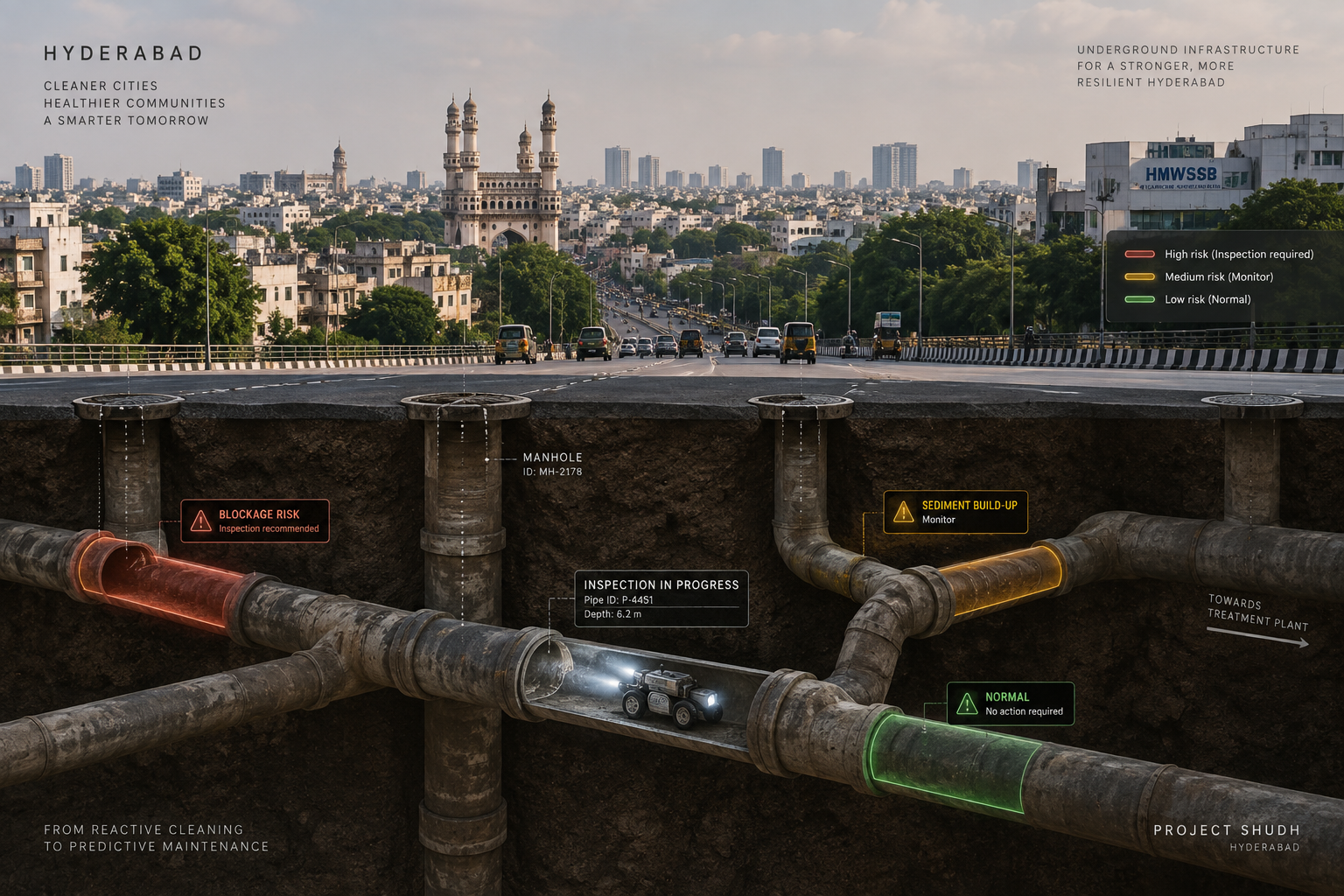
The objective is to create a risk map of the network: which sections are relatively stable, which require inspection and which are approaching a higher probability of failure.
The potential benefit is significant. Instead of allocating maintenance crews uniformly across thousands of kilometres of infrastructure, operators could increasingly direct resources towards locations where the probability and consequence of failure are highest.
The real test will be scale
Project SHUDH has been demonstrated with HMWSSB and launched as a platform for pilot deployment. HMWSSB's managing director has said the system would be piloted before decisions on wider scaling are made.
That distinction is important.
Predictive maintenance works well when the data is reliable, the asset inventory is accurate and the operating system is connected to the maintenance process. Scaling it across an old and continuously changing urban network is considerably more difficult.
The technology also has to demonstrate something more practical than whether a robot can enter a sewer.
It has to show that the information it generates leads to fewer blockages, fewer overflow incidents, faster interventions and lower lifecycle costs.
If it can do that, the implications extend well beyond Hyderabad.
Cities around the world maintain enormous amounts of infrastructure that is difficult to inspect and expensive to repair. Sewers, water pipelines, drainage networks and underground utilities share the same basic problem: the asset is largely invisible until something goes wrong.
The next generation of infrastructure management may therefore depend less on building new networks and more on understanding the ones that already exist.
For decades, cities have maintained sewers by responding to failures.
The more interesting possibility is that, with enough data and the right combination of robotics and AI, the sewer could tell the city where the next failure is likely to occur before the street does.
What are yout thoughts?


