
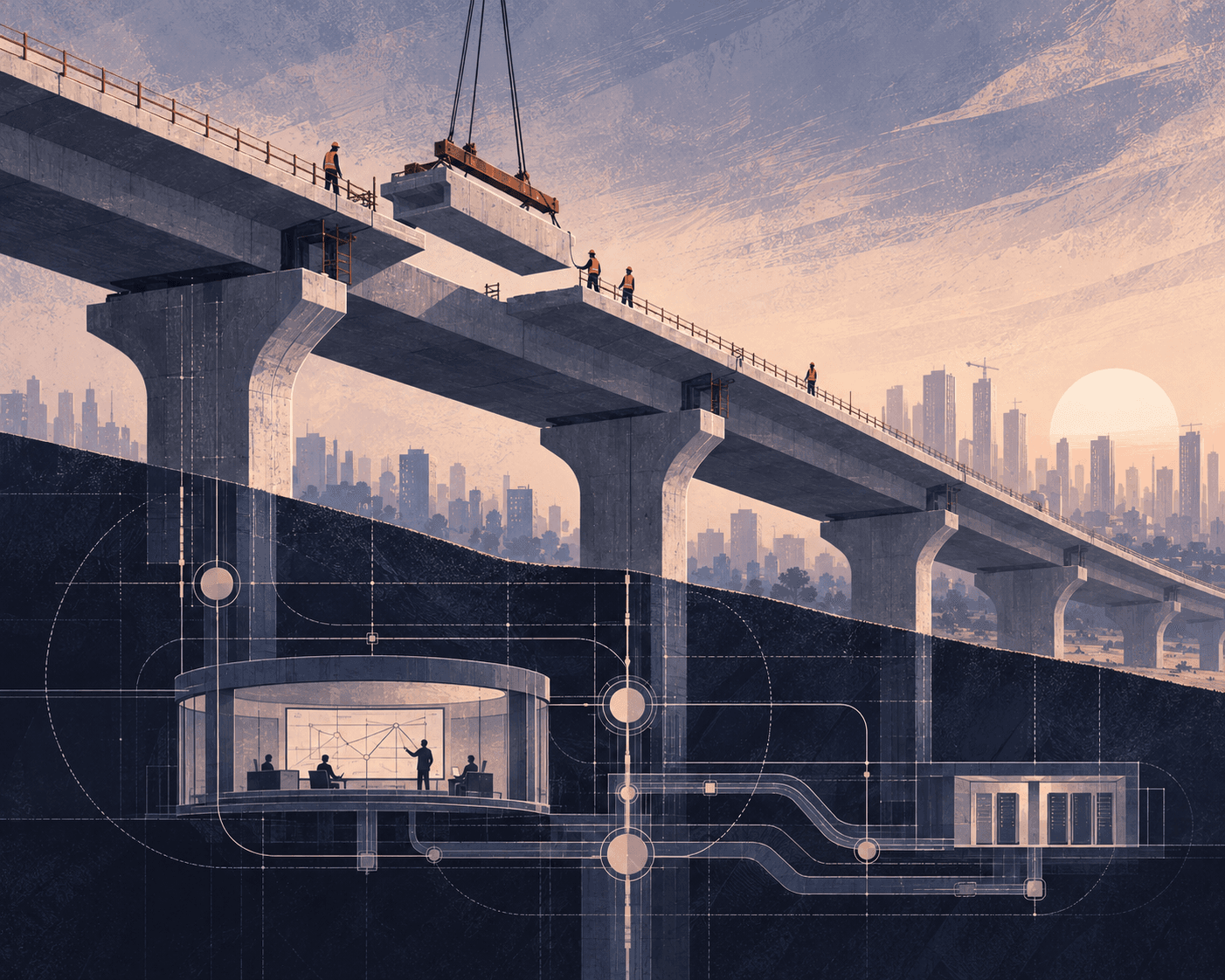
India's infrastructure ambitions are entering a phase in which the central challenge is becoming less about whether projects can be financed or physically constructed and more about whether the institutions responsible for delivering them can keep pace.
The scale is visible in the Union government's FY2026-27 capital expenditure allocation of ₹12.22 lakh crore, equivalent to 3.1% of GDP. Including grants-in-aid to states for the creation of capital assets, effective capital expenditure rises to ₹17.15 lakh crore, or 4.4% of GDP.
This sits on top of a project pipeline that has been expanding for years. The National Infrastructure Pipeline, for instance, eventually identified ₹111 lakh crore of planned infrastructure investment for FY2020-25 across sectors including roads, railways, energy, airports, ports, urban infrastructure and digital infrastructure. Its significance was not only the size of the number, but the attempt to treat infrastructure as a continuing pipeline of projects rather than a collection of isolated announcements. (Press Information Bureau)
The character of those projects is changing as well. India's infrastructure programme increasingly includes high-speed rail, metro systems, tunnels, large transmission networks, renewable-energy installations, semiconductor facilities, data centres, logistics corridors and industrial plants. These are systems in which civil and structural work sits alongside electrical systems, mechanical equipment, digital infrastructure, procurement, logistics, safety and eventual operations.
That creates a different kind of constraint.
The country may have the labour, contractors, machinery, materials and engineering capability required to physically build more infrastructure, while still having difficulty scaling the organisational capability required to coordinate everything that has to happen before an asset can operate.
This distinction between construction capacity and delivery capacity is becoming increasingly important.
Construction capacity is the ability to mobilise labour, equipment, materials, contractors and factories and turn engineering drawings into physical work. Delivery capacity is broader. It includes planning, procurement, contracts, project controls, risk management, approvals, stakeholder coordination, interface management, commissioning and the hundreds of decisions required to keep different parts of a project moving together.
India has spent years expanding the first. The question for the next decade is whether the second can expand at the same speed.
The ₹160,000 number is a signal, not the story
The immediate trigger for this question is a recent estimate reported by The Economic Times: India could need almost 160,000 additional construction project managers by 2035, representing a 67% increase from current levels. PMI's assessment is tied to the growing scale and complexity of projects across infrastructure, manufacturing, energy and urban development.
It would be easy to treat this as another industry hiring statistic. That would miss what makes the number useful.
The important question is not whether India can find 160,000 people with "project manager" somewhere in their job title. It is whether the project-management system supporting India's capital investment can expand as quickly as the projects themselves.
PMI's broader research makes the underlying shift clearer. India had an estimated 3.905 million project professionals in 2025, with demand projected to reach 6.545 million by 2035 in its low-growth scenario. That represents 68% growth in demand and a projected talent gap of 2.939 million once attrition and retirements are taken into account. These figures are not construction-specific. PMI's definition spans project-related roles across the wider project economy.
That distinction matters because India is becoming more project-based across the economy. Infrastructure is one part of it. Manufacturing expansion, energy investment, technology, urban development and large public-sector programmes all create demand for people who can take capital, plans and multiple workstreams and turn them into functioning outcomes.
Construction sits at the sharper end of this trend because its projects are becoming both larger and more interconnected.
PMI's 2026 construction research estimates that the global industry will require nearly 2.5 million additional construction project professionals by 2035, around 60% above 2025 levels. It identifies construction as one of the industries with the fastest projected demand growth, driven by large-scale infrastructure investment, urbanisation, technological change and increasingly complex projects. (Project Management Institute)
In a separate PMI and KPMG industry discussion, a high-growth scenario put India's requirement for construction project professionals at nearly 395,000 by 2035. The same discussion estimated the construction talent gap across South Asia at 291,000 today, rising to 558,000 by 2035. These figures describe different measures from the 160,000 project-manager estimate and should not be combined. (NewsVoir)
Taken together, however, they point in the same direction. Capital formation is increasing the number, size and complexity of projects faster than the systems that prepare, develop and deploy project professionals can comfortably keep up.
Complexity is turning coordination into a core capability
Consider what actually happens when a large infrastructure project encounters a change.
A design revision might alter quantities. That can change procurement requirements and delivery schedules. The contractor may need to rearrange labour and equipment, which can alter the construction sequence. The revised sequence can affect the programme, cash flow and contractual position. It may also have implications for testing and commissioning later in the project.
No individual discipline owns that entire chain.
The structural engineer can understand the design impact. The procurement team can see the effect on materials. The commercial team can assess contractual exposure. The planning team can update the schedule. The contractor can determine whether resources can be moved. The owner may have to approve additional cost. The project still needs someone to integrate all of those consequences and decide what happens next.
That is the function that becomes more important as projects become more complex.
It is also why the old framing of the problem as "India needs more project managers because there are not enough engineers" is too crude. India already has a substantial engineering and technical workforce. The issue is that technical expertise and project integration are different capabilities.
An engineer may be accountable for structural design, geotechnical analysis, electrical systems or construction methodology. A project leader has to understand enough of those disciplines to make decisions across them while also managing contracts, schedules, procurement, approvals, commercial constraints, stakeholders, risk and commissioning.
As the number of interfaces increases, the coordination layer becomes more consequential.
The relationship is almost mechanical. A project with five major interfaces has fewer coordination demands than one with fifty. Once different packages, utilities, contractors, authorities, suppliers and operating systems have to interact, the cost of a disconnected decision grows because the consequence travels across the project.
This is why delivery capacity cannot be measured simply by counting workers or contractors.
The infrastructure pipeline is large enough for small inefficiencies to become large numbers
The government's own project monitoring shows the scale of the environment in which these capabilities will be tested.
As of July 2026, MoSPI was monitoring 1,775 ongoing infrastructure projects costing ₹150 crore or more across 17 central ministries and departments. Their original combined cost was approximately ₹33.70 lakh crore, while the latest revised cost stood at ₹37.11 lakh crore, a difference of about ₹3.41 lakh crore. (NDTV Profit)
That figure should not be treated as a bill for poor project management. The government data does not support such a conclusion. Infrastructure cost revisions can reflect many causes, including changes in scope, land and environmental issues, inflation, design development, geological conditions, contractual changes and other project-specific factors.
What the number does show is the economic scale of the execution environment.
When the value of projects under implementation runs into tens of lakh crores, relatively small failures in planning, coordination or sequencing can have material consequences. A delay in a major project can affect contractor cash flows, financing costs, equipment deployment and the timing of the revenue or economic benefits associated with the completed asset.
Government reporting on delayed projects repeatedly identifies problems such as land acquisition, environmental and forest clearances, utility shifting, financing, detailed engineering, tendering, procurement, equipment supply, geological conditions, scope changes and contractual disputes.
Many of those problems are not "project management problems" in the narrow sense.
They are interface problems.
A utility cannot be shifted until a utility owner, project owner, contractor and relevant authority agree on a workable sequence. A design cannot be implemented until procurement and site conditions are considered. A delayed approval can push site access, contractor mobilisation and equipment deployment further along the schedule. A change in one package can have commercial and programme consequences somewhere else.
Project management does not eliminate those constraints. It creates the organisational machinery required to see their interactions early enough to respond.
That distinction is important. The growing talent gap should be understood as an additional constraint on a system already dealing with multiple execution risks, not as a single explanation for India's delays and overruns.
Modern infrastructure increasingly behaves like an industrial system
The clearest examples are often the ones that look least like conventional construction.
Take India's Mumbai-Ahmedabad high-speed rail project. At Sakhare in Maharashtra, the project has created a large casting operation manufacturing massive precast elements for the elevated corridor. Some girders approach 1,000 tonnes and require specialised transporters and gantry systems to move and erect them along the alignment. (BRENMAN)
Calling Sakhare a construction site understates what is happening there.
It is simultaneously a factory, logistics operation, engineering system and construction interface. Components have to be fabricated, inspected, moved, stored and installed in sequence. The manufacturing schedule has to connect with the viaduct construction schedule. Transport capacity has to connect with site readiness. Installation depends on the right section of the corridor being prepared at the right time.
The physical asset may eventually look like a railway line.
The delivery system behind it looks much more like a distributed industrial operation.
The same principle appears in very different projects. The new Khambatki Ghat tunnel on the Pune-Satara highway involves tunnelling, traffic management, geology, structures, safety, environmental considerations and integration with an existing live highway. The project is not simply about excavating rock. It is about changing the geometry and operating conditions of an existing transport corridor while keeping the network functioning. (BRENMAN)
That is what modern infrastructure delivery increasingly looks like.
The project manager is not merely supervising physical work. The role sits at the point where technical decisions become commercial, logistical and operational consequences.
Project management starts years before construction
The management problem also begins earlier than most public discussion suggests.
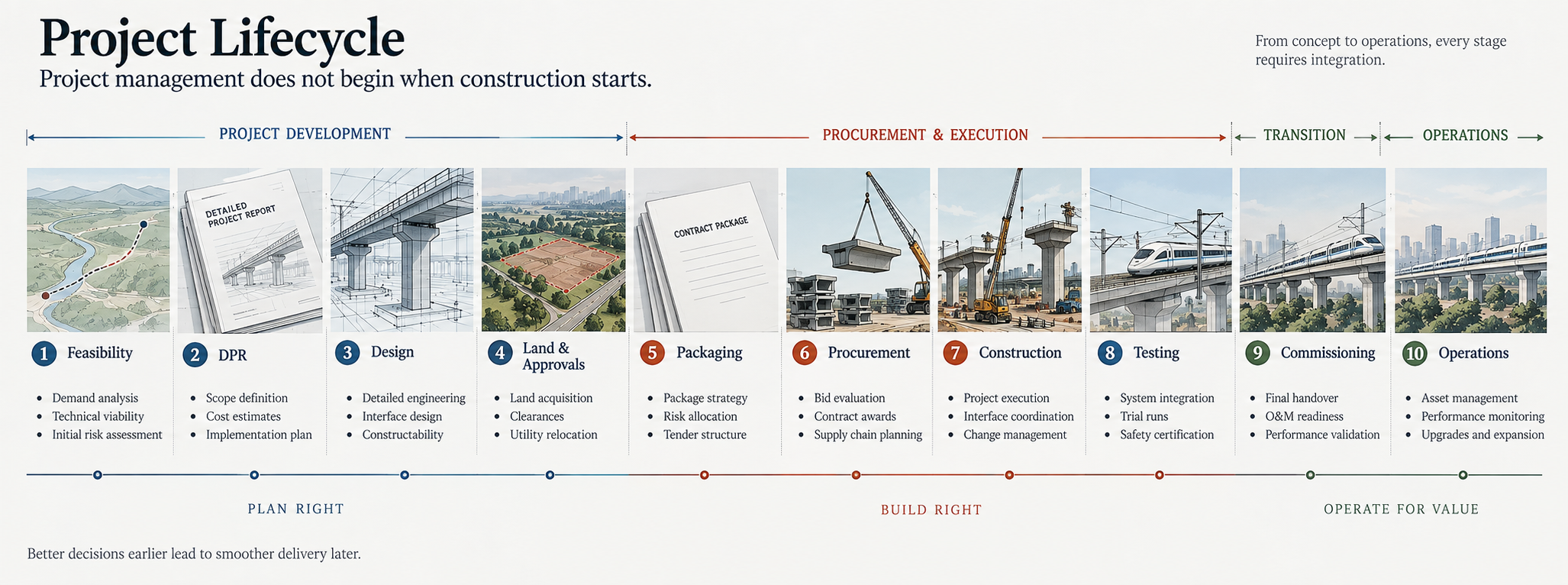
By the time a major contractor mobilises on site, many of the decisions that determine the eventual difficulty of delivery have already been made. Feasibility studies, detailed project reports, design development, land planning, procurement strategy, package structures, contract terms, risk allocation and interface definitions establish the architecture within which construction will happen.
The Mumbai-Hyderabad high-speed rail corridor illustrates this well. The DPR for the proposed 671-kilometre corridor took roughly five and a half years to complete. The document established the project's alignment, engineering and cost framework, but its completion did not itself amount to cabinet sanction, funding or a construction order. (BRENMAN)
That distinction is easily lost in public discussions, where project approval and project delivery are often treated as points on the same continuum.
They are not.
A sanctioned project is still a project. A tender award is still a project. Physical progress is still a project. The actual economic value appears when the infrastructure is commissioned and can reliably perform its intended function.
This is why project management begins before the first concrete is poured. Decisions made during project development determine what contractors inherit later.
A poorly defined interface at the planning stage can become a dispute during construction. An unrealistic programme assumption can become a claim. An incomplete scope can become a variation. A weak risk allocation can create commercial conflict after mobilisation.
In that sense, delivery capability is partly embedded in project design itself.
The experience bottleneck may be harder than the headcount bottleneck
The most difficult part of the talent problem is that not every capability can be produced quickly.
There is a difference between learning how to update a programme in scheduling software and knowing when a programme needs to be fundamentally resequenced.
A professional can be trained to maintain a risk register, use BIM, prepare reports or track earned value. It takes experience to sit across from a contractor during a serious delay, understand what is actually recoverable, determine what the contract allows, assess the commercial consequences and negotiate a path that does not simply move the problem somewhere else.
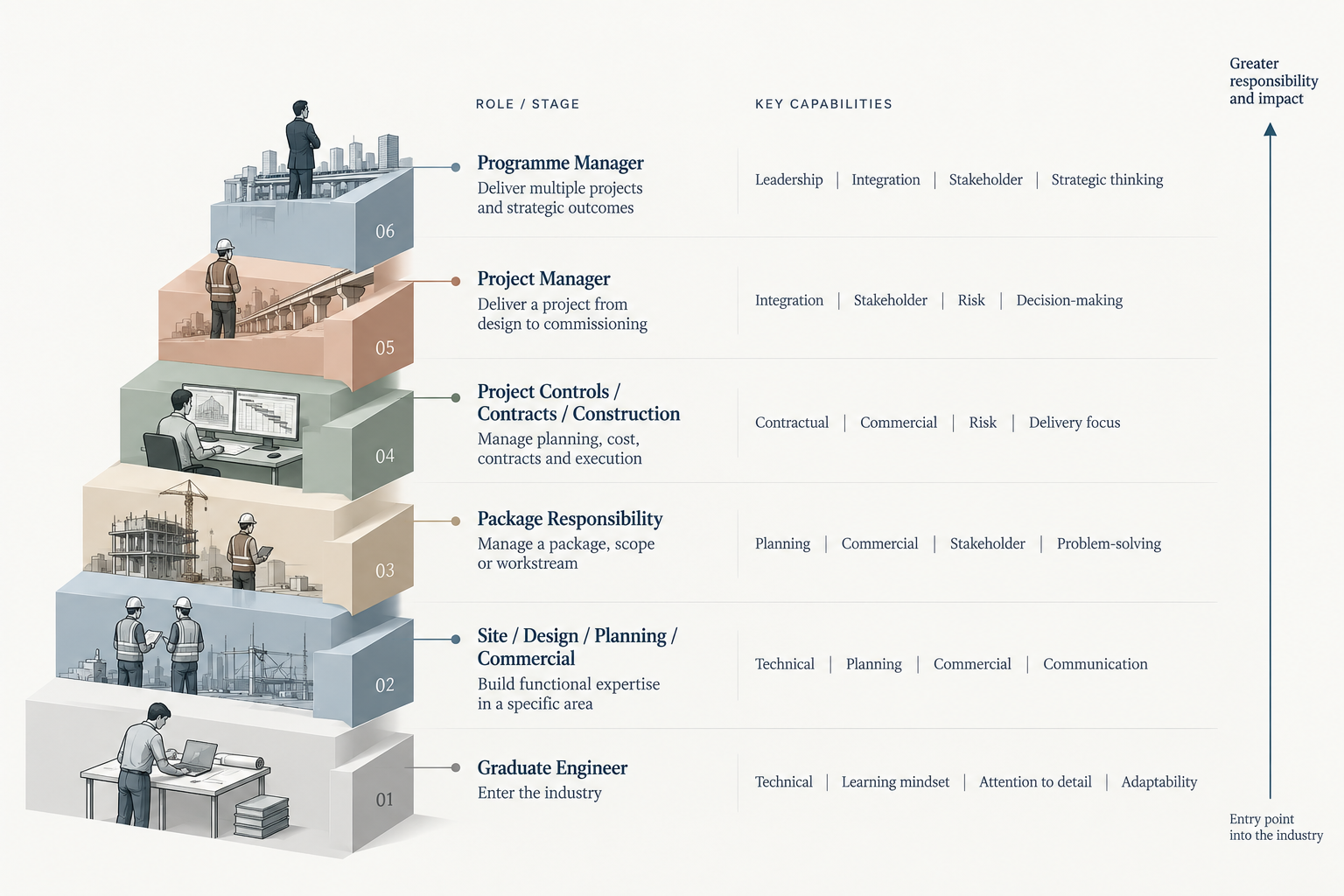
The same applies to claims, design changes, incomplete information, stakeholder conflict and commissioning pressure.
That creates a time-lag problem for India.
If the country expects more experienced project leaders in 2035, the development pipeline for those people has to begin well before 2035. Graduates need opportunities to move from site, planning, design or commercial roles into package ownership, project controls and eventually project and programme leadership.
PMI's broader talent research explicitly identifies the need for stronger education, professional development and clearer career pathways, particularly in fast-growing markets where the labour force may expand faster than project-ready talent.
This is an organisational problem as much as an education problem.
Companies need to identify high-potential technical professionals earlier and deliberately expose them to commercial decisions, planning, contracts and stakeholder management. Owners need capable project teams during feasibility and procurement, rather than treating project management as something to be added once construction starts. Consultants have to move further into owner-side engineering, programme management, project controls and interface management where their technical expertise can influence delivery.
The workforce will not become more senior by accident.
Contractors, owners, consultants and lenders see different parts of the same problem
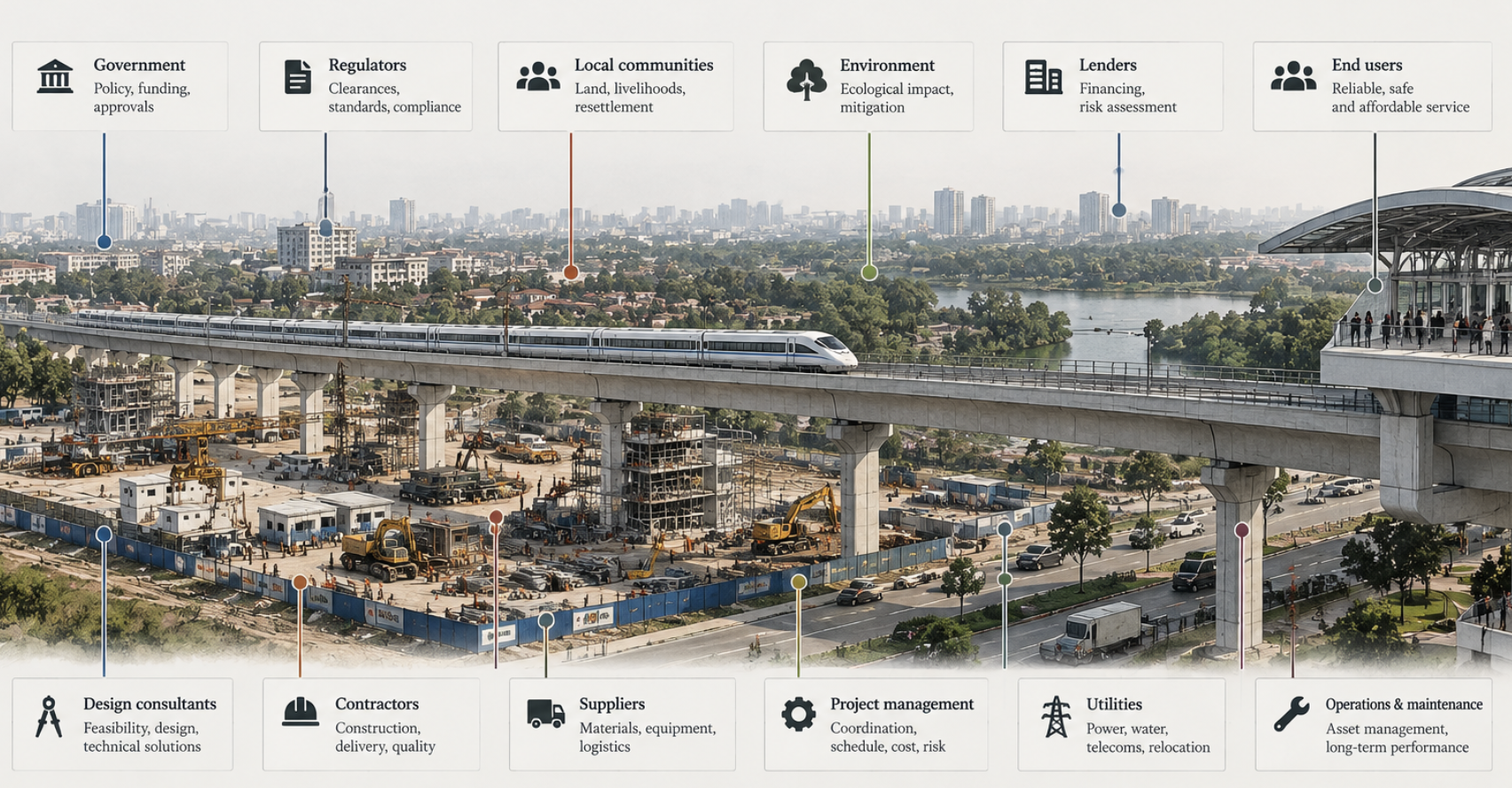
For contractors, project-management capability starts influencing the project before a bid is submitted. Schedule assumptions, procurement lead times, site constraints, resource requirements and risk pricing all affect whether a bid can actually be executed at the margin that was anticipated.
That makes project management a commercial capability as much as an execution capability.
A technically successful project can still be commercially unsuccessful if procurement was poorly sequenced, resources were misallocated or contractual exposure was underestimated. For contractors operating on tight margins, the cost of weak coordination can show up long after the original planning decision.
For project owners, the problem begins even earlier. Scope definition, DPR quality, package structure, procurement strategy, risk allocation and interface management determine the conditions under which contractors will work. An experienced project manager brought into a project only after mobilisation may spend much of their time trying to repair decisions that were taken several years earlier.
Consultants occupy another position. Design remains essential, but increasingly valuable roles sit around the design: owner's engineering, project controls, programme management, construction management, interface management and risk. As projects become more integrated, the boundary between designing an asset and helping deliver it becomes less rigid.
Lenders and investors have their own exposure. A delay can increase interest during construction, defer revenue, reduce debt-service capacity, change project IRRs, create refinancing pressure and require additional equity. From an investment perspective, one of the useful questions is therefore not only whether the engineering is sound, but who is responsible for integrating the project's technical, commercial and schedule risks.
The same project can look completely different to each of these stakeholders.
That is precisely why integration matters.
AI will improve project management. It will not replace project leadership.
Construction has no shortage of new digital tools. BIM, digital twins, drones, computer vision, dashboards, digital documentation and predictive analytics can improve information flow, progress tracking, scheduling, reporting and risk identification.
AI should accelerate several of these processes further.
It can help compare schedule scenarios, surface anomalies, summarise large volumes of project documentation, identify patterns in site data and reduce the administrative burden involved in maintaining project information. PMI's construction research specifically points to demand for project professionals who are comfortable working with AI and combining operational knowledge with broader strategic judgement. (Project Management Institute)
What technology cannot do automatically is decide which human judgement should follow from the information.
A dashboard can identify that an activity is slipping. It cannot, by itself, determine whether the right response is to resequence work, add resources, redesign an element, renegotiate a package or accept a delay because recovery would cost more than the delay itself.
An AI system can flag a contractual clause. It cannot take responsibility for a commercial settlement between an owner and contractor.
A digital twin can show that systems are not ready for commissioning. Someone still has to determine who owns the dependency and what decision should happen next.
Technology will make project information more visible.
That may actually increase the value of experienced project leaders because better information creates more decisions, not fewer.
The industry's talent problem is also a perception problem
There is another constraint that cannot be solved by changing job descriptions.
Construction still competes for talent against industries that are often perceived as cleaner, more predictable and more attractive to younger professionals. Construction can be associated with remote sites, long working hours, traditional hierarchies and fragmented career paths.
Meanwhile, the industry itself is changing.
A major infrastructure project increasingly combines engineering, manufacturing, software, data, advanced equipment, commercial management and systems integration. Semiconductor plants, data centres and high-speed rail do not resemble the image of construction that many young professionals still carry.
PMI's construction research identifies industry perception, retention and professional-development barriers among the factors contributing to the talent challenge. It also highlights the need to broaden the talent pool rather than relying on the same recruitment patterns indefinitely. (Project Management Institute)
Women in particular remain an underused part of that potential talent pool, and the industry will need to improve its ability to recruit and retain them. There is no reason to invent India-specific percentages to make that point. The more basic observation is enough: an industry facing a long-term talent shortage cannot afford to leave large parts of the potential workforce outside its normal career pathways.
The answer is not a marketing campaign about how "cool" construction has become.
It is better career architecture.
The real constraint is the conversion of capital into functioning assets
India's infrastructure story is usually told in terms of allocation.
How much was sanctioned? How much was budgeted? How many kilometres were awarded? How many projects were announced?
Those metrics matter, but they describe the supply of capital and projects more than the quality of delivery.
The harder question is what proportion of the capital deployed becomes functioning infrastructure within a reasonably controlled schedule and cost envelope.
The distinction matters because an allocated rupee is not the same thing as an operating asset. A sanctioned project is not a completed project. A tender award does not guarantee delivery. Physical progress does not necessarily mean that an asset can be commissioned and operated.
That gap between financial commitment and functioning infrastructure is where delivery capacity becomes economically important.
PMI's global construction research cites survey estimates in which 72% of projects exceed budgets, 73% experience delays and 70% encounter scope creep. It also cites a global estimate of roughly $127 million lost for every $1 billion invested because of project-performance inefficiencies. These are global figures, not statistics for India, and they should be treated as indicators of the scale of the project-performance problem rather than as evidence that Indian projects are failing at equivalent rates. (NewsVoir)
India does not need to assume that every delay is a management failure to see why this matters.
Large projects will always face land constraints, geological uncertainty, regulatory processes, weather, market movements, financing issues and political decisions. Better project-management capability cannot eliminate those variables. It can improve the system's ability to identify them, price them, coordinate around them and respond before they compound.
That is a narrower claim, but a more useful one.
From construction capacity to delivery capacity
The distinction between the two forms of capacity is therefore becoming central to India's infrastructure trajectory.
Construction capacity is visible. It is the number of machines on site, the number of workers employed, the factories producing components, the contractors winning packages and the materials moving through the supply chain.
Delivery capacity is less visible.
It lives in project offices, planning meetings, contracts, interfaces, risk registers, approval systems, procurement strategies, commissioning plans and the people responsible for connecting those pieces.
India can expand its contractor base and still face a delivery constraint.
It can produce more engineering graduates and still face a shortage of professionals who have managed an entire project lifecycle.
It can digitise project information and still struggle to make good decisions across organisational boundaries.
It can increase capital expenditure and still find that some of the capital takes longer, or costs more, to convert into productive infrastructure than originally expected.
None of these are contradictions.
They are what happens when physical investment grows faster than organisational capability.
The 160,000 construction project-manager estimate is therefore best understood as a warning about the second layer of India's infrastructure expansion. The broader PMI numbers reinforce that this is not only a construction problem. India is becoming a much larger project economy, and the demand for people capable of managing that economy is rising with it.
The country has already spent years building the physical machinery of an infrastructure boom: roads, railways, factories, transmission systems, airports, ports, tunnels and production facilities.
The next phase requires building the management machinery around them.
That means stronger career pathways for engineers and other technical professionals, earlier exposure to commercial and programme responsibilities, better project-development capability, more disciplined owner-side teams, stronger project controls and broader access to professional development. It also means recognising project management as part of infrastructure policy rather than treating it only as a corporate HR concern.
The test for India's infrastructure programme over the next decade will not be the number of projects that enter the pipeline.
It will be how efficiently the country can move those projects through design, procurement, construction, commissioning and into productive use.
India has demonstrated that it can mobilise capital at a scale that would have seemed ambitious a decade ago. It has also demonstrated an increasing ability to build complex physical systems.
The harder task now is ensuring that the people, institutions and management systems responsible for integrating those systems grow at the same speed.
The infrastructure boom is creating demand for more concrete, steel, machines and contractors. It is also creating demand for something less visible and considerably harder to manufacture quickly: experienced people who can make all of those pieces work together.
That is the difference between having the capacity to build and having the capacity to deliver.
And for an India planning to invest at ever larger scale, the distinction will increasingly determine how much of that capital becomes infrastructure that actually works.


