
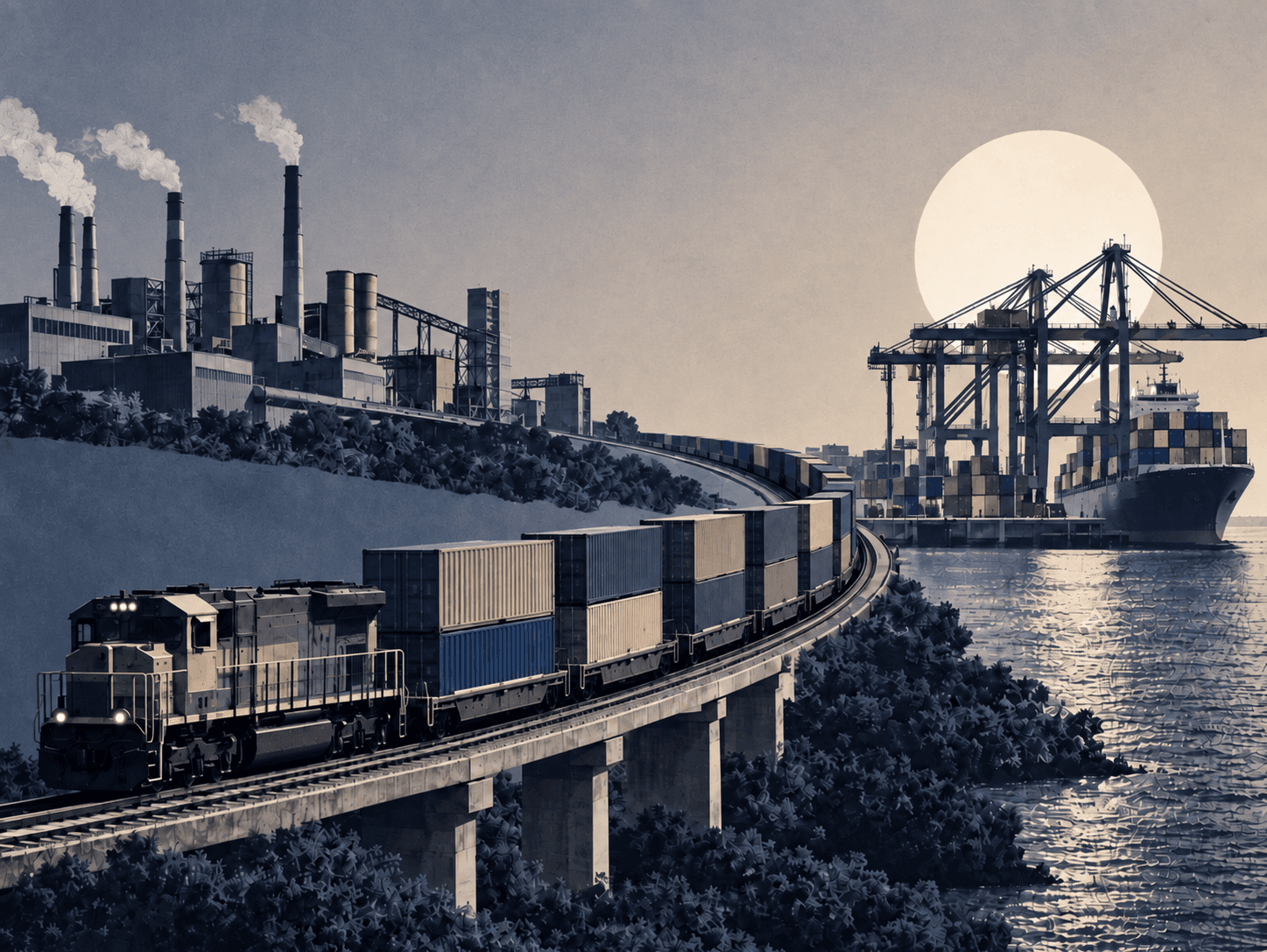
India is spending more than ₹35,000 crore on a new set of roads and railways in Gujarat, but the significance of the investment lies beyond the kilometres being added to the transport network. On September 8, the government opened three remaining sections of the Western Dedicated Freight Corridor (WDFC) for operations, covering 326 km. These sections include the final stretch connecting the freight corridor to Jawaharlal Nehru Port Authority (JNPA). Their commissioning made the entire 1,506-km WDFC between Dadri and JNPA operational. The three sections were developed at a cost of more than ₹20,700 crore and are intended to improve the movement of export-import cargo between industrial centres and the port. The larger question is what this connectivity changes in the economics of moving goods.
The Economics of a Freight Corridor
A freight railway becomes economically useful when it can move more cargo without adding the same amount of traffic to the existing network. That is the basic change the Dedicated Freight Corridor is designed to make. Freight trains have a separate route from passenger services, allowing goods to move on infrastructure built specifically for their weight, length and operating requirements. The WDFC also supports double stack container trains, increasing the amount of cargo that can be carried in a single movement.
The scale of that difference is visible in actual operations. The Eastern and Western DFCs together are now carrying more than 430 freight trains a day. On the WDFC, a recent double stack service between JNPA and Vadodara carried cargo equivalent to more than 250 trucks in one trip. These figures show how dedicated freight infrastructure allows large volumes of cargo to be consolidated into fewer, higher-capacity movements.
Time is another measurable change. According to figures presented at the September 8 commissioning, a freight movement that previously took around 6.5 hours to cover 100 km on the rail network can now cover the same distance in less than half that time on the DFC. For certain journeys, cargo that takes about 30 hours by truck can move through the dedicated corridor in roughly 10–12 hours.
From Freight Corridor to Port
The next change occurs when that freight capacity reaches the port. The final 326 km commissioned in September includes the New Saphale-New JNPT section, giving the 1,506-km corridor a direct connection to JNPA. The port is already linked to Indian Railways through Jasai and has eight full length railway lines serving its three container terminals. JNPA says the DFC makes rail connectivity more viable by reducing haulage charges and enables faster movement of EXIM cargo.The connection is also supported by infrastructure within the port itself. JNPA has developed an integrated common rail yard with two lines capable of handling double-stack and long-haul DFC rakes, allowing such trains to serve multiple container terminals. In August 2026, JNPA began its first long-haul double-stack DFC rake operations.
The significance is that freight capacity does not stop at the corridor. It can continue into the port's rail system, where cargo can be moved towards the container terminals. The connection therefore reduces the break between inland freight movement and the port-handling stage. The benefit is not simply a longer railway route, but a more continuous movement of cargo from the inland freight network to the export-import gateway.
Where the Connectivity Creates Economic Value
Once the freight-to-port connection is established, the economic question becomes who gains from the additional capacity. The most immediate operational effects are on the businesses moving cargo through the system. Freight operators gain access to dedicated freight capacity and higher capacity train operations, ports gain a direct rail connection to the inland freight network; and manufacturers, exporters and importers gain access to that capacity when their cargo is routed through the system.
Consumers are further downstream. Faster or less costly freight movement can affect the wider supply chain, but whether those savings reach consumers through lower prices depends on how they are passed through by manufacturers, distributors and retailers. The infrastructure itself does not guarantee a reduction in retail prices.
This also explains why connecting an industrial cluster matters differently from simply adding another road. A road adds capacity to a particular route; connecting an industrial concentration to a freight network connects that capacity to a concentrated source of cargo demand. The Railways identifies linkages with industries along the DFC as part of the corridor's expected impact, while its Gati Shakti Cargo Terminal programme considers industrial demand and potential cargo traffic when developing freight terminals.
Multiple manufacturers, warehouses and logistics facilities in the same economic region can therefore feed cargo into shared rail and terminal infrastructure. The value of the connection depends on how much of that production can actually use the freight network repeatedly. The objective is not simply to add another route, but to connect where goods are produced, where they are consolidated and where they leave the country.
The ₹35,000-crore connectivity push is ultimately about connecting different stages of the same economic chain. The WDFC adds dedicated freight capacity, its extension to JNPA connects that capacity to a major export-import gateway, and the surrounding railway and highway projects expand the network through which cargo can reach and leave the corridor. The economic value therefore does not lie in the kilometres built individually, but in how effectively those links work together.
The next measure of the investment will be utilisation: how much freight moves on the DFC, how quickly cargo reaches ports, how extensively manufacturers use the network and whether the additional capacity reduces bottlenecks across the wider logistics system. The infrastructure is now in place. The question shifts from how much India has built to how much economic activity that connectivity can support.


