
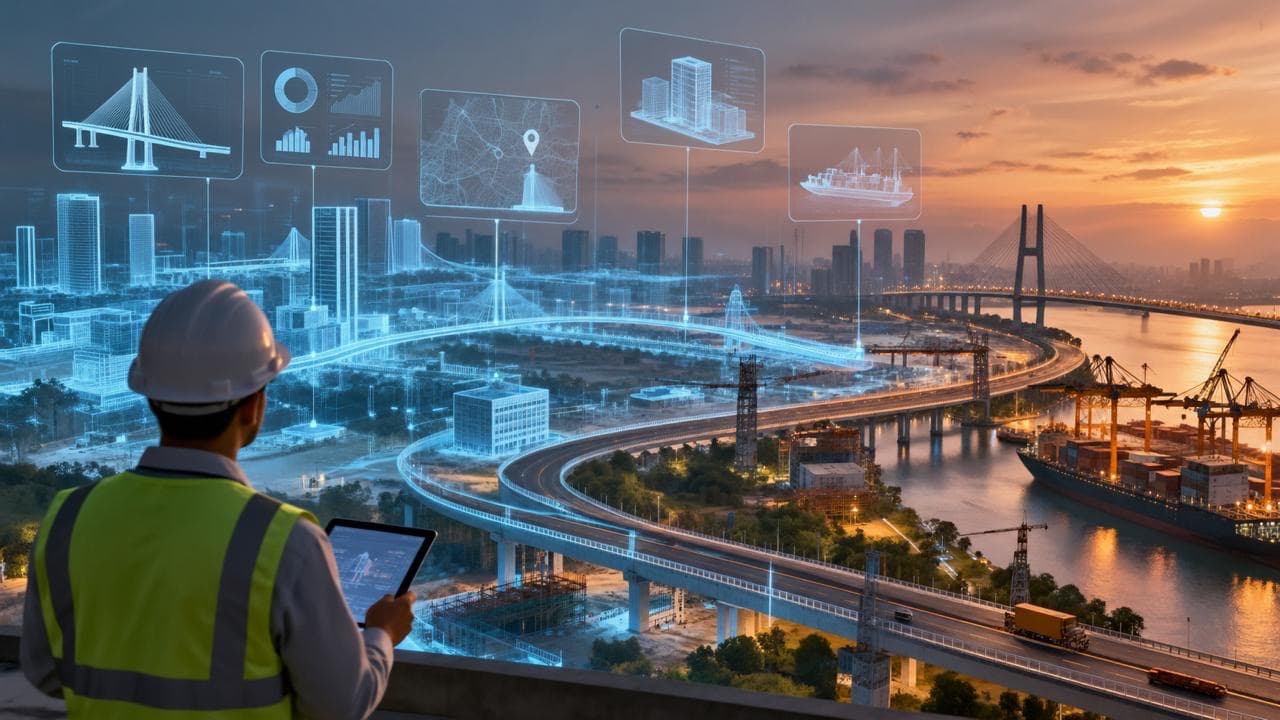
India is moving digital twins from a technology concept towards infrastructure planning and management. But as these systems become more connected to real - world assets, the important questions are no longer limited to what a digital twin can do. They also concern the data behind it, the standards used to connect different systems, and who controls and maintains the model.
The shift is visible in several government initiatives. On February 17,2025, India and the International Telecommunication Union (ITU) announced a collaboration on digital twin technology for future-ready infrastructure planning. The ITU describes the initiative specifically as a collaboration on using digital twins for infrastructure planning.
India's Department of Telecommunications had already launched the Sangam: Digital Twin initiative in February 2024 as a proof of concept involving industry, startups, MSMEs, academia and other participants. The initiative was intended to explore digital twins for infrastructure planning and develop a future blueprint that could inform later infrastructure projects.
The significance of this work is that digital twins are being considered not simply as visual models, but as systems that can connect physical infrastructure with data and simulation. ITU's recommendation on smart-city digital twins describes them as digital representations that can support simulation and, depending on the application, synchronisation with physical systems and real-time support. It specifically identifies uses such as testing plans before implementation and improving urban operations and resilience.There is also evidence that this is moving beyond a purely exploratory stage in specific Indian projects. In March 2026, the Ministry of Ports, Shipping and Waterways said the V.O. Chidambaranar Port Authority had become the first Indian major port to implement a digital twin for port management. The ministry described the platform as a real-time virtual replica of the port's infrastructure, operational assets and maritime ecosystem.
The data question
A digital twin depends on the information connected to the physical system. The material supplied for this report identifies possible inputs including sensors, IoT devices, GIS, BIM, satellite imagery, drones and administrative systems. But these sources do not necessarily produce information at the same frequency or under the same standards.That distinction matters. ITU's smart-city digital-twin recommendation says that a digital twin may require synchronisation between a physical thing and its digital representation, as well as real-time support, depending on its application.ITU's security guidance also requires the trustworthiness and traceability of collected data. It calls for controls over access to data and models and for management of the lifecycle of data, models and applications.The implication for an infrastructure operator is specific: a model cannot simply be judged by how closely it represents the physical asset. The operator also needs to know what information is feeding it, how that information is controlled and whether the data remains trustworthy.
The question of ownership
As digital twins become connected to infrastructure operations, ownership becomes more complicated than ownership of a software platform.A single model can involve information generated by an infrastructure owner, operator, contractor, technology provider and multiple data systems. The physical asset may belong to one organisation while the platform hosting its digital representation is developed or operated by another.
The Indian initiatives currently focus more clearly on building the digital ecosystem around such systems than on establishing a single ownership structure. NUDM, for instance, promotes open standards, interoperability and data exchange between different urban systems rather than a closed platform model.This makes the governance of each operational twin important. The project arrangements will need to establish who controls the model, who can access its data, who can update it and who remains responsible for it as the physical asset changes.The issue is particularly relevant at handover. Infrastructure normally passes from designers and contractors to an operator, but a digital twin can continue evolving throughout the asset's life. Its usefulness therefore depends on whether the digital information can move with the asset and remain accessible to whoever is responsible for operating it.
What standards govern the handover?
NUDM identifies interoperability as a challenge because government departments and urban bodies use different systems and platforms. Its standards framework includes data models and API specifications, security and privacy standards, and national metadata and data standards. It says these standards are intended to improve information consistency, secure data access and transfer, data quality and interoperability between stakeholders.
The National Geospatial Policy also identifies open standards and interoperability as policy priorities and calls for a data-custodianship model for the collection, management and real-time accessibility of geospatial data. The policy includes the development of a National Digital Twin for major urban centres among its focus areas. This reveals that data standards, interoperability and custodianship are already recognised issues in India's wider digital and geospatial policy architecture.
Can operators audit the model?
For an operational digital twin, visibility into the model's data becomes as important as the model itself. ITU's security guidelines for digital-twin networks address data traceability, access control, lifecycle management and auditing. The framework includes controls for managing digital-twin data and models and tracking operations performed on them.This establishes an important principle for infrastructure operators: decisions supported by a digital twin need an underlying information trail. An operator should be able to understand the source of relevant information, its status and the controls governing access and modification.That becomes increasingly important as digital twins are used beyond planning and visualisation. The more closely the model is tied to operational decisions, the greater the need for reliable and traceable information.
From digital model to infrastructure system
India's digital-twin push is significant because it is developing alongside wider efforts to standardise and connect the country's digital infrastructure. The next stage is therefore less about producing increasingly detailed digital representations and more about making them usable throughout an asset's life. That requires the digital model to remain connected to changing physical conditions, retain its data across project handovers and provide operators with sufficient control to verify and maintain it.
For infrastructure owners, the real value of a digital twin will ultimately lie in whether it can function as a dependable layer of asset information, not simply as a visual replica. The decisions around data, interoperability, access and long-term control will determine how far that model can become part of infrastructure management itself.


