The Circular Economy in Construction: Turning Waste Into the Next Building
Every year, the construction industry generates roughly 2.5 billion tonnes of waste globally, more than any other sector. Concrete alone accounts for around 50 to 70 per cent of construction waste in many developed countries.
At the same time, buildings are responsible for around 37 per cent of global energy- and process-related CO2 emissions, including both the energy used to operate them and the carbon involved in producing the materials they are made from.
For decades, construction has followed a fairly straightforward pattern:
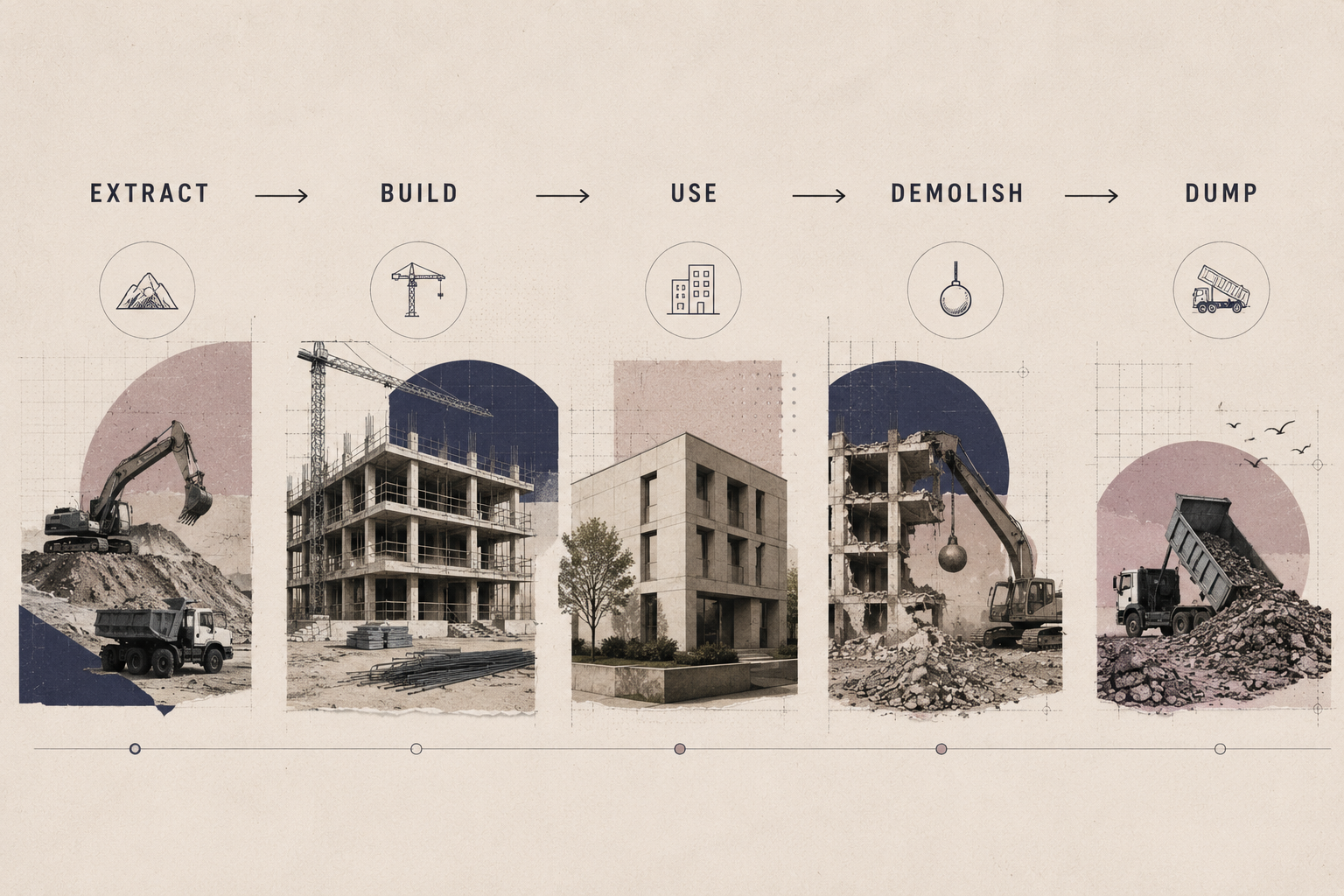
It works, but only if we assume materials are unlimited and waste simply disappears once it leaves a site.
It doesn’t
A circular economy offers a different way of thinking. Instead of treating a building as something that eventually becomes waste, it treats it as a collection of materials and components that can have more than one life.
And interestingly, this starts with design.
Circularity starts before construction begins
When we talk about sustainable construction, the conversation often jumps straight to materials: recycled concrete, low-carbon cement, reclaimed timber, and so on.
But there is another question that comes much earlier:
How are we designing the building in the first place?
A 2024 blueprint from Queensland University of Technology, developed through Australia’s Building 4.0 CRC, identifies three practical pillars for moving construction towards a circular economy.
The first is designing for the end before you start.
That could mean using bolted connections instead of permanent adhesives, standardising components so they can be replaced or reused, or designing walls and assemblies so their different materials can actually be separated.
It’s a simple shift in mindset.
Instead of asking, “How do we build this?”
We start asking:
“What happens to this when we’re done with it?”
That’s a design question as much as it is an engineering one.
Good circular design isn’t necessarily about adding more to a building. Sometimes it’s about designing fewer layers, making connections visible, choosing materials that can be separated, and creating systems that can adapt instead of being demolished.
In other words, designing for disassembly rather than designing for disposal.
The building is only one part of the system
A beautifully designed circular building still doesn’t work if there is nowhere for its materials to go afterwards.
That’s where the second pillar comes in: building the supply chain, not just the building.
Imagine a contractor has 20 tonnes of reclaimed steel from one project. Another project nearby needs steel. On paper, that’s a perfect circular loop.
In reality, there may be no database showing what is available, no standard confirming its quality, no marketplace connecting the two projects, and no simple way to transport it.
The material isn’t the problem.
The system around the material is.
This is where technology, material databases, digital twins, marketplaces and better documentation can make a difference. If we can track where a material came from, what it is, how it has been used, and where it could go next, we can start treating materials as assets rather than waste.
For designers, this is particularly interesting because it changes how we think about information.
A material isn’t just a texture, colour or specification on a drawing.
It has a history, a lifecycle and a future.
So, what is already being reused?
The idea of circular construction can sound futuristic, but many of the materials are already being used in new ways.
Fly ash and slag, back into concrete
Fly ash from coal power plants and ground granulated blast furnace slag from steel production have been used as supplementary materials in concrete for years.
Instead of becoming waste, these industrial by-products can replace part of the cement content. This can reduce the amount of clinker required and, in turn, reduce the associated carbon emissions.
Research also shows that these materials can influence the durability and microstructure of concrete.
So the idea isn’t simply:
“Use waste because it’s cheaper.”
It’s:
“Can a material that already exists perform a useful second job?”
That’s the thinking at the heart of circularity.
Roads made from what used to be waste
India is already becoming an interesting testing ground for this approach.
In 2025, the CSIR-Central Road Research Institute built what was reported as the world’s first steel slag road at Hariza Port in Gujarat, using steel-industry by-products that would otherwise have been stockpiled.
India has also been experimenting with roads using end-of-life plastic waste. Under the PMGSY rural roads scheme, waste-plastic technology is now required on at least 70 per cent of eligible projects, following research into its performance.
The important part isn’t simply that plastic or steel slag is being used.
It’s that a material previously considered “waste” is being reclassified as a construction resource.
That shift in perception is powerful.
Bricks made from agricultural waste
In April 2026, researchers at IIT Jodhpur developed bio-bricks and agro-plastic blocks using crop residue and plastic waste.
Again, the interesting part is the connection
Agriculture produces one waste stream. Construction needs another material. Circular design looks for the point where those two systems can meet.
The result is not just a new brick.
It’s a different relationship between industries.
Construction waste becomes construction material.
And perhaps the most obvious circular loop is construction eating its own waste.
Old concrete can be crushed and processed into recycled aggregate. Quarry fines and other by-products can be used to produce manufactured sand. Research has also explored lightweight aggregates made from industrial and construction by-products.
These approaches can reduce demand for virgin materials and, in some cases. Reduce pressure on natural resources such as river sand.
The building industry starts to look less like a straight line and more like a network.
One project’s waste can become another project’s starting point.
The problem isn’t only technology
This is where circular construction gets complicated.
We already have many of the technologies and materials needed to start making the shift, but technology alone doesn’t create a circular economy.
There are still three major problems.
Trust
A recycled material still needs to meet the requirements of the project.
If you’re specifying recycled aggregate for a structural element, you need reliable testing, certification and standards. Designers and engineers can’t simply assume that “recycled” means “safe.”
Fragmented supply
Waste and demand rarely happen in the same place at the same time.
A useful material sitting 300 kilometres away may not be useful at all if transporting and processing it costs more than using virgin materials.
Circularity therefore needs better networks between demolition contractors, manufacturers, suppliers, designers and builders.
The wrong incentives
In many markets, sending waste to landfill is still easier and cheaper than sorting, certifying, storing and transporting it for reuse.
That's a difficult problem to solve through design alone.
Regulation, procurement policies, financial incentives and industry standards all have a role to play.
This is why the QUT blueprint identifies these wider systems- technology, regulation, skills and incentives- as essential enablers of circular construction.
What does this mean for designers?
This is probably the part of circular construction I find most interesting.
Designers are used to thinking about how something looks, how it works and how people experience it.
Circularity asks us to add another dimension:
What happens to it next?
That could change everything from the way we specify materials to the way we document buildings.
Instead of designing a wall as a finished object, we could think of it as a kit of parts.
Instead of treating a material schedule as static information, we could think of it as a material passport.
Instead of showing only what a building will look like when it's finished, we could communicate how its components can be repaired, replaced, reused or recovered.
Even visualisation has a role here.
If we can make the lifecycle of a building easier to understand, through diagrams, digital models, material maps or clearer documentation, we can make circular decisions easier for everyone involved in a project.
Good design doesn't just make the future look better. It can help make the future more reusable.
From a linear line to a circular system
There is a useful parallel between circular construction and the way infrastructure projects are planned.
A project that ignores land acquisition, procurement or approvals at the beginning doesn't magically avoid those problems later. They simply appear further down the line, usually with a higher cost attached.
Waste works in much the same way.
If we don't think about what happens to materials at the beginning, we eventually have to deal with them at the end.
Circularity isn't a sustainability feature that gets added after the design is finished.
It's a planning decision.
It belongs in the same conversations as cost, programme, procurement, performance and user experience.
The materials to build differently already exist: steel slag, fly ash, recycled aggregate, agro-waste and recovered materials.
What is still missing in many markets is the plumbing around them, the standards, databases, marketplaces, incentives and workflows that make reuse simple.
Because ultimately, the goal isn't to make circular construction the heroic choice that requires someone to fight the system.
The goal is to make it the obvious choice.
And perhaps that's where design has its biggest role to play: not just designing better buildings, but helping design a construction industry where nothing valuable has to become waste in the first place.
────────────────────────────────────────
Sources: QUT/Building 4.0 CRC, “Building the Future – Circular Economy” (2024); IBEF industry analysis on recycled materials in India's construction sector; Frontiers in Built Environment systematic review on industrial by-product aggregates; Scientific Reports research on recycled concrete microstructure; International Energy Agency buildings and emissions data.