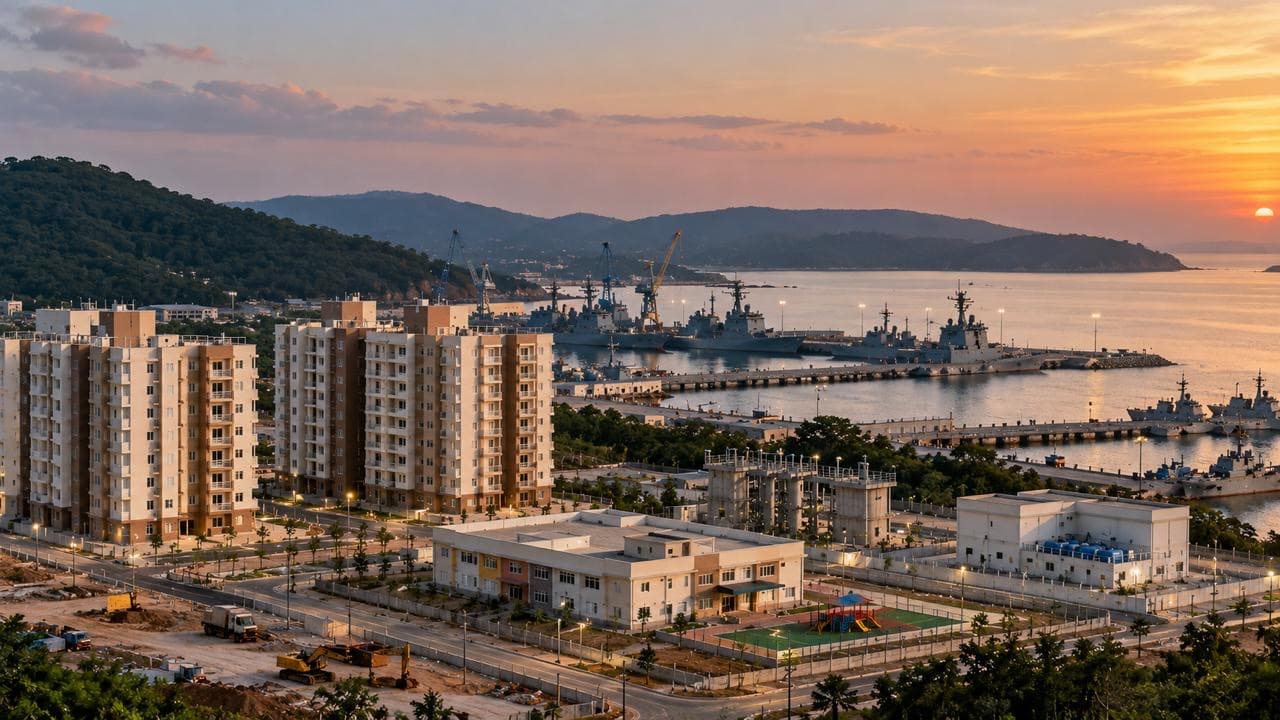
For a naval base to expand, the infrastructure required extends beyond ships, berths and repair facilities. It also includes the homes where personnel live with their families, accommodation for service personnel, schools for their children and the utilities that make these facilities usable. At Karwar, where Project Seabird is expanding the Indian Navy’s infrastructure, these requirements are becoming part of the project’s next phase of development. The readiness of this supporting infrastructure will help determine how effectively the expanding establishment can accommodate its personnel and meet their everyday needs.
On 8 October 2026, General N S Raja Subramani, Chief of Defence Staff and Secretary, Department of Military Affairs, inaugurated two residential towers containing 60 dwelling units each, in-living accommodation for 156 Defence Security Corps (DSC) personnel, a kindergarten school, and trunk utility and amenity infrastructure under Project Seabird Phase IIA. The Ministry of Defence announced the development on 9 October. While the inauguration marks another addition to the project, questions around occupancy, service readiness and maintenance remain important to understanding how these facilities will support the expanding naval establishment.
Residential infrastructure beyond the numbers
The residential package comprises one tower for married senior sailors and another for naval defence civilians. NCC Ltd, Hyderabad, constructed the residential accommodation and associated amenities, while Cemindia Projects India Ltd executed the trunk infrastructure. These facilities serve different requirements within the base: family accommodation supports personnel living with their dependents, while in-living accommodation provides for DSC personnel. The inclusion of a kindergarten school also places an educational facility within the developing residential environment. Together, these components indicate that the project’s infrastructure requirements extend beyond operational naval facilities to the everyday needs of its personnel and families.
However, inauguration alone does not establish that the facilities are occupied or that every associated service is operational. Formal handover, commissioning, occupancy and sustained service delivery are distinct stages.
Phase IIA and the wider expansion of Karwar
Project Seabird Phase IIA forms part of the larger expansion of the naval base at Karwar in Karnataka’s Uttara Kannada district. The programme is intended to support the basing of additional ships and submarines, with its scope extending to a dual-use Naval Air Station, a full-fledged Naval Dockyard and logistics facilities for ships and aircraft. The expansion therefore involves several interconnected infrastructure requirements, including berthing, repair, logistics, accommodation and supporting utilities. The latest residential inauguration represents one element of this wider programme rather than evidence that Phase IIA has been completed.
Power infrastructure and service readiness
Earlier developments illustrate the scale of the supporting infrastructure being created. In February 2025, the Navy inaugurated a main distribution substation under Phase IIA. According to the Ministry of Defence, the installation included four 33/11 kV transformers rated at 35 MVA each, with a stated capability of supplying 65 MVA of stabilised power to operational piers, accommodation and utilities. Three captive power plants, each rated at 3 MVA, were also identified as backup power infrastructure. These figures establish the planned capacity of a major electrical installation.
Water supply and the civilian infrastructure connection
Water infrastructure presents another important connection between the naval base and the surrounding region. In August 2025, the Uttara Kannada district administration published a land-acquisition notification for a proposed drinking-water pipeline project drawing from the Gangavali River. The scheme envisaged a capacity of 21 million litres per day and identified Karwar and Ankola towns, intervening villages and Project Seabird among its intended beneficiaries. The proposal illustrates how infrastructure serving the expanding base intersects with civilian water requirements.
These connections matter because the delivery of buildings and the delivery of services are not identical achievements. Residential facilities require functioning utility connections and arrangements for operation and maintenance. Where infrastructure serves multiple facilities or user groups, coordination between construction contractors, asset owners and service providers becomes particularly relevant. This is an inference from the project’s documented scope, rather than evidence of a specific service deficiency at Karwar. Publicly available commissioning records, handover documentation and service-performance information would be needed to assess the actual readiness of the new facilities.
Continuing works and the scale of the project
Project announcements also show that Phase IIA continues to involve work beyond housing. Government procurement notices published in August and September 2026 covered activities associated with the wider programme, including quarrying and transportation work and consultancy for additional armament storage facilities. These notices indicate continuing procurement and development activity.
The scale of the intended establishment adds to the importance of this supporting infrastructure. The Ministry of Defence has described the expanded base as intended to accommodate approximately 10,000 uniformed and civilian personnel and their families. It has also reported employment generated by construction across the wider project. Such figures indicate the scale of the development, but they should not be treated as measurements of the economic impact of the latest residential package or as evidence of current occupancy.
From inauguration to operational readiness
Karwar’s latest inauguration is therefore best understood as a documented milestone within a larger infrastructure programme. The next indicators of progress are not limited to additional buildings being inaugurated. They include formal handover, actual occupancy, commissioning of supporting services and clarity over the long-term maintenance of the assets. Tracking these outcomes would help establish whether completed construction is translating into usable residential infrastructure while the wider naval expansion continues.
For the infrastructure sector, the distinction is fundamental: project delivery involves not only creating physical assets but also ensuring that they can perform their intended functions. At Karwar, the relationship between housing, utilities and the wider naval establishment will be central to determining how effectively the new facilities support personnel and their families over time.