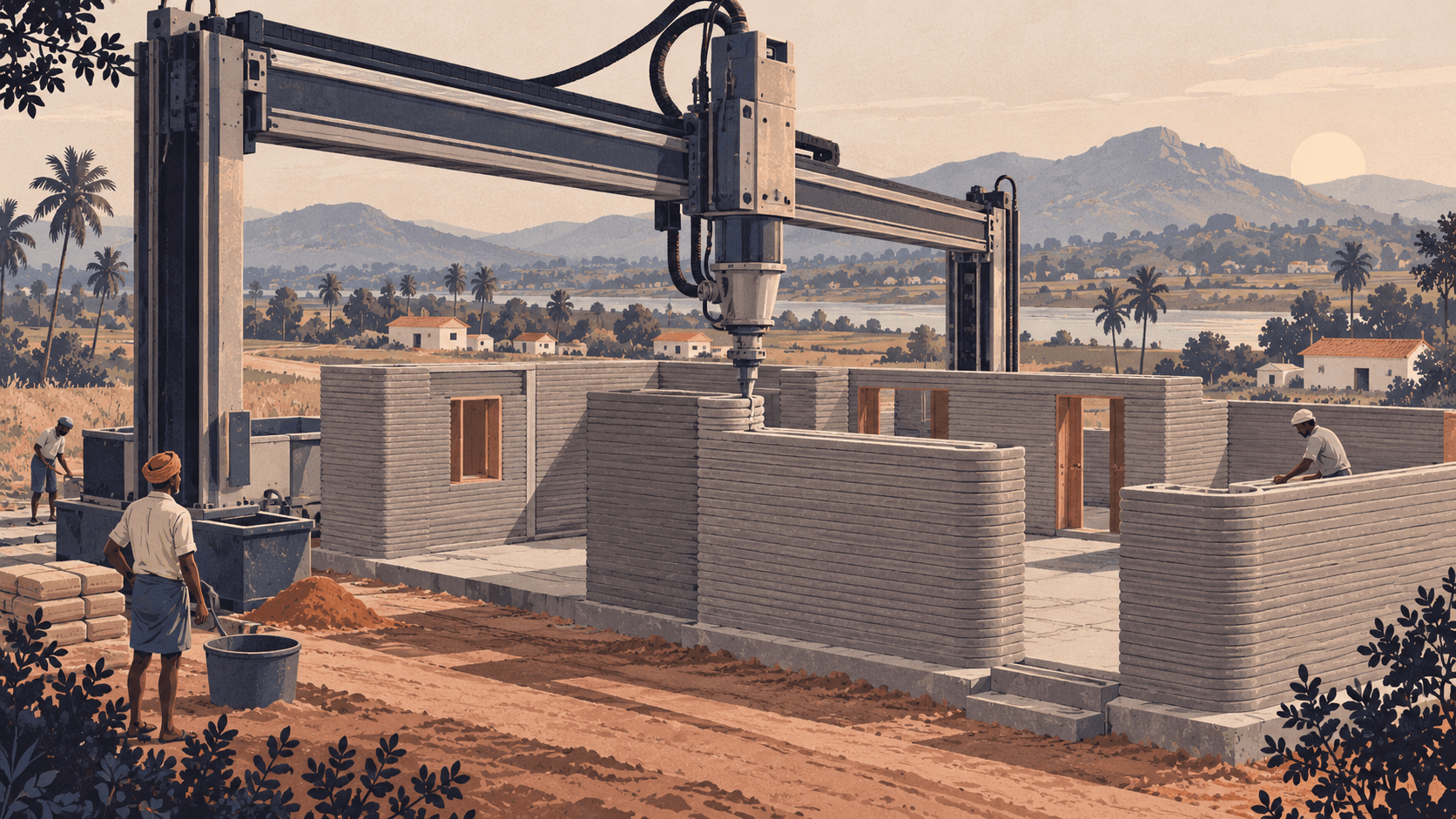
Andhra Pradesh has laid the foundation for a 177-home 3D concrete-printing pilot. The pilot has an immediate test beyond the printer: the public timetable has two versions.
A project report published before the October 4 ceremony described an 18-month programme across Burripalem and Obulnayudupalem. The Press Information Bureau's account of the ceremony says the same 177-house pilot is expected to finish within six months. The release does not state the date from which that clock runs or what counts as completion. Six months may be the construction period announced at the event, while 18 months may cover a wider programme. The records available so far do not resolve the difference. Printing walls is one stage in a longer construction sequence. The programme also requires site preparation, soil stabilisation, foundations, services, finishes and inspections. A schedule that counts printed shells will describe a different result from one that counts completed, inspected and occupied houses.
The project has two sites and two house types. The New Indian Express reported that 100 homes are planned at 25 square metres each, with 77 barrier-free homes at 32 square metres for people with disabilities. Each is to include a household latrine. The pilot will test repeatable design and access alongside the printing process. The record will need to show whether the larger layouts and accessible details survive the same production cycle as the standard unit.
The reported outlay is ₹13.93 crore before taxes. The Union rural development ministry is to contribute ₹9.44 crore and Andhra Pradesh ₹4.49 crore, according to the pre-event account. The Union share includes ₹3.40 crore for the printing machinery, ₹1.50 crore for technical supervision by CSIR-Central Building Research Institute and ₹4.54 crore for construction. The state's share includes ₹3.64 crore for land preparation and soil stabilisation, with ₹0.85 crore toward construction.
Those components make a simple cost-per-house comparison misleading. The budget includes equipment that may serve more than one unit, technical oversight and site work. To compare printed homes with conventional PMAY-G construction, the project will need to disclose which costs are capital equipment, which recur at each site and which belong to the house itself. It will also need a like-for-like comparator with the same floor area, accessibility features, location and stage of completion.
CSIR-CBRI is expected to supply designs, mix formulations and technical oversight. The two villages can therefore generate evidence on whether the material and printing process work under local site conditions. Useful measures would include printer hours per house, material consumed and wasted, rework, labour by trade, time to weather-tight shell, completion time, defects at inspection and the cost of services and finishes. The public material reviewed for this story does not yet provide those baselines or a reporting schedule.
The Union ministry says the pilot aims to reduce construction time, cost and labour. Those are stated objectives, not demonstrated outcomes. Durability will take longer to establish than the initial build. For now, the near-term test is whether the 177 houses are delivered to the published design and within a clearly defined timetable.
The next useful disclosure is a project schedule that names the start date, milestone dates and handover standard, alongside the separate funding heads. Without that ledger, a six-month announcement and an 18-month programme can both remain true while telling readers very little about when families will receive finished homes.