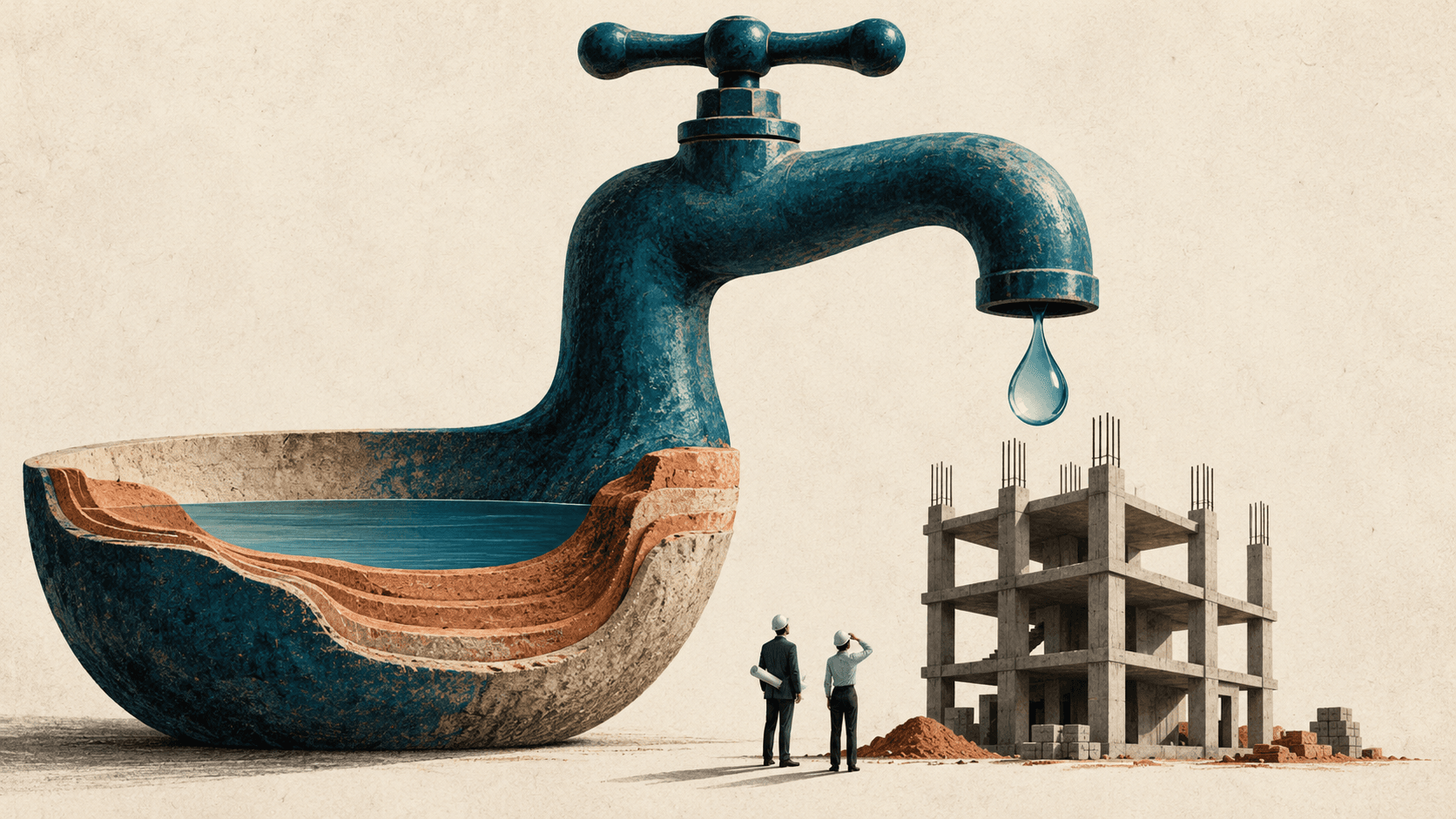
India’s infrastructure teams have two dated signals to work with this October: a reduced reservoir buffer and a seasonal outlook shaped by very strong El Niño conditions. Together, they justify checking how projects will secure water through the dry months. They do not establish that every city faces a shortage or that a particular project has already lost working days.
The Central Water Commission’s bulletin for 15 October records 126.717 billion cubic metres of live storage across 178 monitored reservoirs. That is 68.58% of their combined live capacity, 75.47% of the corresponding previous-year storage and 83.56% of normal storage. CWC defines normal as the average over the previous ten years.
Capacity and normal storage answer different questions. The unfilled share of a reservoir is not automatically a drought deficit. The seasonal comparison is more useful for judging how much buffer remains against the usual pattern of demand and inflows.
The southern buffer is smaller
In CWC’s southern region, covering Andhra Pradesh, Karnataka, Kerala, Tamil Nadu and Telangana, 50 monitored reservoirs held 24.760 billion cubic metres. That was 44.31% of live capacity, compared with a corresponding normal level of 77.54%. CWC classified the Pennar and Cauvery basins as highly deficient.
These are measurements for 15 October. A project manager still needs the reservoir and allocation serving the site, subsequent inflows, utility restrictions and competing commitments. A regional total cannot reveal the hours of supply at a particular batching plant or the water available to a municipal pumping station.
El Niño adds a planning risk
The WMO’s 14 October account of the South Asian seasonal outlook describes very strong El Niño conditions and an increased likelihood that they will persist during October–December. Its rainfall outlook varies geographically: below-normal rainfall is likely across much of central and southern peninsular South Asia, while other areas have normal-to-above-normal prospects.
That is a seasonal probability assessment, not a forecast of water deliveries to a construction site. In its 30 July parliamentary reply, the Ministry of Earth Sciences also explained that Indian impacts depend on evolving ocean–atmosphere conditions, with El Niño one factor. Neither document attributes a specific project delay to El Niño.
Translate the warning into a site water balance
Our project-controls recommendation is to build a weekly water balance for the next construction stage. List demand separately for concrete production, curing, earthwork moisture conditioning, dust control and worker facilities. Record the source, permitted quantity, delivered quantity, quality requirements and usable storage for each demand. The forecast becomes actionable when that balance identifies a shortfall against planned work.
A backup tanker supplier also needs a checked source and a deliverable volume. Two suppliers drawing from the same constrained source may leave a project exposed to the same interruption. Where treated wastewater is proposed, the engineer must verify its suitability for the intended use and the applicable specification before substitution. Saving water cannot justify weakening curing or concrete-quality requirements.
For operating infrastructure, the equivalent review should connect source availability with intake limits, treatment capacity, pumping constraints and demand. A reservoir-storage percentage alone cannot establish how long a city can maintain supply.
What would establish a delivery impact?
A report of water-related delay should show the restriction or supply failure, the affected activity, the daily records and the change to the programme. Higher tanker bills require invoices and matched volumes; reduced output requires production records. Those records would allow a later update to distinguish a precautionary plan from an observed cost or schedule impact.
The unanswered question for each exposed project is specific: how much compliant water can its suppliers deliver through the next critical work stage, and what happens if that volume falls? The next CWC bulletin, local utility notices and the site’s weekly supply records should determine when the plan changes.
Dated record
14 October 2026: WMO published the South Asia winter outlook.
15 October 2026: CWC reservoir-storage observation used here.
22 October 2026: Bridging Room reviewed the records. No named project’s water-related delay is established in this article.