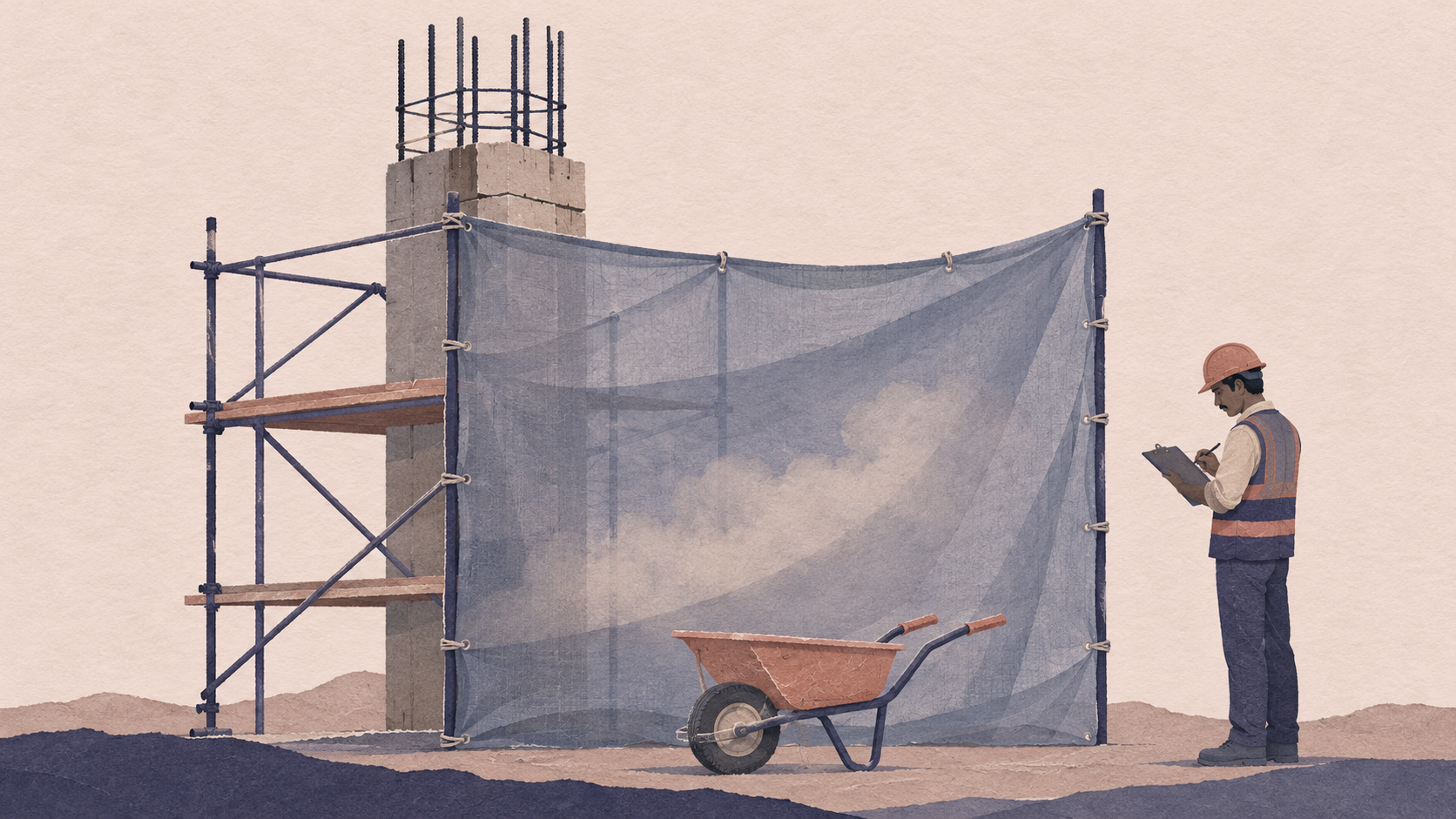
Faridabad enters a dated construction-restriction window on 5 November. The district’s 4 November announcement covers dust-generating demolition and outdoor construction through 20 November, unless amended or withdrawn earlier. For project teams, the immediate task is to establish which planned activities fall within the restriction and who can authorise any claimed exemption.
Roads and utility corridors are included
The announcement expressly includes highways, roads, flyovers, overbridges, transmission lines, pipelines and telecommunications works. Public ownership alone therefore offers no basis for assuming that a linear project may continue dusty work.
Listed exemptions include railways and metro services, airports and inter-state bus terminals, hospitals, water supply and sanitation, national security and defence activities, and projects of national importance. Exempt projects remain subject to dust-control standards and construction-and-demolition waste requirements.
A useful project review would connect each activity in the short-term programme to the applicable direction. Excavation, demolition, material handling and an enclosed installation package raise different practical questions. The announcement does not resolve every work-package boundary. A contractor should obtain the operative order and any subsequent clarification before treating a broad project description as permission for a particular activity.
The district names the enforcement chain
Municipal and development authorities, planning enforcement officers and executing agencies have implementation duties. For linear works, the district identifies NHAI project directors and the relevant public-works and utility engineers. It also calls for daily inspections and action-taken reports recording sites visited, violations and action. These go through pollution-control regional officers to the City Magistrate.
Those reports would make a stronger basis for follow-up reporting than an equipment count. How many distinct sites were checked? What was the activity observed? Was a correction verified on a return visit? A notice records an enforcement step; it does not, by itself, establish that a site corrected the problem.
Office attendance is a separate requirement
The same announcement caps simultaneous attendance in Haryana government offices and private establishments in the district at 50%, with exemptions where the arrangement is impractical for industrial establishments and essential services. Office rosters and construction-site work permissions need separate checks.
SCC Times’ 4 November account places the district measures within a CAQM order dated 30 October covering the wider NCR. This report has checked the district’s official announcement and that secondary account; the signed district order and complete CAQM instrument have not been independently inspected.
What the next fortnight should establish
No current site-inspection dataset or measured reduction in emissions has been verified for this report. An AQI movement alone would not isolate the effect of construction restrictions from other sources and weather.
The next reporting milestone is the district’s first consolidated inspection record under this window. It should allow the published directions to be compared with the activities agencies actually inspected and the corrections they confirmed.
30 October: CAQM order date reported by SCC Times.
4 November: Faridabad publishes its implementation announcement.
5–20 November: announced restriction window, subject to earlier amendment or withdrawal.