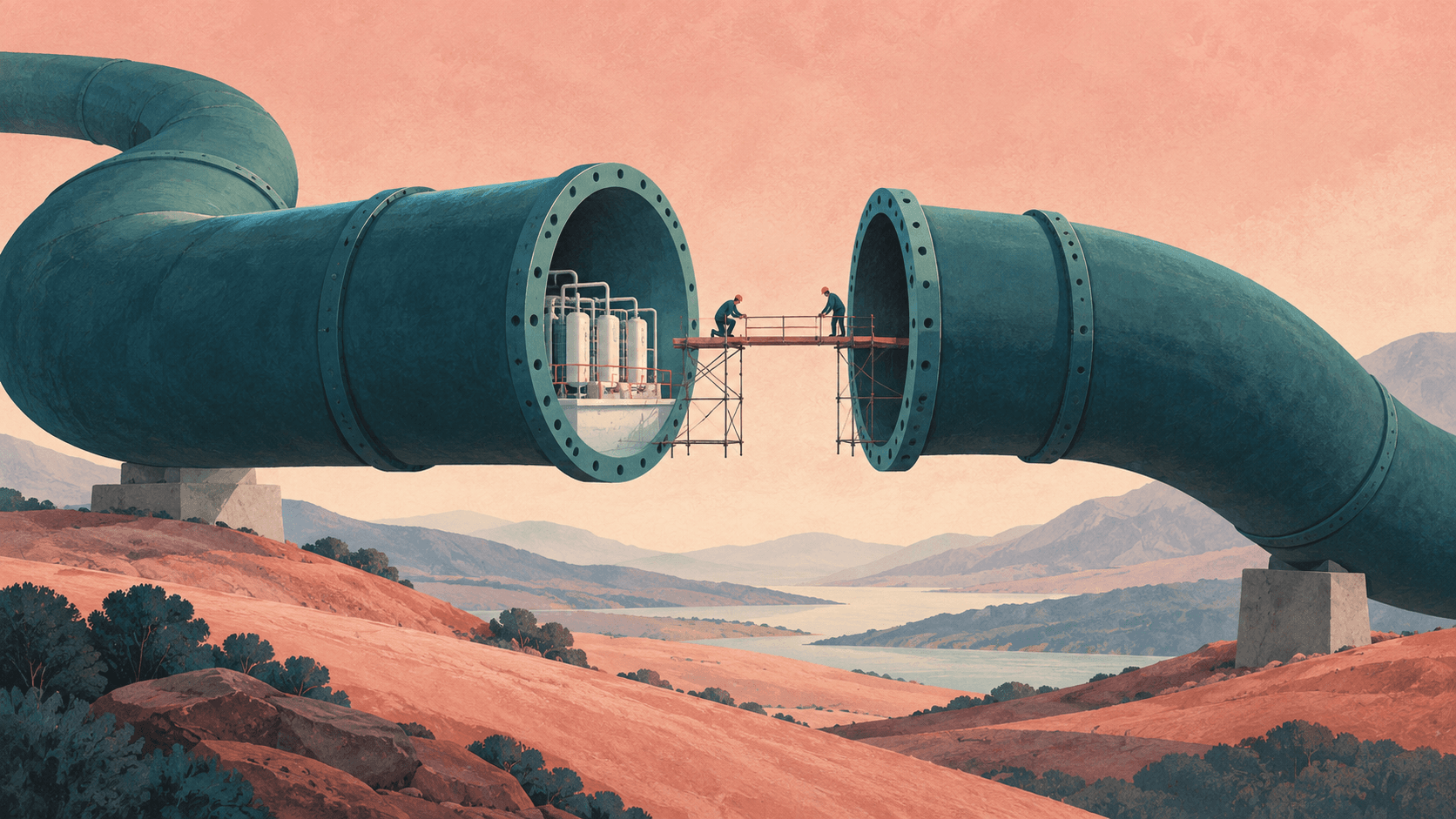
India has signed buyers for a substantial volume of future green hydrogen. Delivering to them will require coordinated construction of production plants, electricity supply, water systems and storage.
In its 29 October update, the Ministry of New and Renewable Energy reported 5,55,610 metric tonnes a year of green-hydrogen-equivalent offtake commitments. It counted 23 contracts since 2023, including 18 signed during 2026. More than 70% of the committed volume is export-oriented.
These are supply commitments. The tally does not establish that the corresponding plants are complete or that this volume has been produced. MNRE associates the agreements with roughly ₹90,000 crore of expected investment; that figure should not be read as expenditure already incurred.
What the number measures
“Offtake” means an agreement for a buyer to purchase a producer’s output. A credible purchaser and a long contract can help a developer demonstrate future revenue when arranging finance. Whether a particular agreement satisfies lenders depends on its terms and the project’s remaining risks.
The national figure also needs its unit kept attached. Hydrogen equivalent allows commitments involving hydrogen and its derivatives to be expressed on a common basis. A tonne of ammonia is not a tonne of hydrogen. Adding the ammonia volumes in individual announcements directly to MNRE’s hydrogen-equivalent total would give a misleading result.
Two agreements, two delivery schedules
L&T’s April announcement describes a long-term take-or-pay agreement with ITOCHU for 300,000 tonnes a year of green ammonia from a proposed Kandla facility in Gujarat. MNRE’s October update places deliveries from December 2029. The ministry’s date is a forward delivery expectation, not evidence of commissioning.
A take-or-pay structure can strengthen revenue certainty because payment obligations are tied to contracted quantities, subject to the agreement’s conditions. The public announcement does not expose the complete contract, so it cannot settle questions about exceptions, delay relief or financing conditions.
Reliance’s 16 March release describes a binding, 15-year green-ammonia supply agreement with Samsung C&T valued above US$3 billion. It specifies the second half of FY2029 for commencement. On India’s April-to-March financial-year convention, that means October 2028 to March 2029. Samsung’s counterparty announcement says supplies begin in 2028. The statements therefore need not conflict.
The US$3 billion is an agreement value over its term. It is not a disclosed construction budget. Nor do the announcements establish actual annual deliveries today.
The construction brief extends beyond the plant
The ministry’s 28 October backgrounder explains the electrolysis route: renewable electricity splits water into hydrogen and oxygen. For developers, this connects the process equipment schedule to the availability of power and treated water.
Our delivery assessment is that these interfaces deserve separate milestones. A completed electrolyser building cannot demonstrate reliable output if the power connection or water-treatment system is unavailable. Equally, a commissioned utility does not establish that the process plant has passed performance tests.
For engineers, contractors and investors tracking these projects, four records would make the next update more useful:
Financial close and the scope of contracts actually awarded.
Dates for electricity and water availability, matched to plant start-up.
Commissioning and sustained-performance results, with measured output.
Emissions verification and acceptance against the buyer’s contractual specification.
“Green” requires evidence too
India’s 2023 standard sets a well-to-gate emissions ceiling of 2 kg of CO₂ equivalent per kilogram of hydrogen. Its stated boundary includes water treatment, electrolysis, purification, drying and compression. This makes utility and process performance relevant to the product’s classification.
A signed sales agreement alone does not establish compliance with that threshold. Export contracts may also impose buyer-specific requirements; the reviewed announcements do not provide enough detail to determine compliance with every destination’s rules.
The dates to keep in view
16 March 2026: Reliance announces its Samsung C&T supply agreement.
22 April 2026: L&T announces its ITOCHU green-ammonia agreement.
29 October 2026: MNRE publishes its consolidated commitment tally.
October 2028 to March 2029: Reliance’s stated commencement window.
December 2029: MNRE’s stated delivery start for L&T–ITOCHU.
The unanswered question is how much of the contracted volume is backed by financed, fully serviced projects with demonstrable construction progress. The sources reviewed establish demand agreements and intended schedules. The next meaningful development will be a project-level financing, construction or commissioning record that can be checked against those schedules.