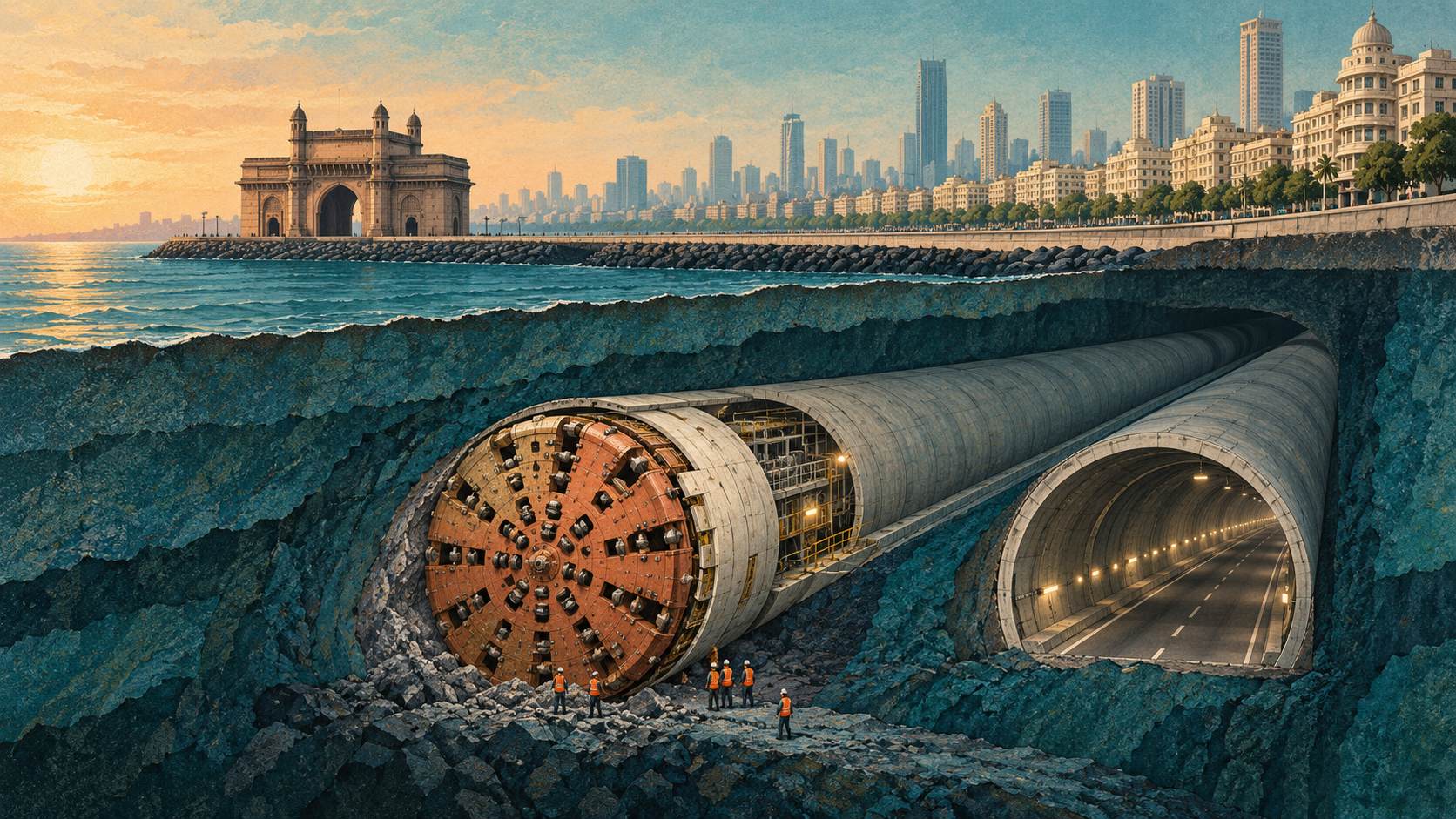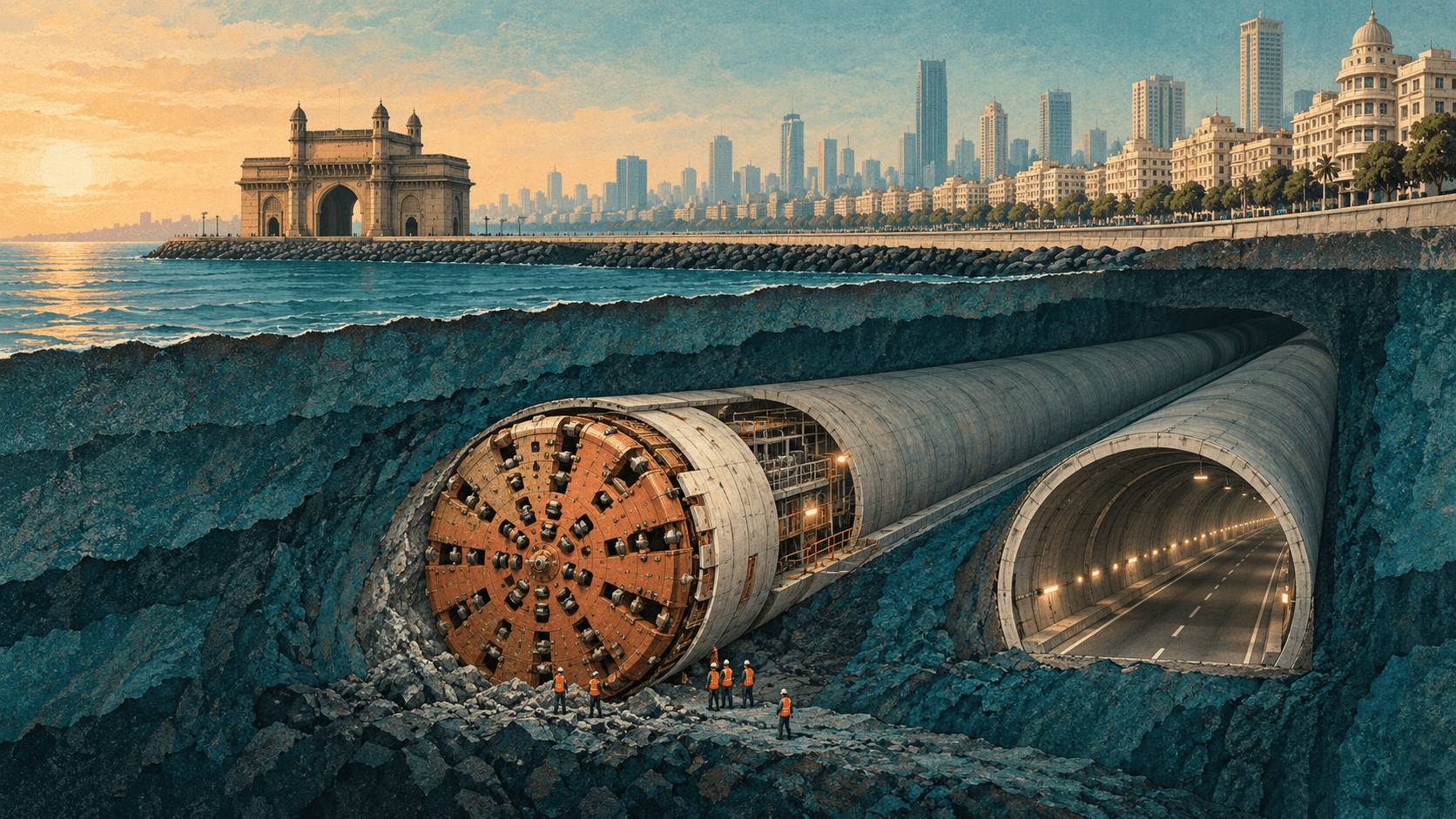
Mumbai’s Orange Gate–Marine Drive road tunnel has moved beyond shaft construction. MMRDA reports that mining of the southbound tunnel has crossed 1,000 metres and that overall physical progress reached 33.27% through September 2026. The figures come from the authority’s project status page, checked on 19 October.
The useful distinction is between the distance bored and the readiness of the road. A mined tunnel still needs its road surface, connecting passages, services and safety systems. MMRDA’s percentage describes the project as a whole; it does not establish that a third of the route is ready for traffic.
Two tunnels beneath an occupied city
The scheme links Orange Gate with Marine Drive across Mumbai’s island city. Its design includes two bored tunnels, cut-and-cover sections, open ramps at both ends and an elevated down ramp from the Eastern Freeway.
MMRDA lists the bored lengths as 3.71 km and 3.73 km, adding to 7.44 km of tunnel construction. These are two parallel tubes, not a 7.44 km end-to-end journey. The authority describes the overall project length, including cut-and-cover sections and ramps, as 4.9 km.
Each tube has an 11-metre internal diameter and is designed for two 3.2-metre traffic lanes, an emergency lane and a raised footpath. The stated design speed is 80 km/h. That is a design parameter, not a prediction of average travel speed after opening.
The alignment has to maintain clearance from Metro Line 3, Central and Western Railway infrastructure, and building foundations. MMRDA puts the maximum depth of the tunnel crown at about 52 metres below ground. Those interfaces make this a construction-sequencing story as much as a road-capacity story.
What the progress figure leaves open
The authority says refurbishment of one tunnel-boring machine and construction of the launch shaft at the Eastern Waterfront are complete. It identifies the southbound bore as the one that has crossed 1,000 metres. The status note does not provide an equivalent mined distance for the other tube.
The planned works include precast reinforced-concrete lining segments, cross passages, concrete carriageways, ventilation, fire-resistant systems, lighting and intelligent traffic management. The published progress summary does not give separate completion or testing figures for these systems. A breakthrough, when achieved, will therefore be one milestone in a longer commissioning sequence.
For residents and road users, the eventual benefit also depends on how traffic enters and leaves the tunnel. Faster movement underground can still meet a queue at a surface connection. That is a question for junction design, traffic modelling and operating plans; the construction percentage cannot answer it.
Approved cost is not expenditure
MMRDA’s background note records administrative approval of ₹8,056 crore. Larsen & Toubro was awarded the work on a design-and-build basis, with a notice to proceed dated 20 June 2024.
The same page reports financial progress of 27.04% through September 2026. It does not explain the denominator or provide a rupee expenditure figure alongside that percentage. Multiplying it by the approved project cost would create an expenditure estimate that the published summary itself does not establish. Nor does the difference between physical and financial percentages, on its own, prove a payment delay.
The delivery timeline
12 January 2024: foundation stone laid.
20 June 2024: notice to proceed issued for the design-and-build contract.
1 October 2024: 1.96 hectares handed over by Mumbai Port Authority; launch-shaft works followed.
Through September 2026: MMRDA reports 33.27% physical and 27.04% financial progress, with southbound mining beyond 1,000 metres.
The next useful disclosure would separate progress in each bore from ramps, cross passages and safety-system installation. A dated testing and commissioning programme would then show how those work fronts come together. Until that record is available, the reported mining distance is evidence of construction progress, not an opening-date commitment.