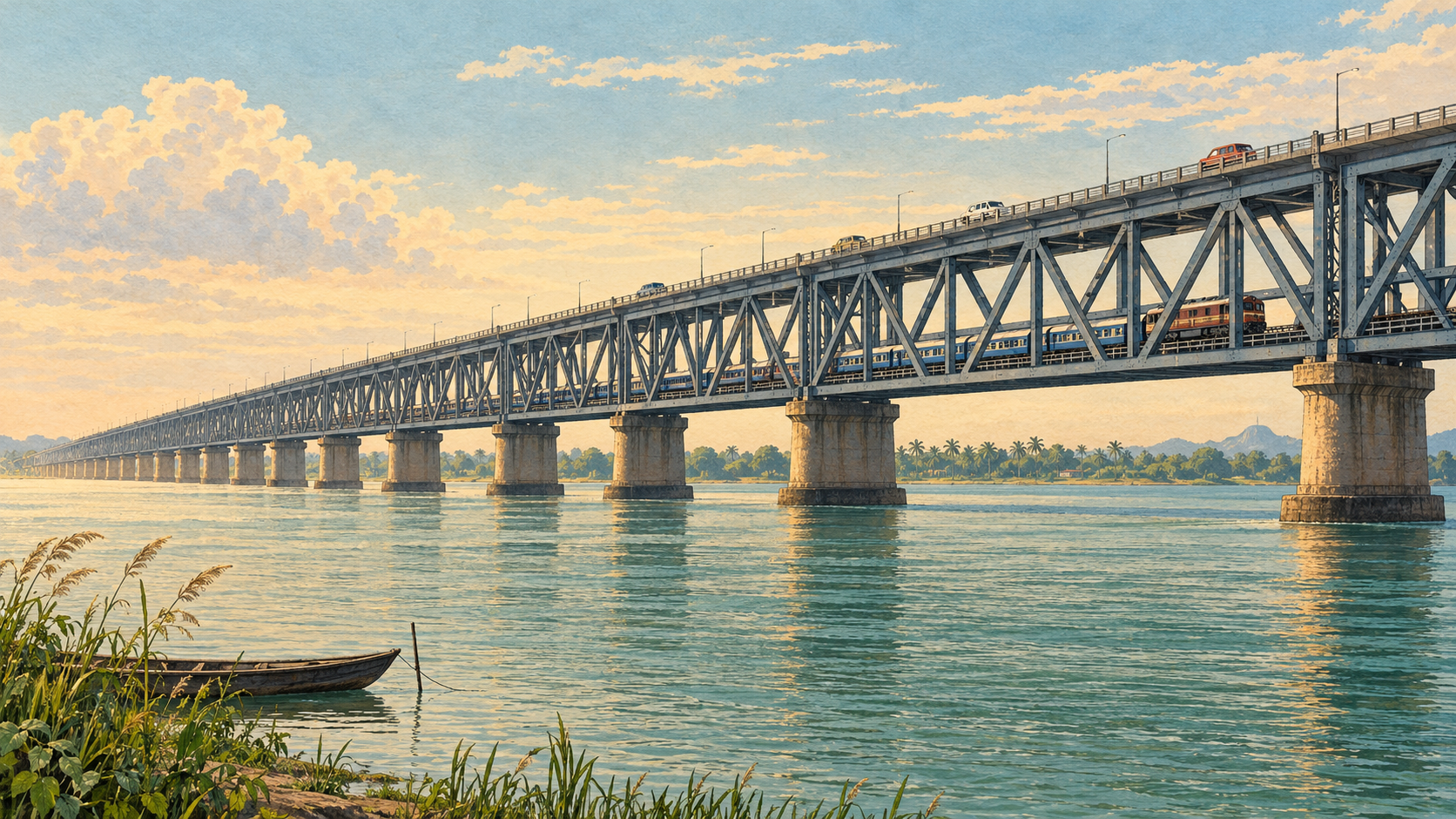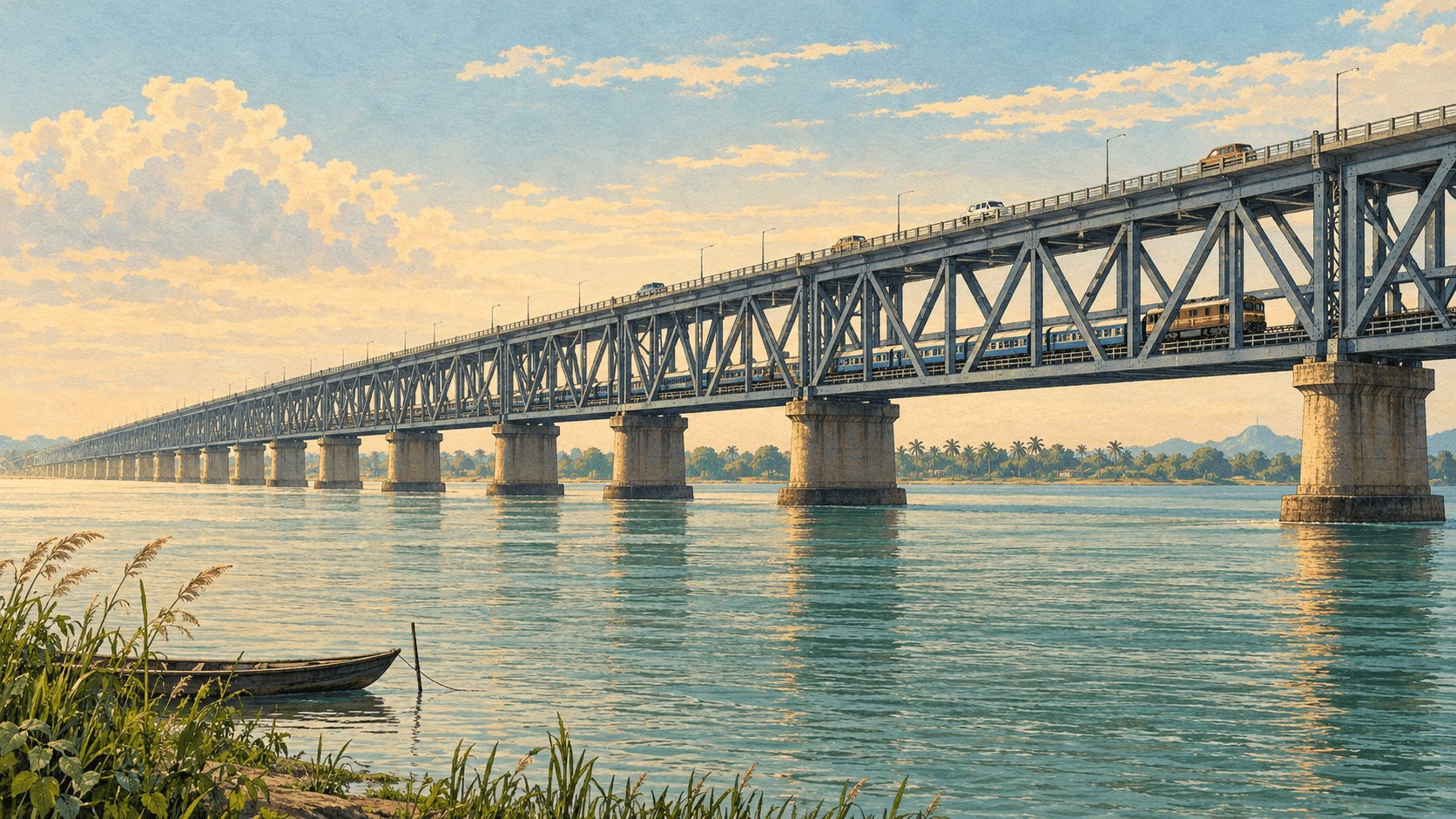
Across the Godavari at Rajahmundry, now Rajamahendravaram, a bridge connects the city with Kovvur on the opposite bank. The road-cum-rail crossing that opened in 1974 emerged from a railway requirement and a wider demand for road access. Its construction history extends from the decision to combine the two modes to the availability of individual work sites on the approaches.
How the bridge took shape
Plans for another railway crossing prompted demands for a road connection between Kovvur and Rajahmundry. In the Rajya Sabha on 6 June 1964, P. K. Kumaran described representations from residents of East and West Godavari and from the Andhra Pradesh government. He argued that adding a road crossing to the railway project would cost less than constructing it separately. This was an argument made during the project’s development, rather than a verified comparison of its eventual costs. Parliamentary debate, 6 June 1964
The state’s 1964–65 budget speech also records a decision to provide a contribution to the Railway Ministry for the road crossing. Together, these records show that the road component required discussion over both transport needs and responsibility for funding it.
The resulting bridge carried road and rail traffic across the same river crossing. The East Godavari district administration credits Braithwaite, Burn and Jessop Construction Company with its construction. Separate approach works involved another contractor, as the subsequent court record shows. District engineering history
Building the approaches
An agreement dated 17 June 1970 covered construction of the approaches. A later Andhra Pradesh High Court judgment records a 42-month stipulated period and completion on 10 December 1974 after two extensions. These dates refer to the approach contract. State of Andhra Pradesh v. Associated Engineering Enterprises, 24 March 1989
The judgment recounts the contractor’s claim that Kovvur-side sites were handed over late. Its compensation table lists delays of two to 26 months. For K1–K3, it records foundation access in January 1972 and access for subsequent work in May 1973; K7 carries the 26-month delay.
The contractor sought compensation for price increases, overheads and associated costs. The dispute reached arbitration and the courts. In its 1989 decision, the High Court deleted the ₹2,81,800 award under Claim 1. The recorded delays therefore cannot be presented as compensation that the contractor ultimately secured under that judgment.
This part of the history concerns access and sequencing on the approaches. It should not be treated as a complete account of the main river spans or every package that made up the crossing.
Opening to traffic
The contemporary chronology in Yojana’s January 1975 issue records the bridge’s opening to traffic on 20 November 1974. The entry appears under November on printed page 102. Yojana archive
That date differs from 16 August 1974 given on the district tourism website. The latter also identifies Fakhruddin Ali Ahmed as the President at the inauguration, although his official biography dates his accession to 24 August. The contemporary opening-to-traffic record is used here.
The November opening and the approach contract’s December completion should remain separate in the chronology. Neither record, on its own, explains the precise scope available for use on each date.
An asset beyond its construction
The crossing’s maintenance history continues. A September 2026 tender listing describes replacement of poles and lighting fixtures on part of the road-cum-rail bridge towards Kovvur. It sits beneath a broader project title referring to riding-surface improvements, footpaths and handrails. Tender listing
The listing is a procurement lead from a tender aggregator. The original departmental document, award and completion status have not been verified. It cannot establish that the broader resurfacing and footpath works have been carried out, or provide an assessment of the bridge’s structural condition.
For this crossing, the next useful maintenance records are the awarded scope, the work-completion report and any operating restrictions during execution. They would show what has changed on the bridge since the notice was issued.