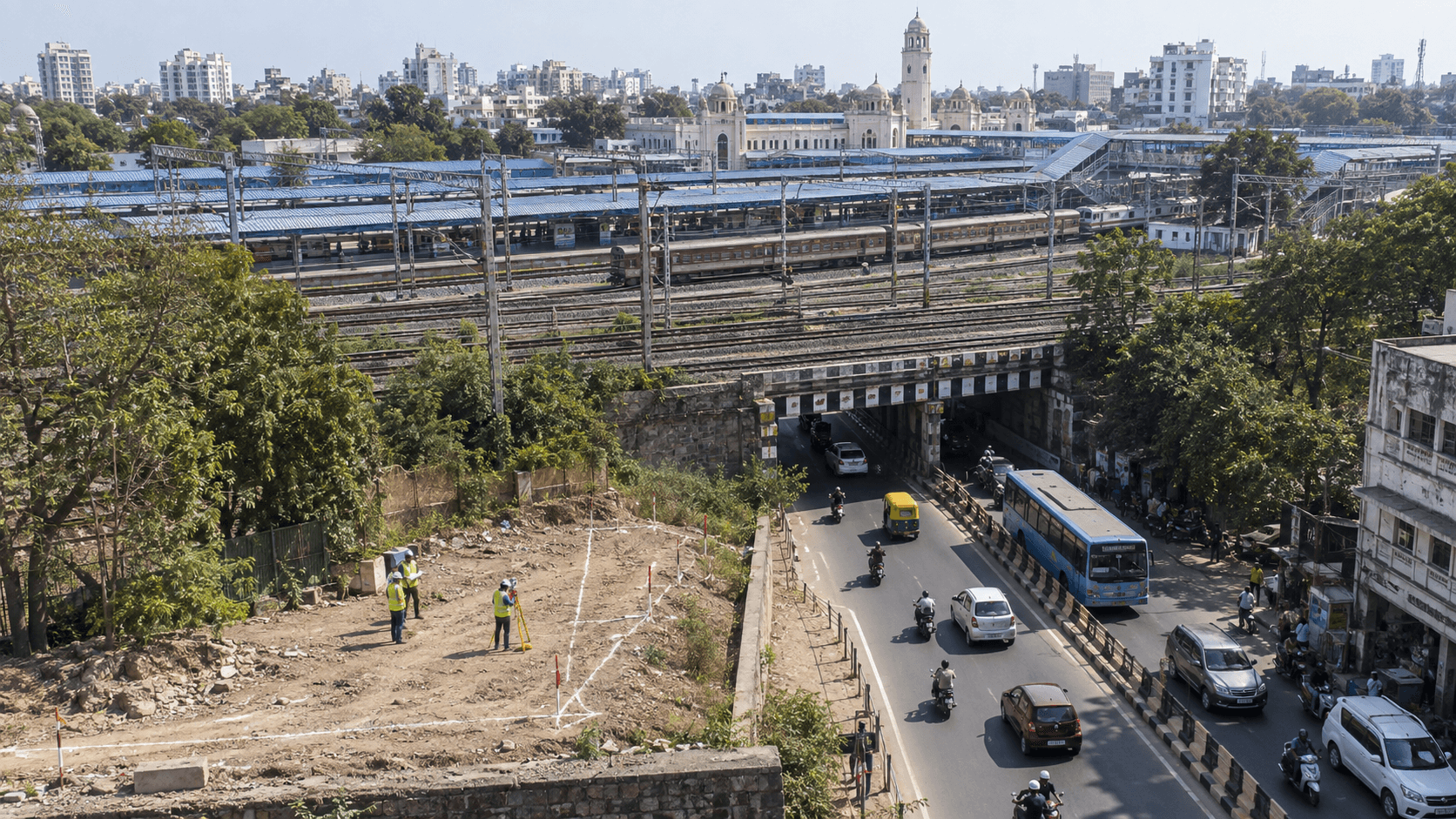
Vadodara has a bridge approval. It does not yet have a bridge.
On 24 September, the Ministry of Railways said Indian Railways had approved a four-lane road overbridge at Alkapuri in Vadodara Division. The announced cost is ₹166.5 crore, split equally between the Railways and the Government of Gujarat. Each side is expected to carry about ₹83.28 crore.
That is the clean part of the story. The harder part begins below the approval note, at a place where a railway station, a state bus terminal, city roads and a future high-speed rail station are expected to interact.
Why Alkapuri is not a routine bridge
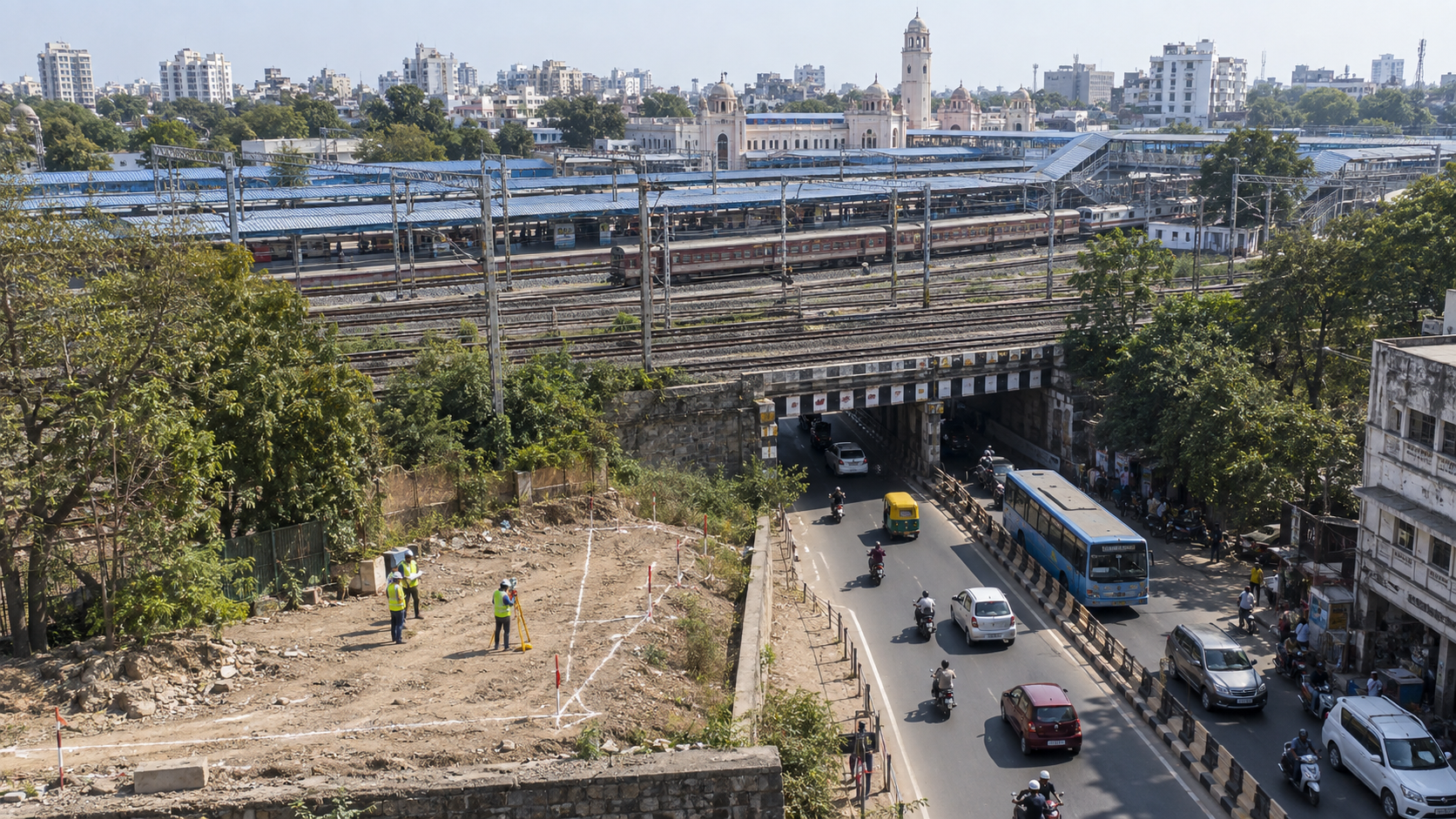
The existing Alkapuri road underbridge sits close to Vadodara railway station. According to the official release, it has only about three metres of vertical clearance. Larger vehicles cannot use it easily. The location also faces recurrent waterlogging during the monsoon, while peak-hour traffic exceeds 1,600 passenger car units an hour. Pedestrian facilities are described as inadequate.
A new overbridge is therefore meant to solve several problems at once: clearance, capacity, drainage exposure, conflict points and access between major transport nodes. That combination makes the project more valuable, but it also makes the delivery problem more complicated.
A bridge beside a live railway station is not simply a civil structure placed across tracks. It is an interface programme. Designers must fit approaches into an already constrained city. Construction teams must work around railway operations. Traffic managers must keep local movement functioning while approaches, piers and utilities are handled. Pedestrians need a safe route before, during and after construction.
The approval fixes the funding principle. It does not fix those interfaces.
The station interface is the schedule
Project schedules often show a bridge as a chain of activities: survey, design, foundations, substructure, superstructure, approaches and opening. At Alkapuri, the real critical path may sit between those headings.
The first question is alignment. Where the approaches land will determine land requirements, utility diversions, access to businesses and the effect on local junctions. A technically elegant span can still create a poor urban connection if ramps transfer congestion to the next intersection.
The second question is railway access. Any work above or beside operating tracks needs defined blocks, approved methods and clear possession windows. These are not administrative details. They govern when cranes can lift, when launching can occur and how much contingency the programme needs.
The third question is the relationship with the future high-speed rail station. The ministry says the bridge will improve connectivity between Vadodara station, the GSRTC bus station and the upcoming high-speed rail station. That promise needs to become a coordinated drawing. Passenger movement, pick-up and drop-off areas, bus access, emergency routes and pedestrian crossings should be treated as one system.
The fourth question is water. The existing underbridge is vulnerable to monsoon waterlogging. An overbridge may reduce dependence on the low crossing, but it does not remove the need to manage runoff from ramps and adjoining roads. Drainage outlets, levels and maintenance access need to be visible in the design package.
What the cost split does and does not tell us
The 50:50 arrangement is useful because it identifies two principal public funders. It also creates a coordination obligation. Scope changes, utility costs, station-area works and local traffic measures can fall between agencies unless responsibility is fixed early.
The ₹166.5 crore figure should therefore be read as an approved project cost, not as evidence of money spent or work completed. The next financial evidence will be the sanctioned scope, tender value, contract award, change-control rules and the treatment of risks that are still uncertain.
For project controllers, the useful baseline would separate the bridge structure from enabling works. Land, utility relocation, traffic diversions, railway blocks, station interfaces, drainage and pedestrian facilities should have owners, dates and cost allowances. If they remain buried inside a single line called “ROB works”, delays will appear late and accountability will remain weak.
The documents worth watching next
Five records will show whether the approval is becoming a buildable project.
First, the general arrangement drawing and approach alignment. Second, the land and utility interface register. Third, the tender documents and contract model. Fourth, the construction-stage traffic and railway-block plan. Fifth, the integrated milestone schedule linking approvals, possessions, civil works and commissioning.
The public announcement does not provide these records. That limit matters. It means no reliable conclusion can yet be drawn about the start date, completion date or final configuration.
The bridge has a persuasive need. The constrained underbridge, waterlogging, traffic volume and transport-hub connections make the case visible. But the next test is not whether the project can be announced again. It is whether the agencies can turn a shared budget into one coordinated baseline.
For now, 24 September 2026 is the approval milestone. The next milestone to report is the tender and the interface plan that sits behind it.