There is a particular kind of uncertainty that comes with construction. You can spend months designing a building, coordinating drawings, planning procurement and working out the sequence of construction, and still have a significant part of the project remain unknown. It is the part that sits beneath the site.
I started thinking about this while working on an upcoming episode of the Bridging Room Podcast with Prof. T. G. Sitharam and Deepankar Choudhury. The conversation was about geotechnical engineering, but what stayed with me was a much broader question: how much do we really know about the ground before we make some of the biggest decisions in a construction project?
The ground is not something we design. It is something we investigate and try to understand. We can design a foundation, but we cannot design the soil beneath it. We can decide where a tunnel should go, but we have to understand the geology through which it will pass. The quality of that understanding can have a direct impact on how a project is designed, constructed and eventually performs.
This is where I think geotechnical investigation becomes much more important than it sometimes appears.
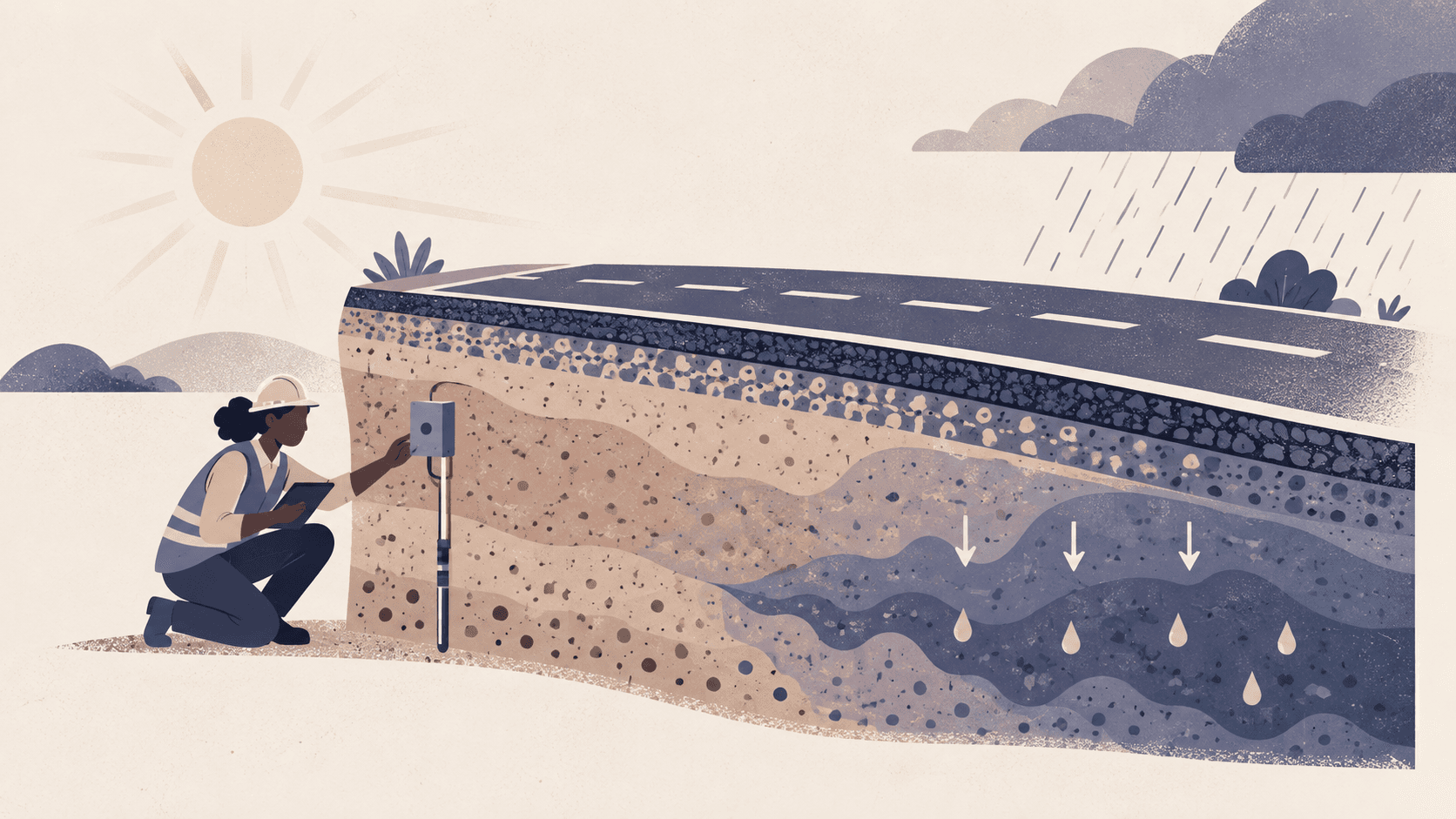
A geotechnical investigation is essentially an attempt to reduce the uncertainty below the surface. Engineers drill boreholes, collect samples, conduct tests and interpret the results to understand the conditions of a site. The information then feeds into decisions about foundations, excavation, retaining structures, tunnels and other parts of the project.
Yet because this work happens before construction visibly begins, it can sometimes be treated as an expense rather than an investment.
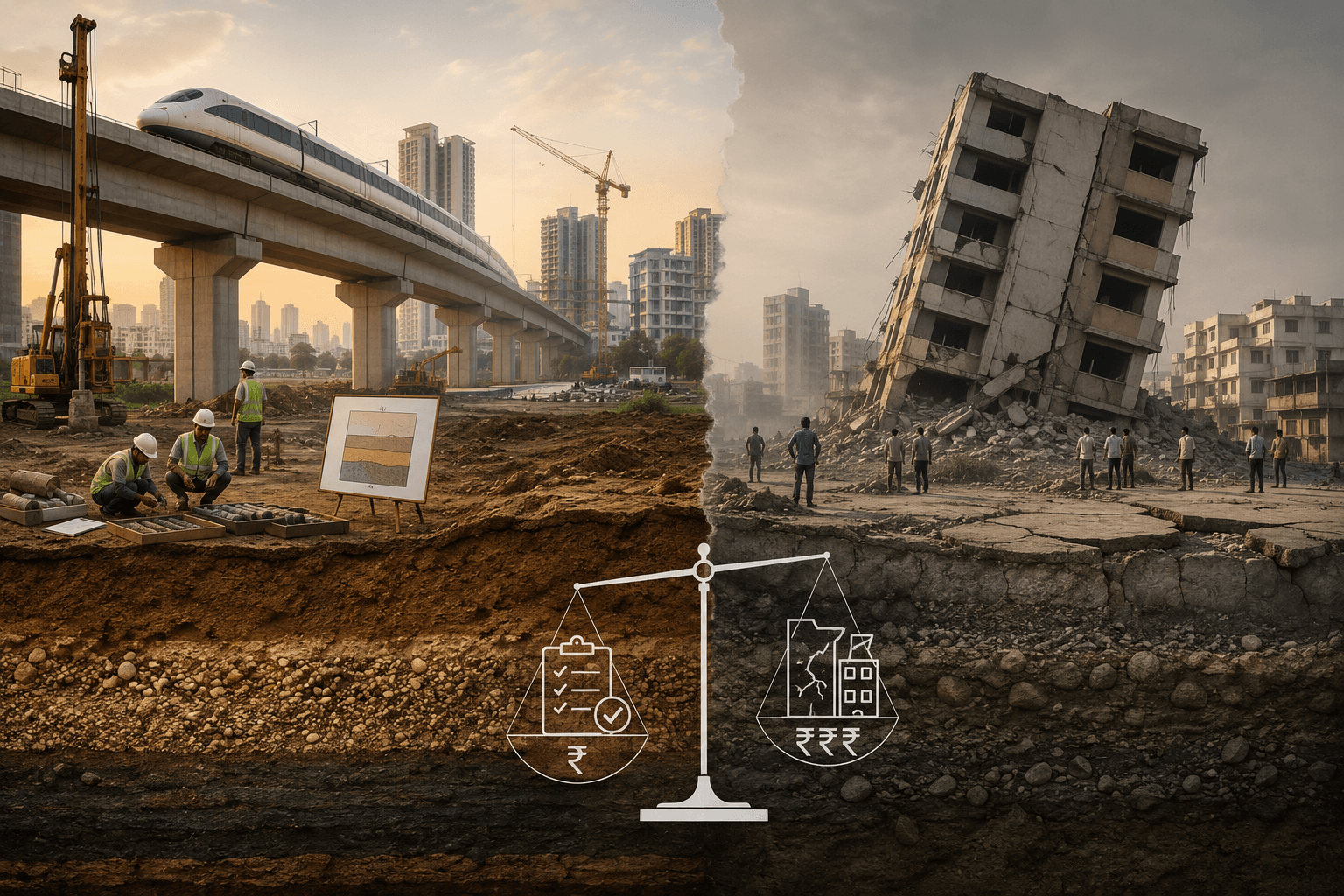
That point came up in our yet-to-be-released conversation with Deepankar Choudhury. He spoke about geotechnical investigation as something that can represent roughly 2–5% of a project's cost. For a builder or contractor looking at ways to reduce initial expenditure, that can seem like a relatively easy cost to cut.
The difficulty is that the saving is immediate, while the risk may only appear much later.
If the assumptions about the ground turn out to be wrong, the consequences can extend far beyond the original investigation. Settlement, unexpected groundwater, unsuitable soil or other unforeseen conditions can lead to redesign, additional testing, foundation strengthening, delays and significant additional costs. In the case of an earthquake, inadequate understanding of ground conditions can become a much more serious issue, particularly where phenomena such as liquefaction or differential settlement affect how a structure behaves.
There are examples in India that make this risk difficult to ignore. Following the 2001 Bhuj earthquake, researchers documented liquefaction and other ground failures that affected dams, embankments, pipelines and port facilities. One particularly striking case was the Kandla Port Customs Office tower, a 22-metre-high building supported on a piled-raft foundation. Post-earthquake investigations found that liquefaction and lateral spreading had contributed to settlement and the tilting of the building.
Mumbai provides another example of why understanding the ground matters. A study of the city used data from 238 boreholes to assess liquefaction susceptibility under different earthquake scenarios. The study identified several areas, including Borivali, Malad, Dahisar and Bhandup, where the underlying conditions could make them susceptible to liquefaction under certain levels of earthquake shaking.
These studies do not mean that a particular building in one of these areas will necessarily fail in an earthquake. What they demonstrate is something simpler: ground conditions vary, and those variations matter. Without enough information about the subsurface, it becomes much harder to understand how a structure and the ground beneath it are likely to behave.
Prof. T. G. Sitharam brought another interesting perspective to this during our conversation. He spoke about the way geotechnical investigation is approached in North America, particularly in the US and Canada, where there is a stronger emphasis on understanding and documenting subsurface conditions as part of project planning and risk management. As he explained it, there is a greater acceptance of spending money upfront to reduce uncertainty before construction begins.
There is some institutional evidence behind that distinction. The US Federal Highway Administration, for example, maintains dedicated guidance for subsurface investigation covering everything from planning and execution to quality assurance, interpretation and reporting. In other words, the investigation of the ground is treated as a structured part of transportation engineering rather than simply a preliminary exercise before construction.
That comparison stayed with me because it changes the way we look at the cost of investigation. If the investigation is seen only as an expense, then 2–5% can feel like money that can be saved at the beginning of a project. If it is seen as a way of understanding and managing risk, the same expenditure starts to look very different.
India is building infrastructure at an extraordinary pace, from metro systems and expressways to tunnels, bridges, airports and high-speed rail. As these projects become larger and more complex, the consequences of getting early assumptions wrong also become greater. I don't think the answer is simply to investigate more. Investigation has a cost and can never remove uncertainty completely. The more useful question is whether we are investing enough in understanding the ground for the level of risk involved in a particular project.
That was one of the things I found valuable about speaking with Prof. Sitharam. With his experience across geotechnical and earthquake engineering, academia, infrastructure and technical education, he brings a perspective that connects the technical side of the discipline with the larger decisions being made around infrastructure.
It also made me think about geotechnical investigation less as a report that sits at the beginning of a project and more as one of the project's fundamental sources of information. What is discovered during investigation influences design, which influences construction, cost and schedule, and ultimately the performance of the asset.
The conversation with Professor Deepankar Choudhury took this idea into the practical realities of construction. When an initial investigation is inadequate, the problem may not reveal itself until the project is already well underway, or sometimes until the structure has been completed. By then, the cost of finding and fixing the problem can be many times greater than what was saved at the beginning.
Perhaps that is why this conversation has stayed with me. As India continues to build at a remarkable pace, I think we need to pay more attention to the information that exists before construction begins. The most important decisions on a project are not always made when the building is visible or the bridge is ready to open. Some of them are made much earlier, when engineers are still trying to understand what lies beneath the site.
Our conversations with Prof. T. G. Sitharam and Professor Deepankar Choudhury explore this subject in much greater depth, from the importance of geotechnical investigation and the risks of overlooking subsurface conditions to the differences in how these investigations are approached across different parts of the world.
The episodes are not live yet, but both conversations will be coming soon on the Bridging Room Podcast. If this is a subject you work with, or simply one you've never thought much about, I think these conversations will give you plenty to think about.
Stay tuned for the episodes.