
Every June, the same headlines return. Every June, they're a little worse.
This year, the story wasn't a decades-old municipal road finally giving up. It was some of India's newest, most-publicized infrastructure — expressways inaugurated with fanfare, framed as proof that Indian road-building had entered a new league — failing within a single monsoon of opening. The Delhi-Dehradun Expressway, a roughly $1.26 billion project, developed large potholes and cracks about three months after its April launch. The Kanpur-Lucknow Expressway caved in within weeks of its own opening. The Pune-Mumbai Expressway's new missing-link stretch showed pothole-like patches after the season's first rain. On the Delhi-Mumbai Expressway, NHAI terminated a contractor outright over repeated failures to meet contract terms.
The optics were almost too on-the-nose: to manage the embarrassment, crews lined up industrial fans along a freshly built expressway to dry out waterlogged soil before repairs could even begin. That image is worth sitting with, because it's the whole story in miniature — a repair response built for the cameras, applied to a problem that was never going to be solved with fans.
This isn't a monsoon problem. It's a design and accountability problem that the monsoon exposes.
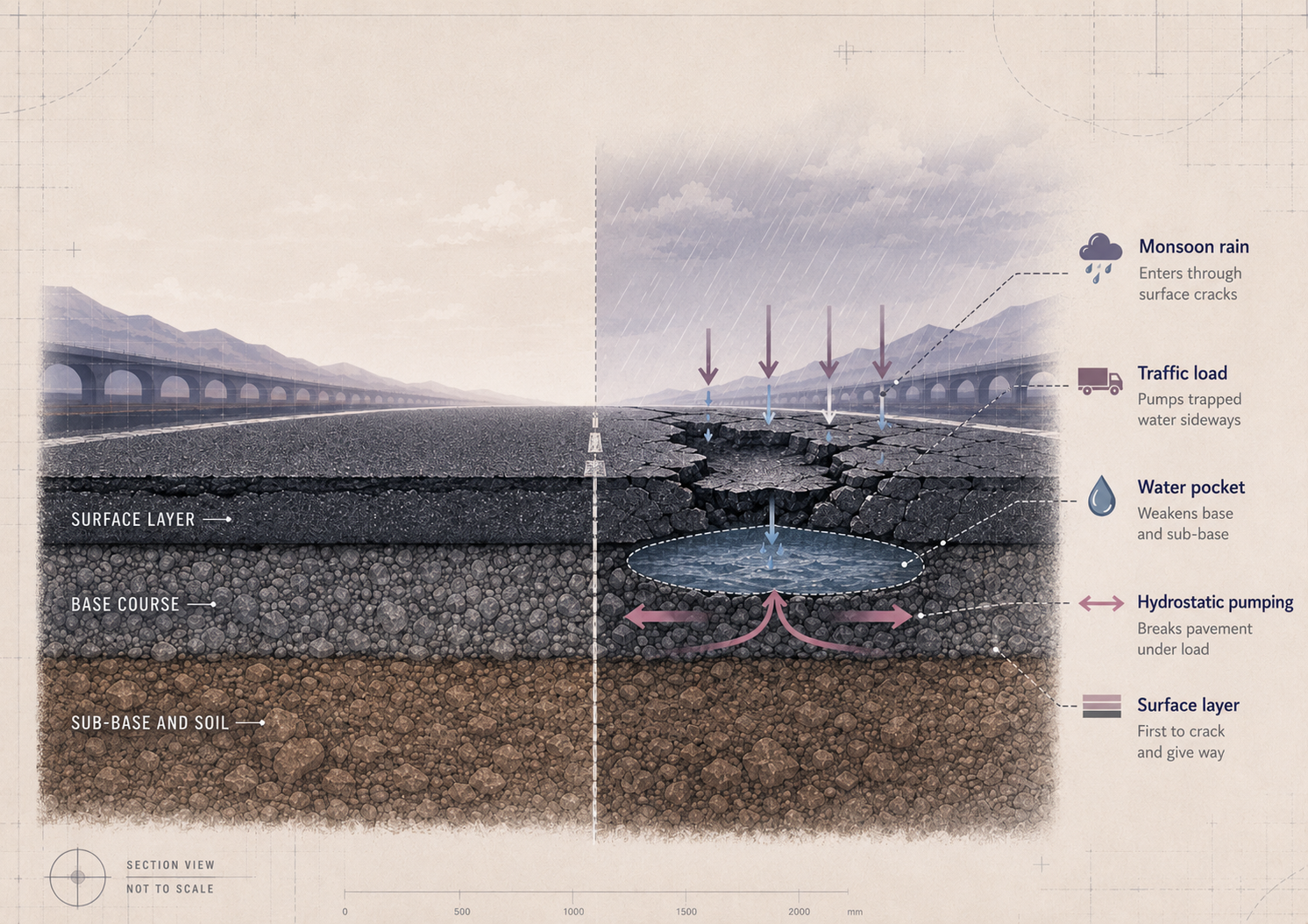
The technical mechanism is well understood and not particularly mysterious. Water gets into cracks in the pavement surface — a process engineers call stripping — and starts stripping the bond between aggregate and binder. Under traffic load, that trapped water gets pumped through the pavement structure (hydrostatic pumping), which weakens the sub-base until it can no longer bear the load above it. What starts as a hairline surface crack becomes a structural failure within days, sometimes hours, of sustained rain.
None of that is new information. What's more revealing is the repair cycle it forces: asphalt needs a dry surface to bond properly, so any patch job done mid-monsoon is close to cosmetic — a temporary fix that fails with the next downpour. The only repair window that actually holds is post-monsoon, once the ground has dried out. Which means every patch you see going in during July or August is, more often than not, a stopgap being applied for optics rather than durability — exactly what played out with the expressway fans.
The deeper issue is what these events say about the front end of the process — design, drainage planning, compaction standards, and contractor accountability at the point of construction — because none of that is supposed to fail this fast. A road engineered and compacted to spec, with functioning drainage, does not develop craters in twelve weeks. When it does, the fault line runs back through the DPR, the quality-control regime during construction, and whoever signed off on completion — not the rain.
The numbers put a scale on what looks, city by city, like isolated bad luck.
Data the Road Transport and Highways Ministry gave Parliament this year shows pothole-related road deaths rose 53% over five years, with 9,438 people killed nationwide between 2020 and 2024. Annual deaths climbed from 1,481 in 2021 to a peak of 2,385 in 2024. Uttar Pradesh alone accounted for more than 54% of the national total. Over the same period, the country recorded 23,056 pothole-related accidents and nearly 20,000 injuries, almost half of them classified as grievous.
That's roughly five deaths a day, every day, for five straight years — from a category of failure that is, in principle, entirely preventable and cheap relative to the cost of the roads themselves. Gadkari's ministry pointed to ₹7,071 crore spent on repairs and maintenance in 2025 alone. The spending curve and the fatality curve are both going up together, which is the actual finding here: this isn't a funding gap so much as an execution and accountability gap.
The jurisdictional split doesn't help. The Centre owns national highways; everything else — arterial city roads, most of the roads people actually commute on — sits with the states. That fragmentation is visible on the ground right now: in Hyderabad's Nizampet, open storm drains, unfinished drainage works, and exposed manholes have turned routine commuting into a genuine safety concern this season, with residents pushing for repairs that haven't come. In Nagpur's Sakkardara, commuters describe the same pattern repeating every single monsoon — skidding two-wheelers, blown suspensions, punctured tyres — a cycle that keeps raising questions about construction quality and where the maintenance budget is actually going, without ever quite getting answered.
What this means for anyone building or maintaining roads in India
A few things worth sitting with, if you work anywhere near this pipeline:
"Inaugurated" and "durable" have become two separate claims. A ribbon-cutting is not a quality signal anymore — several of this year's highest-profile failures were on roads less than six months old. Contract terms, defect-liability periods, and post-monsoon inspection clauses matter more than launch-day press coverage.
Repair timing is a design decision, not an emergency response. If mid-monsoon patchwork is known to fail, then a maintenance plan that only mobilizes crews when a pothole becomes visible is, by construction, a plan to fail publicly every year. The fix has to be scheduled around the drying window, not the complaint cycle.
Drainage is not a line item you can cut. Nearly every failure story here — from the expressways to Nizampet's open nalas — traces back to water that had nowhere designed to go. Drainage design is where a lot of the actual pothole problem is quietly decided, long before a single layer of asphalt goes down.
The accountability question is still open. NHAI terminating one contractor on the Delhi-Mumbai Expressway is notable precisely because it's rare. Most of the roads in the stories above will be patched, photographed, and forgotten until next June — with no clear record of who specified what, and who signed off on it.
The monsoon isn't the villain in this story. It's closer to an annual audit — one that Indian road infrastructure keeps failing, in mostly the same places, for mostly the same reasons.
Sources: The Diplomat; Telangana Today; The Hitavada (Nagpur); Press Trust of India / Rajya Sabha and Lok Sabha replies from the Ministry of Road Transport and Highways; ITPL pavement engineering analysis.