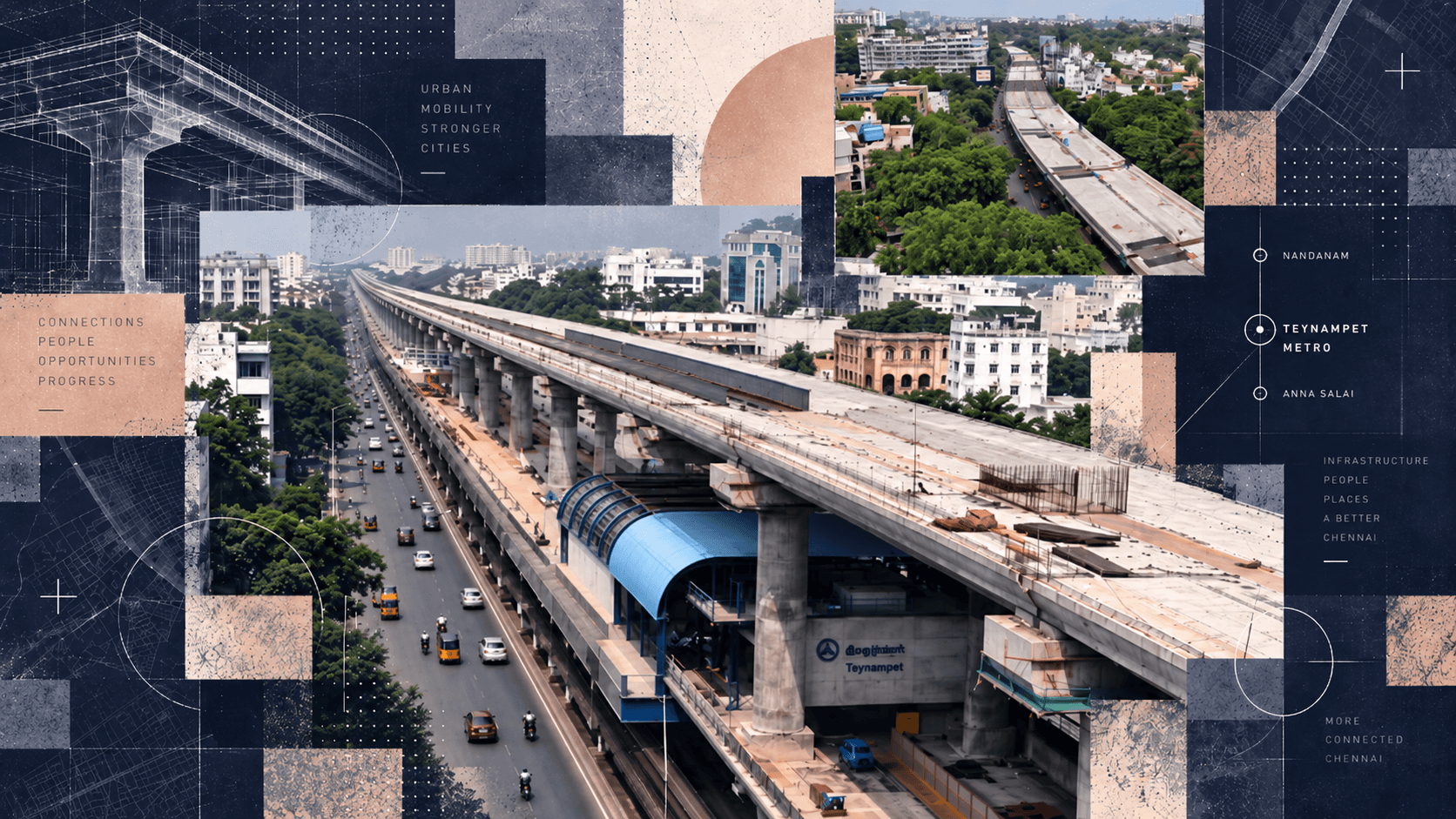
Chennai’s ₹621crore Anna Salai flyover was already well into construction when its original design ran into a problem and had to be changed . Around 88 pillars had been built and 50 spans installed before an issue with the existing Metro infrastructure at Nandanam Teynampet meant that part of the flyover had to be redesigned.
The redesign has not increased the project’s overall cost, according to officials, but it has pushed the completion target from September 2026 to February 2027 and changed how the affected section will be built. This change raises questions about how design coordination and engineering decisions made early in a project can shape what happens on the ground and the consequences when those decisions have to change later ,most importantly how such changes affect the work already completed, the work still to come and the time needed to finish it.
The 3.2 km Teynampet - Saidapet elevated corridor is being built along Anna Salai, one of Chennai’s busiest roads, to provide a faster route between Teynampet and Saidapet. But the flyover is being built around existing Metro infrastructure, with limited road width and underground utilities leaving little room for new foundations and supports. This challenge can be traced back to how the flyover was originally planned. At the Nandanam and Teynampet Metro stations, the plan was to use three columns to support the flyover, including a central pillar in the middle of Anna Salai. These supports would rest on the existing Metro station structures below, reducing the need for new foundations in an already constrained stretch. But as construction progressed, the existing Metro foundations were found to be positioned differently from what the Detailed Project Report (DPR) had assumed. With the road also narrowing to about 28 to 40 metres in some sections therefore placing central pillars would leave less space for traffic and make the original arrangement difficult to execute moreover if the central pillars were placed on the existing foundations, even small differences in their positions would have caused the flyover to move out of a straight line and become curved. The constraint therefore lies in both the flyover’s design and the challenge of fitting a new structure around infrastructure that is already in place.
Now the revised plan changes the way the flyover will be supported in this stretch. Instead of relying on the original arrangement the new design will use portal type supports, with shorter spans of about 11 metre which will allow more support to be placed along the stretch, replacing the 30 metre spans planned under the original arrangement. This will ensure the structure works within the space available while avoiding the existing Metro foundations.
The change also affects the work around each new support. Electricity, water and telecom lines around the foundation locations may need to be relocated before construction can proceed. In practical terms, the redesign means changes not only to the structure, but also to the foundations, fabrication, erection and the way construction is managed around live traffic. Moreover, on site, teams may also have to change the order of work and move resources to support the new plan .
A design change at this stage affects more than the drawings , it needs new approvals and can require changes to procurement, fabrication and components already planned under the earlier design. For a project already under construction, these changes can add time and require the contractor to rethink how labour, equipment and materials are planned. This is where a mid project design change can begin to affect the wider delivery of the project.
Officials from the Tamil Nadu State Highways Department explicitly claim that redesign will not increase the project’s overall cost. However, the unchanged contract value does not necessarily capture the wider financial effects of the delay . A longer construction period can affect the contractor’s cash flow, resource deployment and site overheads, while extended traffic disruption and delayed project completion can also defer the expected benefits of the corridor.
The delay also affects people beyond the construction site. Anna Salai is a major traffic route, so ongoing construction and traffic diversions can increase travel times for commuters and cause congestion on nearby roads. The delay also means that commuters will have to wait longer for the flyover’s expected benefits, including faster travel between Teynampet and Saidapet. The completion date has moved from September 2026 to February 2027. Therefore, while the redesign may not increase the project’s stated cost, the delay and changes in execution can still carry wider economic implications.
The question, then, is not simply why the design had to change, but why the mismatch was identified only after construction was well underway. The DPR appears to have carried assumptions about the existing Metro foundations that were not fully verified against site conditions before execution. That puts greater importance on the roles of the design team, project engineers, consultants and agencies coordinating the flyover with the existing Metro system. A more detailed site verification and constructability review before construction could have identified the mismatch earlier, when changes would have been easier to make and less disruptive to the project. This case highlights a key lesson on constructability: a design can be technically sound on paper but still face problems when it meets an existing urban infrastructure system. For brownfield projects, verified as-built information, accurate utility mapping and coordination between new and existing infrastructure are critical before construction begins.
The Anna Salai flyover offers a wider lesson for infrastructure planning: the real test of a design begins when it meets the realities of construction. A design can satisfy technical requirements and still prove difficult to deliver when it meets the realities of an existing city. The larger lesson is that good infrastructure planning must anticipate those realities early, because once construction begins, correcting an overlooked constraint becomes a project challenge in itself.
The social impact goes beyond the delayed benefits. When a major public project requires a fundamental design change only after construction is underway, it changes how citizens view the promises made by infrastructure planning. Even if the redesign carries no additional project cost, the public still bears the uncertainty of a project that takes longer to deliver. It raises a deeper question: how much confidence can citizens place in plans that have not been fully tested against reality and how effectively public money, expertise and planning are being used.
As cities become more layered with roads, Metro systems and utilities, such conflicts will become harder to avoid. The real shift must be from correcting constraints during construction to anticipating them during planning and turning infrastructure from something that simply gets completed into something delivered efficiently and with public confidence intact.