For a commuter travelling through Chennai’s western suburbs, the difference between spending an hour on a bus and reaching the destination in 25–30 minutes can change how much time remains for work, education and everyday responsibilities. Early passenger accounts following the opening of Chennai Metro’s Yellow Line suggest that the new service could make such differences to individual journeys. For the infrastructure industry, this is also what makes the project significant: the value of a transport corridor is not measured only by the infrastructure constructed, but by how effectively it connects people to the places they need to reach.
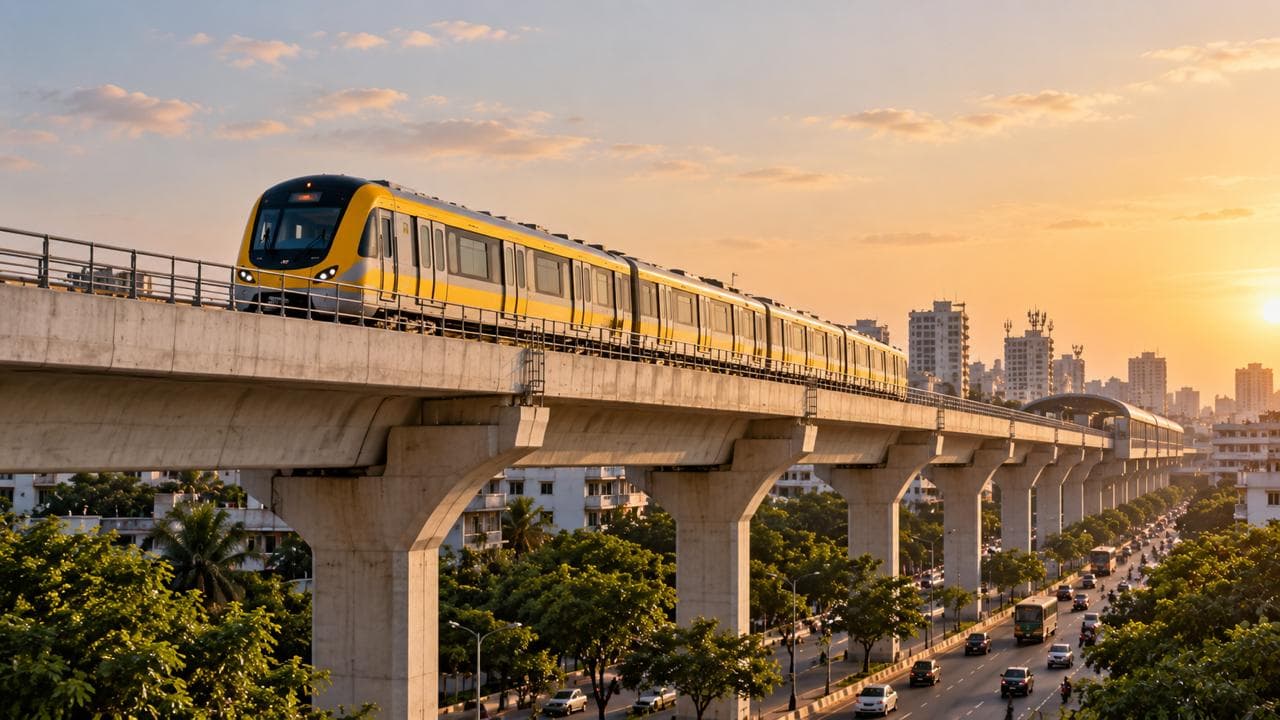
Inaugurated on 11 October 2026, the 14.64-km elevated stretch connects Poonamallee Bypass with Vadapalani through 11 stations. Built at a cost of approximately ₹4,900 crore, it includes a 3.7-km double-decker structure, making the corridor a significant addition to Chennai’s expanding urban transport infrastructure. The project was announced as part of a wider package of development projects inaugurated by Prime Minister Narendra Modi in Tamil Nadu.
From inauguration to passenger service
Commercial operations began at 4 pm on 11 October and continued until 9 pm that day. The line carried 25,474 passengers during its first five hours of service. Regular services began at 7 am the following day, with operating hours listed until 9 pm. The initial ridership indicates considerable interest in the new connection, but the inaugural day is not a reliable measure of sustained demand. Passenger numbers may differ once the novelty of the service wears off and commuters begin incorporating it into regular work, education and other journeys. Daily ridership, station-wise passenger counts and peak-hour occupancy will be necessary to establish how demand develops.
The published timetable provides a baseline for examining service availability. From Monday to Saturday, trains are scheduled at 10-minute intervals between 8 am and 11 am and between 5 pm and 8 pm. During other operating hours, the interval is 15 minutes. Sunday and public-holiday services are also scheduled at 15-minute intervals. These timings are available through the CMRL Ticketing portal . The schedule establishes when passengers can expect trains to run, but actual headways and punctuality will determine how consistently the service meets that expectation. Operating records would help establish whether trains maintain the advertised intervals and whether demand requires changes to frequency or capacity.
A double-decker structure within the urban corridor
The project’s engineering significance lies partly in its 3.7-km double-decker section. According to PIB, the corridor also incorporates advanced signalling designed to support driverless operations. The arrangement accommodates metro infrastructure at different levels within the same corridor, making the use and maintenance of the structure an important part of its long-term operation.
The distinction between technical capability and operating practice is relevant here. DT Next reported that trains would initially operate with two onboard operators, despite being designed for unattended operation. Full driverless operations were expected by mid-2027, subject to testing and safety certification. The transition therefore involves more than the installation of signalling equipment. Testing and safety certification remain part of the process before unattended operation can be introduced. The eventual operating arrangement will also need to be assessed through its performance in regular service.The double-decker design makes inspection planning, maintenance access and coordination around the road corridor relevant operational considerations.
The passenger journey beyond the train
For commuters, the significance of the Yellow Line is more immediate: whether it reduces the time and difficulty involved in travelling across Chennai’s western suburbs.
Early commuter experiences highlight the potential time savings. A Saveetha University student said a bus journey to Vadapalani that usually took more than an hour could be completed in approximately 25–30 minutes by metro. Karunakaran, a carpenter from Iyyappanthangal, reported that a journey previously taking around 45 minutes through traffic could be completed in about 20 minutes. A mason, G. Laxmanan said he would prefer the metro for a Kumananchavadi–Porur journey that took 30-45 minutes in a shared auto, compared with approximately 10 minutes by metro.
These accounts illustrate the potential value of a rail alternative on journeys affected by road traffic. They remain individual experiences, however, rather than a representative measurement of corridor-wide travel-time savings.
The same report raised concerns about crowding on three-coach trains and the monitoring of the designated enclosure for women. Passengers questioned whether the available train capacity was sufficient, while the newspaper reported that monitoring of the women’s enclosure was not consistent throughout the journey. These observations identify issues requiring attention, but further evidence would be needed to establish whether they persist during routine operations.
Access to the wider network is another part of the journey. At Vadapalani, passengers can connect to the existing Phase I metro network through a link bridge. New entry and exit facilities at Vadapalani and work on additional stations remained incomplete. The opening of the new stretch therefore provides a functioning connection to the existing network, while some surrounding infrastructure continues to be developed.
Measuring the corridor’s performance
The Yellow Line’s initial operating period presents CMRL with an opportunity to assess how the service performs beyond its inauguration. Daily ridership, train occupancy, actual headways, delays and station-level passenger flows would help establish whether the published service pattern is appropriate for demand.
Traffic and safety records would also be needed to assess whether the new service has changed road movement around the double-decker section. The infrastructure’s design alone cannot establish whether congestion has declined or how effectively road and rail operations are coordinated.
The Yellow Line has already provided commuters with a new transport option and a connection to Chennai’s existing metro network. Its longer-term significance will depend on whether that option remains reliable, accessible and capable of accommodating passenger demand. The inauguration marks the beginning of that test; sustained operating data will show how well the corridor meets it.