How much does it really cost to reach an airport when you don't own a car? For millions of passengers, airport accessibility is not just about how far a terminal is from their homes. It is also about the cost of getting there, the availability of public transport and whether those services can be relied upon when they have a flight to catch.
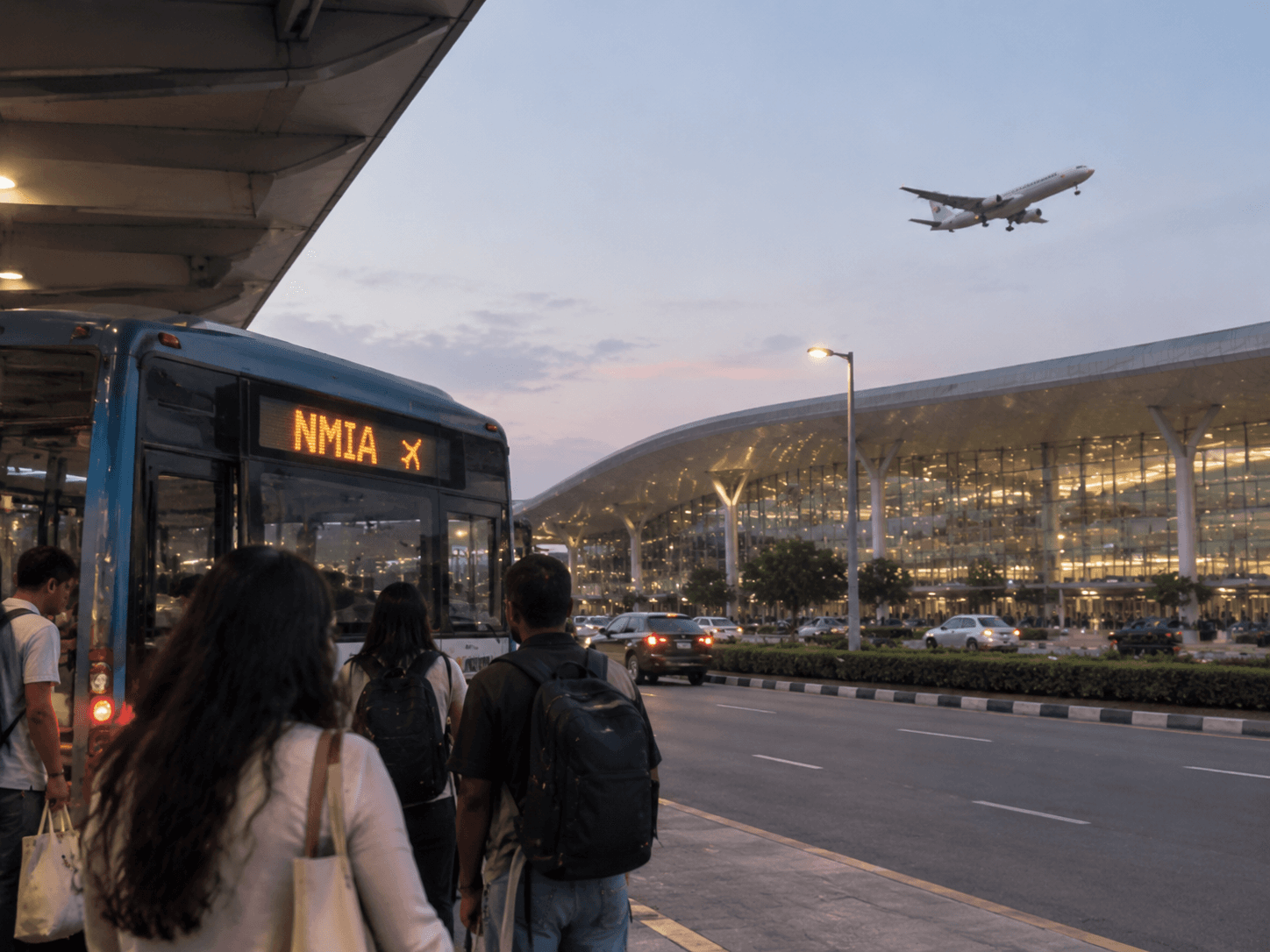
With Navi Mumbai International Airport (NMIA) expanding its public transport network, passengers now have access to several alternatives to private taxis, including state-run buses, municipal transport and app-based services. The expansion could make air travel more accessible to people across the Mumbai Metropolitan Region. But the real test is whether these services offer an affordable and dependable journey from a passenger's doorstep to the airport terminal.
Consider a passenger travelling from Dadar to NMIA. An MSRTC e-Shivai bus ticket costs ₹170, while the fare from Borivali is ₹210. These fixed fares offer a considerably cheaper alternative to private cabs. However, the ticket price tells only part of the story. Passengers may have to pay separately to reach the boarding point, wait for connecting services and account for unpredictable journey times.
What does the bus network offer?
In an October 5, 2026 mobility update, Adani Airport Holdings announced an expanded network of MSRTC, NMMT and Chalo services ahead of the winter aviation schedule, which began on October 25.
The Maharashtra State Road Transport Corporation (MSRTC) commenced its air-conditioned e-Shivai services on October 7, connecting NMIA with Dadar and Borivali, among other destinations. The Dadar route operates through Sion and Atal Setu, while the Borivali route connects the western suburbs, including Bandra and Chhatrapati Shivaji Maharaj International Airport's Terminal 1, before reaching Navi Mumbai.
The network extends beyond state-run buses. Chalo operates 21 daily services connecting NMIA with Marol in Andheri East, Bandra, Dadar and the World Trade Centre in Colaba. Meanwhile, Navi Mumbai Municipal Transport (NMMT) operates seven dedicated airport routes, A1 to A7, connecting Terminal 1 with Kharkopar, Targhar, Belapur, Nerul, Panvel, Khandeshwar and the Airport Project Office. Belapur and Nerul services are advertised at intervals of 15–20 minutes during peak hours.
These connections are important because they extend airport access to residential areas and suburban transport hubs rather than restricting it to a handful of direct intercity routes.
The hidden cost: getting to the bus stop
One of the biggest gaps in the airport's connectivity announcement is the cost of reaching the bus network itself.MSRTC's direct services are useful for passengers living close to Dadar, Borivali or designated stops along the routes. However, someone travelling from another suburb may first need to take an autorickshaw, another bus or a suburban train to reach the boarding point.
The suburban railway network offers another economical way to approach the airport. However, NMIA does not have a suburban railway station inside its terminal complex. Passengers must use nearby stations such as Targhar, Panvel or Bamandongri and complete the remaining journey by road.
NMMT's A1 route connects Kharkopar railway station to the airport, while A2 connects Targhar railway station to Terminal 1. These rail-plus-bus combinations provide additional options, but passengers must account for connecting fares, waiting times and the inconvenience of changing vehicles, particularly when carrying luggage.
Consequently, the advertised ₹170 Dadar fare is not necessarily the total amount a passenger from another part of Mumbai will spend. The actual cost depends on the starting point, distance to the boarding stop and number of transfers involved. The airport announcement does not provide a consolidated door-to-terminal fare comparison covering these additional journeys.
Affordable does not always mean reliable
The more significant concern is whether passengers can depend on these services when they have a flight to catch.
A Mid-Day field test conducted in October 2026 offers an indication of the challenges. Its reporter travelled from Dadar to NMIA in one hour and 12 minutes during a non-peak period. However, an MSRTC driver indicated that the journey could take approximately one hour and 40 minutes during peak traffic.
The Borivali journey presented a more difficult picture. The reporter boarded a bus at Sukarwadi at 3.40 pm and reached the airport at 6.30 pm, taking two hours and 50 minutes. The report also cited a conductor who said the journey could occasionally take as long as four hours. The route passes through several suburban locations before reaching the Vashi connector, making it vulnerable to congestion along multiple stretches.
Service frequency was another concern. On October 10, the reporter reportedly waited from 6.30 pm until 8.30 pm for a bus from NMIA to Dadar. For airport passengers, such uncertainty can be particularly consequential because their journeys are tied to fixed departure and arrival schedules.
The buses offer passenger-friendly features, including 45 seats and luggage compartments for check-in suitcases. However, the field report also highlighted the absence of wheelchair accessibility, an important consideration when assessing whether public transport adequately serves passengers with different mobility requirements.
These findings suggest that the challenge is not simply introducing more routes. It is ensuring that buses arrive at predictable intervals and that journey times remain sufficiently reliable for passengers travelling against flight deadlines.
What happens after dark?
Late-night connectivity is another important test. The airport announcement describes MSRTC services as operating from early morning to late night. However, the published departure timings indicate that these services do not provide round-the-clock connectivity.
Dadar services operate between 5.30 am and 9.30 pm from the city, with the last reported departure from NMIA at 11.10 pm. Borivali services begin at 6.30 am, while the last reported departure from the airport is 10.45 pm.
NMMT's published A1 schedule indicates operating hours of 6.30 am to 9.45 pm. The A2 Targhar connection is listed as operating until 10.30 pm towards the airport. These timings leave gaps for passengers arriving on late-night or early-morning flights, particularly those travelling beyond Navi Mumbai.
Chalo's airport bus information advertises services between 6 am and 10 pm. The airport has also announced a complimentary hourly shuttle between NMIA and CSMIA, operated by Cityflo, Aarya and Chalo. However, without a complete published timetable specifying the shuttle's first and last departures, passengers cannot assume that the service will be available for every flight arrival.
The Bigger question
NMIA's public transport network matters because airport accessibility is not determined by terminal capacity or runway infrastructure alone. It also depends on whether passengers can reach the airport affordably, conveniently and reliably.
The new bus services are a meaningful step towards reducing dependence on private vehicles. They provide fixed-fare alternatives, connect several parts of the MMR and create additional links with the suburban railway network. For airport employees, frequent travellers and passengers on tighter budgets, these options could make a considerable difference.
However, the early operating experience reveals a gap between connectivity on paper and connectivity in practice. Limited departure windows, unpredictable journey times, additional feeder costs and incomplete late-night coverage can make public transport difficult to rely upon, particularly for passengers with luggage or strict flight deadlines.
The real measure of affordable airport connectivity, therefore, is not how many buses an airport announces or how low its cheapest ticket is. It is how much passengers actually spend from their doorstep to the terminal, how long the journey takes and whether they can depend on the service when they need it.