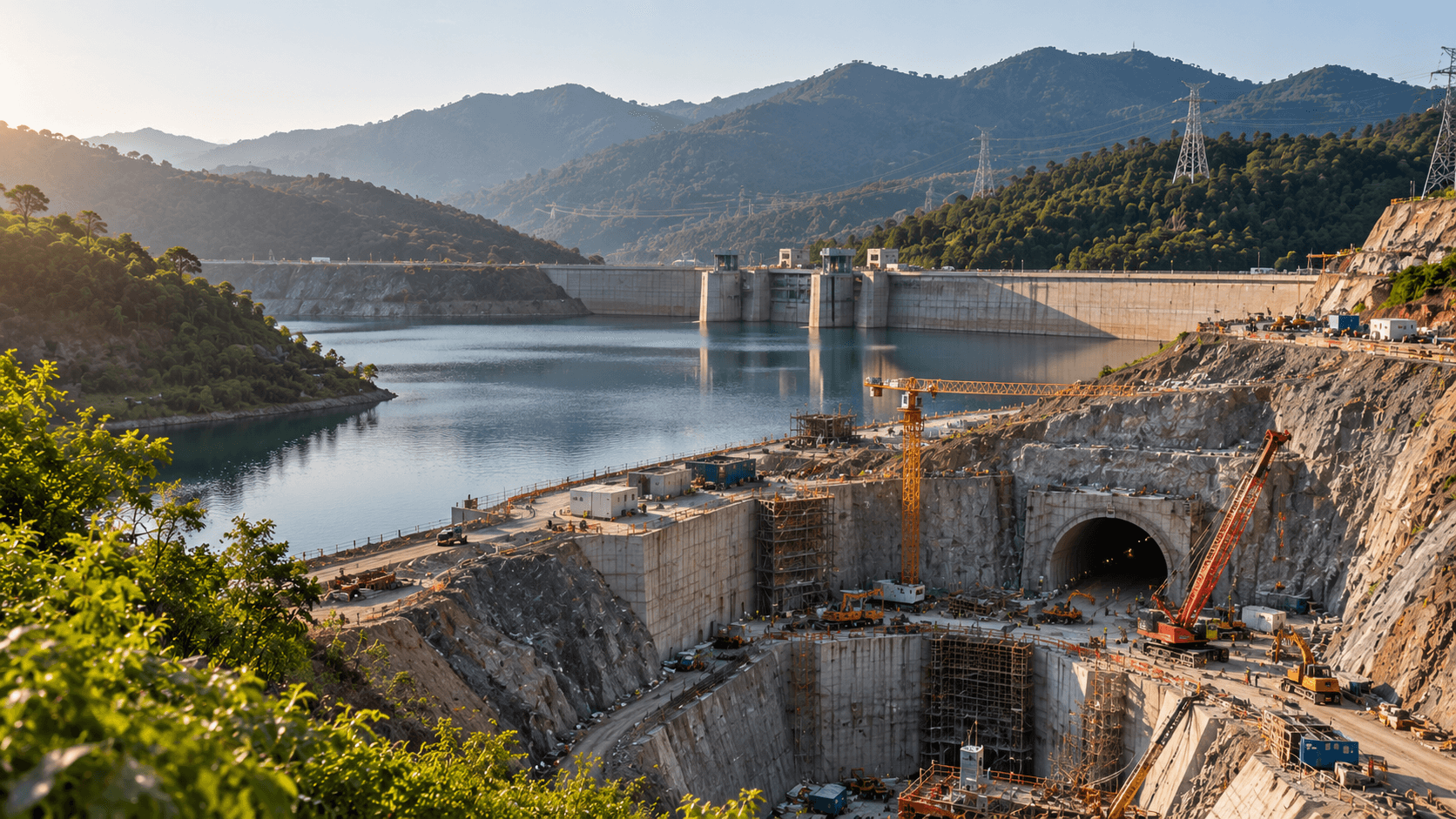
India's pumped-storage pipeline is expanding, but how much of that capacity is backed by the construction contracts, land arrangements and transmission infrastructure needed to bring it into operation? The distinction matters because a pumped-storage project requires more than an approved design or an announced investment. Reservoirs, underground excavations, water arrangements and grid connectivity must progress together if projects are to meet their commissioning schedules.
The Ministry of Power's October 19, 2026 backgrounder reports 7.43 GW of operational pumped-storage capacity as of August 2026, alongside 15.87 GW across 11 projects under construction or implementation and 10.40 GW across eight projects concurred or appraised by the Central Electricity Authority (CEA). India has also identified 345.38 GW of potential across 320 projects. These figures represent distinct development stages: identified potential and appraised capacity should not be treated as commissioned assets.
A comparison of Tata Power's 1,000 MW Bhivpuri project in Raigad district and its 1,800 MW Shirawta project in Pune district shows how procurement, approvals and enabling infrastructure shape project readiness.
Bhivpuri: from DPR approval to major civil works
Bhivpuri has progressed into construction. Tata Power's October 2024 investor presentation records CEA approval of the project's Detailed Project Report (DPR) in September 2024. The project's environmental assessment also documents its proposed engineering configuration, including underground water-conductor systems and reservoir infrastructure.
A further milestone came in March 2025, when Hindustan Construction Company (HCC) announced a ₹2,470 crore civil and hydro-mechanical contract awarded to its joint venture with Tata Projects. The scope includes the cofferdam, intake structures, headrace tunnels, penstock, surge shaft, pressure shaft, underground powerhouse, tailrace tunnel, new lower reservoir and associated access infrastructure. Tata Power's FY2025–26 annual report also records the award of major civil works and the ordering of electro-mechanical equipment.
The project uses the existing Thokarwadi reservoir as its upper reservoir and proposes a new lower reservoir. Reusing an existing reservoir reduces the need to develop two entirely new water bodies, although the new reservoir, underground excavations and associated foundations still require site-specific engineering and construction. Transmission planning provides another delivery milestone. Tata Power's July 2026 announcement identifies the 765/400 kV South Kalamb inter-state transmission system substation as Bhivpuri's connection point. The company has also announced a letter of award from SECI for supplying 324 MW under a long-term pumped-storage purchase arrangement, with commissioning targeted by 2029. These arrangements establish a commercial and grid-planning framework, while the execution programme must keep generation and transmission readiness aligned.
Shirawta: approvals and procurement shape the next stage
Shirawta's 1,800 MW scheme has a different delivery profile. The Ministry of Power's July 2026 project-status record lists its CEA concurrence date as September 1, 2025. Its environmental clearance followed on June 15, 2026. The project proposes a new upper reservoir and uses the existing Shirawta reservoir as its lower reservoir.
Procurement records offer a more specific view of its development. In a February 2026 postal-ballot notice, Tata Power described competitive bidding for multiple Shirawta packages, covering civil and structural works, hydro-mechanical equipment such as penstocks and gates, electro-mechanical works, approach roads and the main transmission package. The notice stated that final bidder selection was pending at that time. A separate tender published on October 14, 2026, covers prefabricated construction for a labour colony at Shirawta. This is an enabling-work procurement rather than an award of the main civil contract. Together, these records show why individual package milestones matter: preparatory infrastructure and the principal construction works serve different purposes and should be tracked separately.
Land arrangements are another important consideration. Shirawta's environmental -clearance documentation records a total land requirement of approximately 197.8 hectares, including 160.783 hectares of forest land and 37.014 hectares of non-forest land. The documentation records possession of the required non-forest land, while forest diversion follows a separate approval process. The project's construction sequence therefore depends on coordinating land availability and applicable permissions with the release of work packages.
Geology and transmission: the execution tests
For both projects, construction readiness ultimately depends on the relationship between the design and actual site conditions. Borehole investigations, permeability tests, rock-mass classifications and slope-stability assessments inform the design of reservoir foundations, tunnels, powerhouse caverns and access roads. Their findings influence excavation methods, groundwater control, grouting, rock support and lining requirements.
These engineering considerations also affect contractual risk. The allocation of responsibility for unforeseen ground conditions, additional excavation support, design changes and extensions of time determines how such conditions can affect project costs and schedules. Procurement progress must therefore be considered alongside the technical basis of the design.
Transmission infrastructure requires similar coordination. Bhivpuri's South Kalamb connection is identified in project disclosures and transmission-planning records, while Shirawta's February 2026 procurement notice includes a main transmission package. The relevant delivery milestones are the progress of associated substations and transmission works, package completion and alignment with the generating plant's commissioning schedule.
From pipeline capacity to deliverable infrastructure
Bhivpuri has an approved DPR, an awarded major civil and hydro-mechanical contract, electro-mechanical procurement and an identified transmission connection. Shirawta has progressed through CEA concurrence and environmental clearance, with procurement covering its principal construction and transmission packages.
The comparison demonstrates why pumped-storage development must be assessed through individual delivery milestones rather than capacity figures alone. These projects are intended to help shift electricity from periods of surplus renewable generation to periods of higher demand, supporting greater flexibility in the power system. That contribution depends on completing the reservoirs, underground works and grid connections required to operate the assets.
For infrastructure planners, contractors and asset owners, a construction-readiness audit connects the proposed commissioning date to the practical conditions needed to achieve it: executable designs, coordinated procurement, land and water arrangements, construction sequencing and transmission availability. India's identified pumped-storage potential is substantial; converting it into operating infrastructure will depend on how effectively these requirements are managed through delivery.