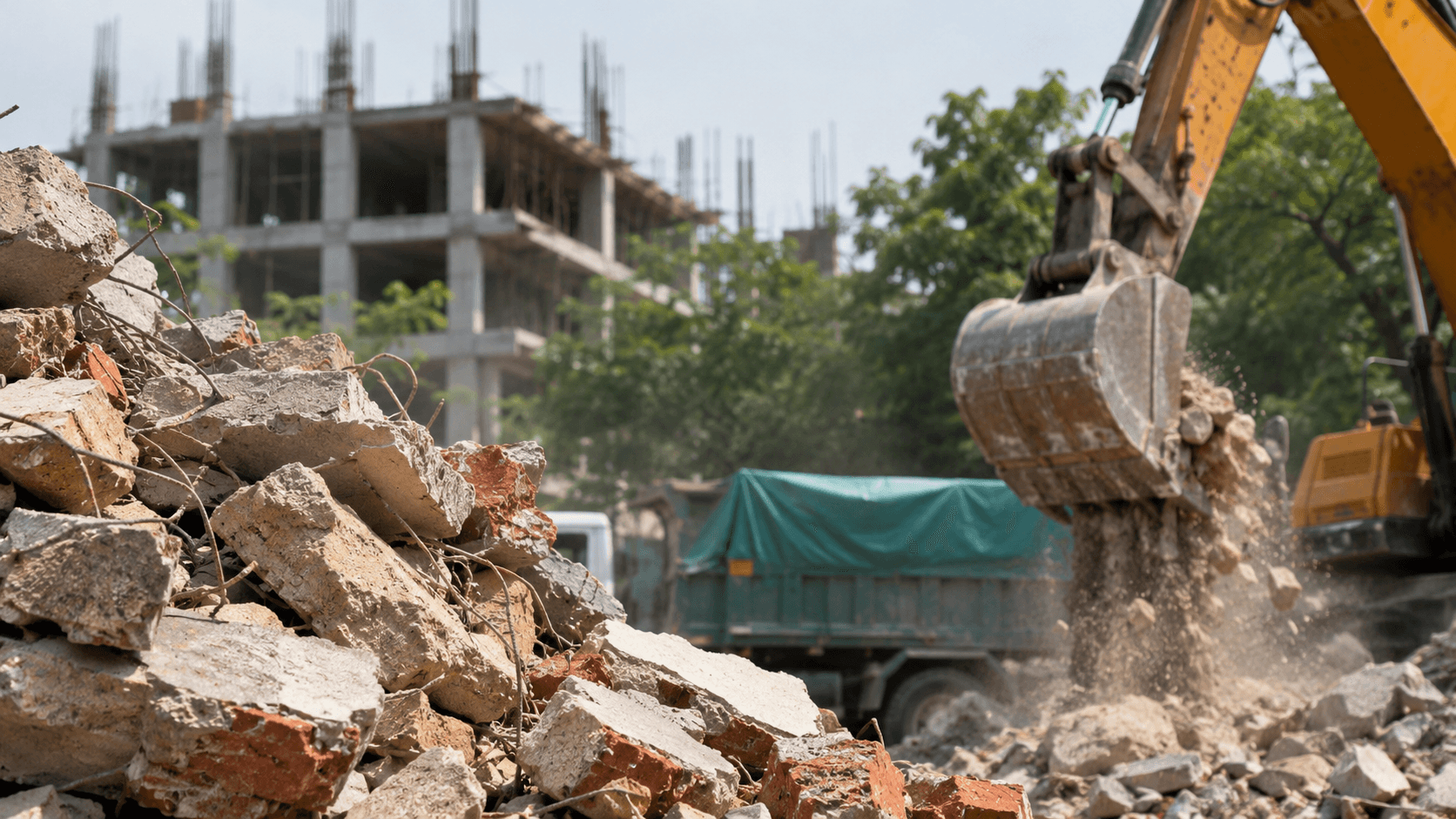
A building can disappear from a neighbourhood in a matter of weeks. What remains is often a mountain of concrete, broken bricks, plaster, tiles and metal. For residents nearby, the consequences can be immediate: dust in the air, debris on roads, blocked drains and trucks moving waste through residential areas. But once the demolition is over and the debris leaves the site, who is responsible for where it goes?
That question sits at the centre of India's revised construction and demolition (C&D) waste management framework. The Environment (Construction and Demolition) Waste Management Rules, 2025, notified by the Ministry of Environment, Forest and Climate Change through G.S.R. 219(E) on 2 April 2025, came into force on 1 April 2026. They replace the 2016 framework and introduce a more structured system of waste management, recycling obligations, digital monitoring and environmental compensation.
The significance is not limited to keeping construction sites clean. It concerns how cities manage the material generated by their redevelopment, how infrastructure projects account for their environmental footprint and whether waste can be recovered as a resource rather than dumped elsewhere.
Responsibility does not end at the construction gate
The 2025 rules distinguish between the waste generator, the producer, the contractor, the authorised agency, the recycler and the local authority.The waste generator is defined as the occupier of a project who has full control over the construction, reconstruction, demolition, renovation or remodelling activity that generates waste. The producer, meanwhile, carries the primary responsibility for environmentally sound management and disposal of the waste generated by the project, including meeting the prescribed Extended Producer Responsibility (EPR) targets.
Under Rule 9, waste generators must collect and segregate debris into separate material streams, store it appropriately and arrange for recycling, either on-site or off-site. They must transport the waste to designated collection points or intermediate storage facilities, or hand it over to an authorised agency or recycler. They are also responsible for preventing air pollution, littering and public nuisance during collection, segregation and storage.
Producers have additional obligations. These include preparing an integrated waste management plan with local authority approval, following prescribed demolition safety procedures, including IS 4130, and informing the concerned local authority before undertaking demolition. This distinction matters because outsourcing waste transportation does not automatically transfer the producer's overall responsibility. Contractors and service providers must assist with collection, transportation and coordination, but the producer remains accountable for meeting its obligations.
The local authority is not just a collection agency
The framework also places significant responsibility on municipal bodies and development authorities. They must monitor implementation, approve waste management plans, establish collection points and facilitate transportation to registered recyclers.Where a functional recycling facility is unavailable, the local authority or development authority must establish an intermediate waste storage facility, either directly or through an authorised operator. Local authorities must also incorporate mandatory compliance conditions into tenders, work orders and other project documents. State pollution control boards and committees are responsible for enforcement and can take action, including imposing environmental compensation for non-compliance. This creates a shared accountability structure. A project cannot be assessed only by whether its contractor has removed the debris. The destination, authorisation of the receiving facility and the records of handling also matter.
Following the paper trail: A Delhi Metro project
A useful example of how these responsibilities enter infrastructure procurement is Delhi Metro Rail Corporation's (DMRC) Contract D2C-08 for civil works at the Sanoth Depot on the Rithala–Kundli corridor under Phase IV.
The publicly available contract addendum contains specific provisions on C&D waste. It requires the contractor to dispose of construction and demolition waste only at an authorised or approved recycling facility. It also requires the contractor to submit a compliance report detailing the recycled C&D products used in the project alongside its monthly environmental report to DMRC.The contract further links compliance with recycled-material requirements to contractor payments, stating that DMRC may stop payments if the specified recycled materials are not used. This provides an example of how a public infrastructure agency can translate waste-management expectations into contractual obligations. It also demonstrates that accountability can be built into procurement rather than treated as an environmental requirement to be addressed after construction.
However, there is an important limitation. The publicly available contract establishes what the contractor is required to do; it does not independently establish that every waste consignment from the project has reached an authorised recycler or that the local authority has verified its disposal. The actual waste quantities, transport records, receiving-facility receipts and project-specific approvals would be needed to establish that.That distinction between a contractual commitment and verified compliance is central to assessing implementation.
From debris to a measurable resource
The rules also attempt to create a market for recycled construction material. Under the EPR framework, producers must meet recycling obligations through certificates purchased from registered recyclers. The prescribed targets increase in phases, reaching 100% of the assessed recyclable waste from the first year of generation under the schedule.
Separately, the rules introduce minimum targets for using processed C&D waste in new construction and road projects. For construction and reconstruction, the target begins at 5% in 2026–27 and rises to 25% from 2030–31 onwards. For road construction, the corresponding target begins at 5% in 2026–27 and reaches 15% from 2030–31. These targets apply to specified processed debris-derived materials, not all recoverable materials such as scrap metal, wood, plastic and glass.
The Central Pollution Control Board's online C&D waste management portal provides the digital infrastructure for this system. Producers, recyclers, intermediate storage facilities and collection points must register. Waste generation, handling, storage, recycling and the production of value-added materials are recorded, allowing authorities to cross-check material quantities. Procurement and utilisation of processed waste must also be reported through the portal.
This is important for infrastructure development. Recycled aggregates, concrete products, blocks and other processed materials can potentially reduce dependence on virgin construction materials. But their use must meet applicable technical specifications and quality requirements. Recycling cannot come at the expense of structural safety.
The implementation gap is the real test
The rules establish responsibilities, but their effectiveness will depend on whether local authorities have sufficient collection points, storage facilities, processing capacity and monitoring systems.Delhi-NCR offers an indication of the problem. On 20 February 2026, the Commission for Air Quality Management issued Statutory Direction No. 97, highlighting continuing gaps in the handling and transportation of construction material and demolition debris. It directed municipal corporations and development authorities to establish at least one C&D waste collection point within every 5 km × 5 km grid under their jurisdiction.
For projects involving demolition on plots of 200 square metres or more, the direction also requires an estimated waste declaration before building-plan approval, a receipt confirming deposition of demolition waste before reconstruction and verification of that receipt before the completion or occupation certificate is issued. The directions took effect on 1 April 2026. These requirements introduce a more tangible compliance test: the project must be able to demonstrate where its debris went, rather than simply declare that it was disposed of responsibly.
For residents, this can mean fewer instances of debris being abandoned in public spaces and better control over dust and transportation. For infrastructure developers, it means accounting for waste management in project planning, procurement, contractor supervision and environmental reporting. For recyclers, it creates a formal role in a system that increasingly treats construction debris as a recoverable resource.
Ultimately, the question is not simply who clears a demolition site. It is whether responsibility can be traced through every stage, from the generation and segregation of waste to its transportation, processing and eventual reuse. The 2025 rules provide that accountability framework. Their first year of implementation will show whether the documentation, infrastructure and enforcement needed to make it work are actually in place.