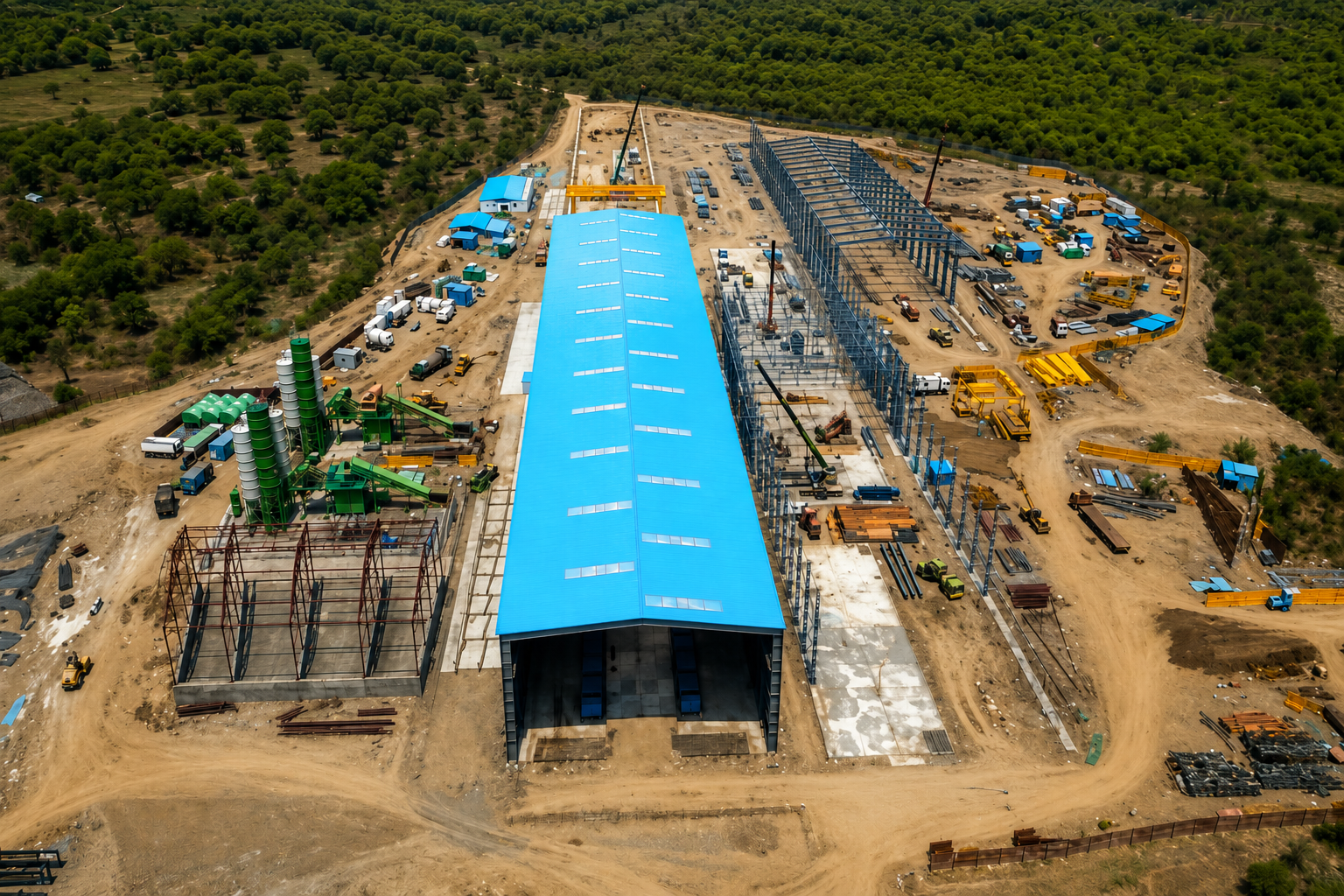
About 118 kilometres north of Mumbai, in Palghar district, the village of Sakhare looks very different from the cities the Mumbai-Ahmedabad High Speed Rail project is intended to connect. The houses are modest, the surrounding landscape is rural, and the Sahyadri hills sit beyond the construction corridor. Yet this is now one of the important production centres for India's first high-speed rail line.
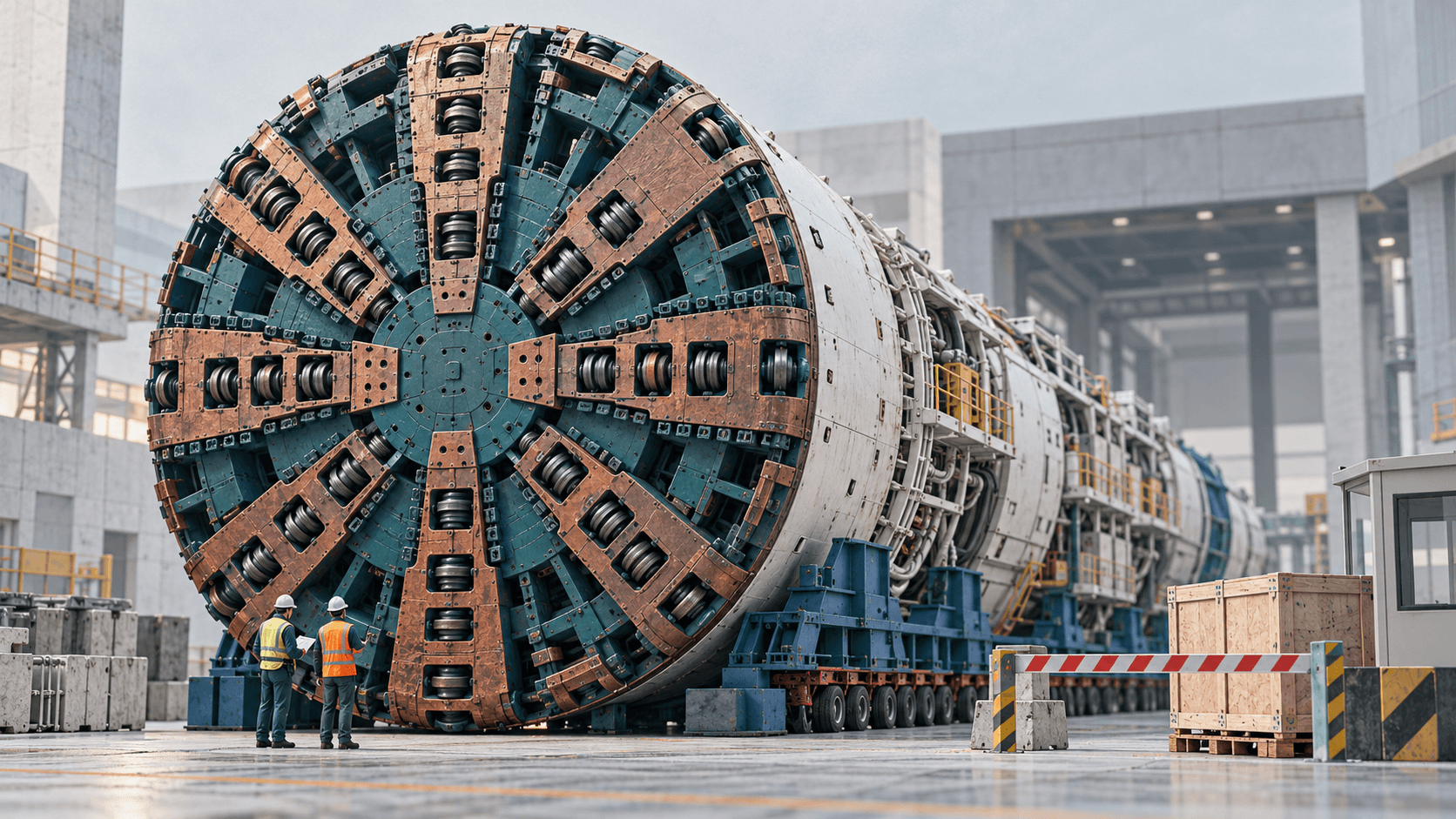
Spread across about 50 acres, the Sakhare casting yard manufactures the massive concrete girders that will form much of the elevated railway through Maharashtra. The machinery operating here is among the largest ever deployed for Indian railway construction. A straddle carrier weighing about 380 tonnes moves on 80 tyres while lifting a girder weighing close to 1,000 tonnes. Bridge gantries weighing roughly 350 tonnes position those girders, while another transporter, weighing about 380 tonnes and running on 216 tyres, carries them along the viaduct alignment.
The scale is striking, but the more important story is what the site says about how India is learning to build very large infrastructure projects.
The Mumbai-Ahmedabad High Speed Rail corridor is 508 kilometres long, with 12 stations between Mumbai and Sabarmati. It is designed for an operating speed of 320 km/h, and the sanctioned project cost is ₹1.08 lakh crore. The project passes through Maharashtra, Gujarat and the Union Territory of Dadra and Nagar Haveli. As of March 2026, the entire 1,389.5 hectares required for the project had been acquired, all statutory clearances had been obtained and 1,651 identified utilities had been shifted.
Those numbers describe the size of the project. Sakhare explains how something of that size is actually built.
The railway is being manufactured before it is assembled
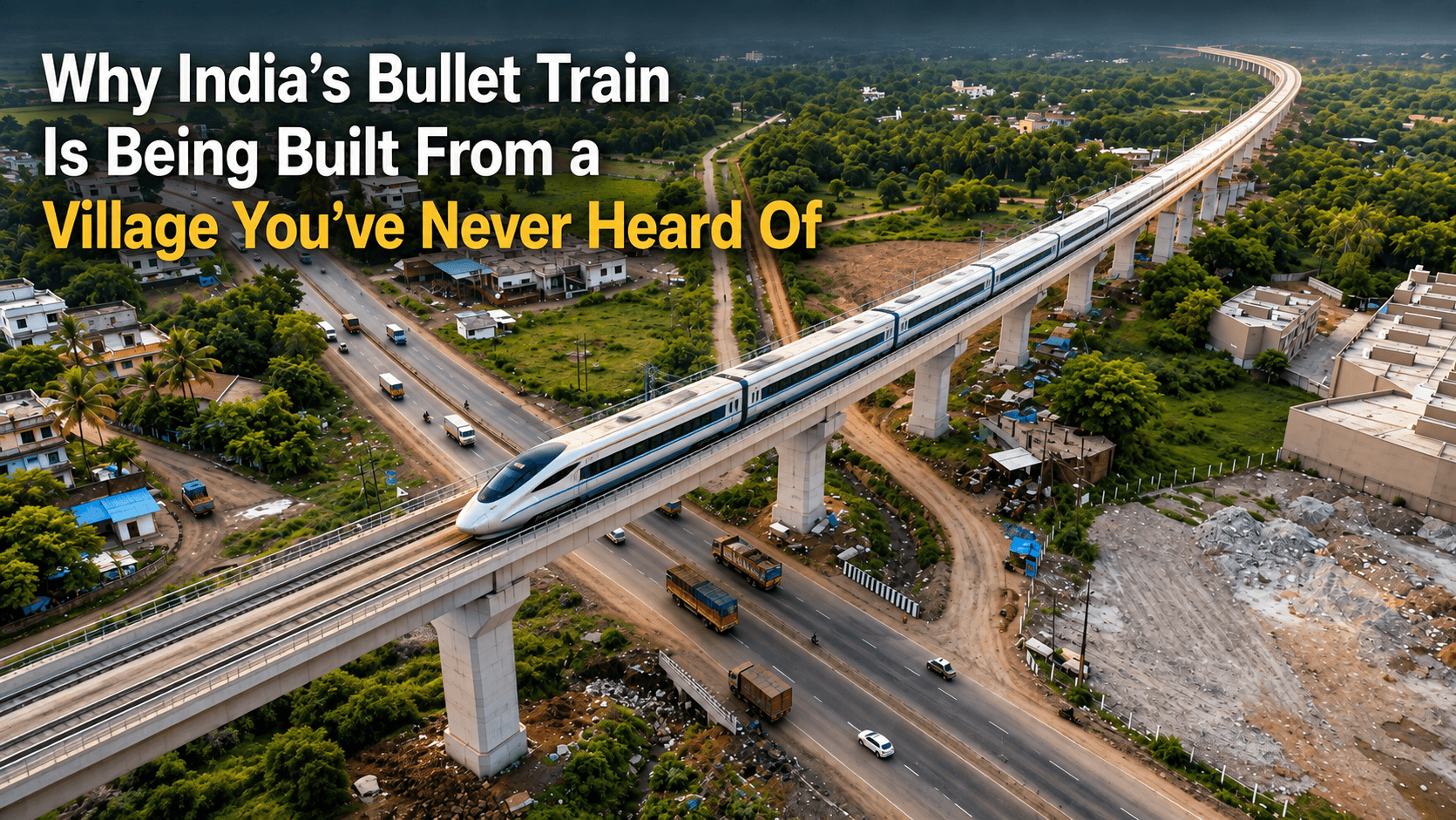
The Maharashtra section of the corridor is 156 kilometres long. Of this, 135 kilometres runs on an elevated alignment between Shilphata and Zaroli on the Maharashtra-Gujarat border. Around 124 kilometres of that section consists of viaducts and bridges. The project also includes three stations in Maharashtra, seven mountain tunnels covering about six kilometres, steel bridges and special earth structures.
The elevated railway is not being constructed entirely by assembling small components directly over the final alignment. A large proportion of it is being produced in advance.
The clearest example is the full-span pre-stressed concrete box girder. Each girder is 40 metres long and weighs approximately 970 metric tonnes. It is cast as a single unit, without construction joints, using about 390 cubic metres of concrete and 42 tonnes of steel. For the Maharashtra section, 2,575 such full-span girders are planned along 103 kilometres of viaduct.
That is an important shift in construction logic.
The project is effectively separating production from installation. A casting yard becomes a factory. Reinforcement is fabricated and assembled there, concrete is produced and placed there, the girder is cured and stored there, and only after it has passed the required checks is it transported to the viaduct for installation.
This approach allows work on the substructure and superstructure to proceed in parallel. While piles, pile caps, piers and pier caps are being constructed along the alignment, girders can be manufactured elsewhere and accumulated in casting yards. Once the supports are ready, the completed spans can be moved into place.
NHSRCL says the full-span method can enable construction progress up to ten times faster than conventional segmental techniques. That figure should be understood as a comparison of construction methods, not as a claim that the entire railway can be built ten times faster. The advantage comes from shifting repetitive work into a controlled production environment and reducing the number of individual pieces that need to be assembled at height.
For a project extending over hundreds of kilometres, that distinction matters.
The challenge is no longer simply how to design a viaduct. It is how to create a system that can manufacture, inspect, transport and install thousands of near-identical structural elements at a predictable rate.
That is closer to industrial production than conventional site construction.
Sakhare is a factory inside a megaproject
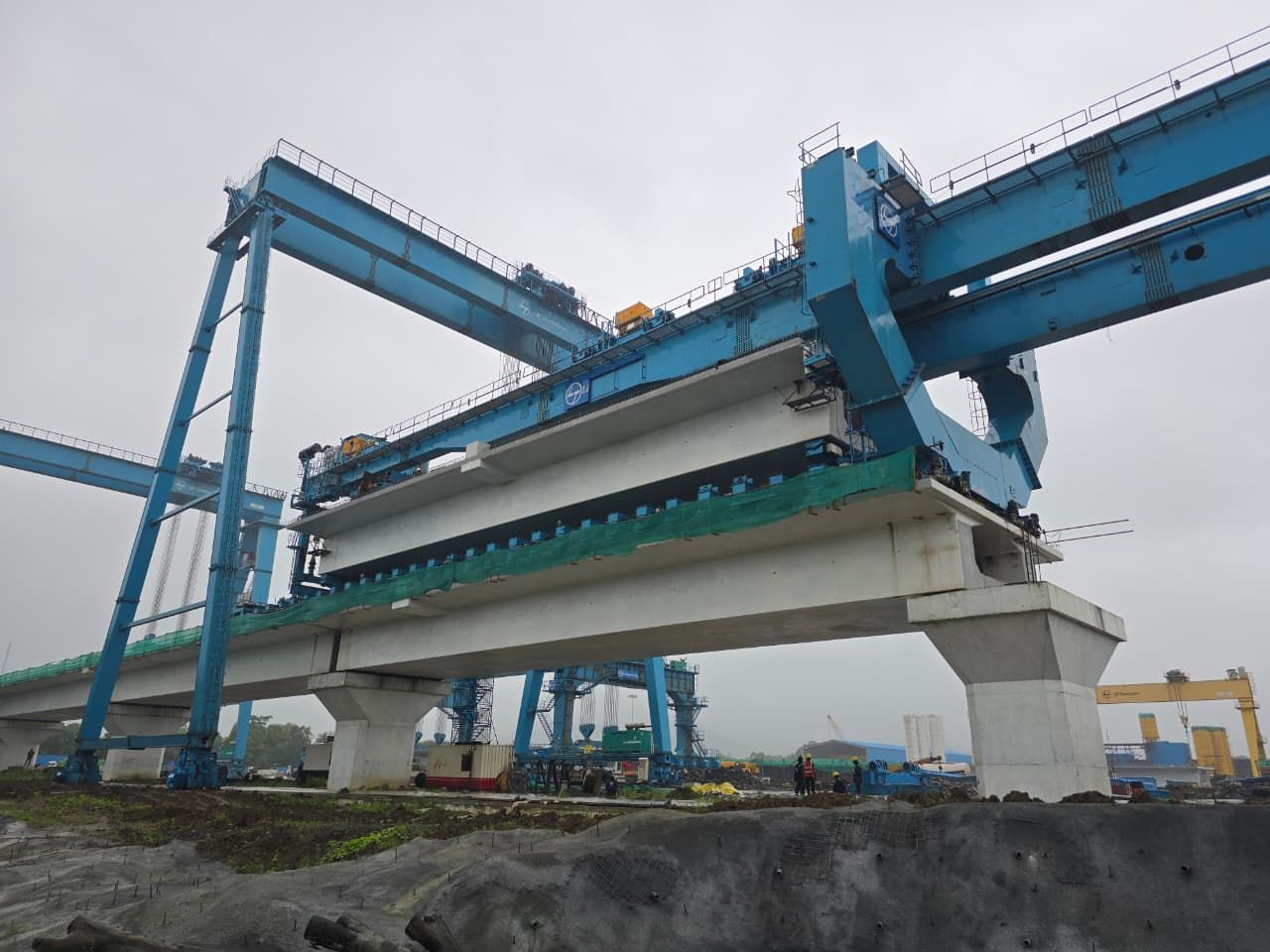
The scale of the machinery at Sakhare makes the production model easier to understand.
Indian Express reported that the casting yard operates with a 380-tonne straddle carrier supported on 80 tyres, which is used to lift a girder weighing roughly 1,000 tonnes. Two bridge gantries, each around 40 metres high and weighing approximately 350 tonnes, operate within the yard. A separate girder transporter, weighing about 380 tonnes and using 216 tyres, carries a completed girder along the elevated section towards the launching location.
Once the girder reaches the relevant location, another launching gantry positions it between two completed piers. Indian Express reported that the installation of one such girder at the site involved around four hours of controlled activity. The significance of that process is not the individual operation. It is the fact that the operation has been designed to become repeatable.
The first full-span girder in the Maharashtra section was launched at Sakhare in June 2025. NHSRCL subsequently reported that the first girder had been launched using a full-span launching gantry on 6 September 2025, marking the beginning of the full-span launching programme in Maharashtra.
This is a useful distinction for anyone managing a construction project.
Large projects rarely become faster simply because workers work harder. They become faster when the method of production changes.
A project can improve productivity by reducing the number of components, moving repetitive work into a controlled environment, standardising processes, investing in specialised machinery and creating a reliable flow of materials between production and installation.
The MAHSR project is applying all five.
The casting yard is therefore not a temporary support facility sitting beside the "real" project. It is part of the project's core production system.
The most difficult part of a megaproject can happen before construction
The image most people have of the bullet train project is a concrete viaduct rising through Gujarat and Maharashtra. But for several years, one of the project's biggest constraints was nowhere near the construction site.
It was land.
The MAHSR corridor requires 1,389.5 hectares. According to the Ministry of Railways, land acquisition in Maharashtra was a significant source of delay until 2021, after which the process accelerated. By February 2026, the government reported that the entire land requirement had been acquired and all 1,651 identified utilities had been shifted.
This is more than a project administration detail.
Land acquisition determines where foundations can be built. Utility relocation determines whether access roads and structures can proceed. Clearances determine whether work can start. Contracts determine who is responsible for each package. Design approvals determine what can actually be constructed.
The construction programme can therefore be constrained long before the first column is cast.
The Maharashtra corridor passes through 95 villages and towns between Shilphata and the Gujarat border. The project is being inserted into an existing landscape rather than a blank construction zone, which makes land, access and stakeholder coordination part of the engineering problem itself.
This is one reason large infrastructure projects are difficult to compare with ordinary building projects.
In a conventional building, the client may control most of the site. A linear infrastructure project can pass through hundreds of properties, existing roads, utility corridors, rivers, railways and communities. The construction team has to coordinate all of them while maintaining continuity over a route hundreds of kilometres long.
The schedule is therefore not controlled only by the contractor.
It is controlled by the interfaces between institutions, landowners, consultants, authorities, utilities, suppliers and construction teams.
The village sees the project differently from Mumbai
For a passenger in Mumbai, the project is primarily a transport investment.
For a resident of Sakhare, it is a physical structure that has arrived in the landscape.
Indian Express reported from the village in 2026 that the viaduct now stands alongside homes and that the casting yard has introduced a large-scale industrial operation into an area that was previously rural. The newspaper also spoke to residents who could see the infrastructure from their homes without necessarily expecting to use the train themselves.
That difference in perspective matters because infrastructure creates different categories of value for different people.
For the passenger, the benefit is faster travel.
For the state, it is a new transport network and a demonstration of high-speed rail capability.
For the engineering industry, it is an opportunity to develop experience with systems that India has not previously built at this scale.
For a village along the alignment, the immediate experience may be construction activity, altered access, land acquisition, heavy vehicles and a permanent structure in the landscape.
None of these perspectives cancels the others.
A serious infrastructure project has to account for all of them.
This is particularly relevant to construction management because the technical design of a project is only one part of the problem. Projects of this scale also require the management of people, access, contracts, utilities, environmental requirements and public expectations.
The viaduct is the physical output. The coordination system behind it is the project.
The railway changes engineering method as the terrain changes
The Mumbai-Ahmedabad corridor is often discussed as though it were one continuous piece of elevated railway.
It is not.
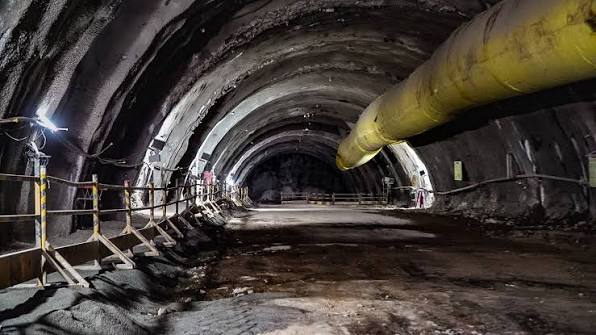
The Maharashtra section alone contains viaducts, steel bridges, river crossings, mountain tunnels, stations and an underground section in Mumbai. The full project includes a 21-kilometre tunnel between Bandra Kurla Complex and Shilphata, along with seven mountain tunnels in the Maharashtra portion.
This creates a major coordination challenge.
The same project has to accommodate different construction systems in response to different physical conditions.
A standard viaduct span can be industrialised.
A river crossing requires a different structural system.
A mountain tunnel depends on geological investigation, excavation and ground support.
The BKC section requires underground construction in a dense urban environment.
The project therefore illustrates an important principle of infrastructure engineering: standardisation is powerful, but standardisation does not mean that every part of the route can be built in exactly the same way.
The project needs a common set of engineering standards and interfaces while allowing specific construction methods to respond to the conditions of each location.
The government's own descriptions of the project emphasise the importance of geotechnical investigation and the use of common engineering standards for components such as piers, viaducts, tracks, station structures, electrification and signalling, while foundations are designed according to local soil conditions.
That is a useful model for future infrastructure projects.
Standardise what can be standardised.
Adapt what cannot.
Japan is supplying more than trains and technology
The Mumbai-Ahmedabad project is being developed with Japanese technical and financial assistance. JICA's records show multiple yen-denominated ODA loans for the project, while the Indian government describes the corridor as being executed with technical and financial assistance from Japan.
But the most interesting transfer may not be visible when the train begins operating.
It is the knowledge being accumulated during construction.
The project uses the Japanese Shinkansen-based ballastless J-Slab track system. NHSRCL has established a specialised training facility at Surat, with courses covering areas including track slab manufacturing, reinforced concrete track-bed construction, track slab installation, rail welding and turnout installation. Nearly 1,000 engineers, work leaders and technicians are planned to be trained, with Japanese experts involved in training and certification.
The project has also accelerated the domestic manufacture of specialised construction machinery.
NHSRCL says the heavy machinery used for full-span girder installation, including straddle carriers, launching gantries and girder transporters, has been designed and manufactured in India. The Ministry of Railways has described the indigenisation of heavy construction machinery and specialised track equipment as one of the outcomes of the project.
This is where the project becomes strategically significant beyond the Mumbai-Ahmedabad corridor.
India is not simply buying a completed railway technology package.
It is building experience in designing, procuring, manufacturing, installing and maintaining the systems required for high-speed rail.
NHSRCL itself describes the project as a foundation for a domestic high-speed rail ecosystem, covering areas such as viaduct construction, tunnelling, bridge launching, ballastless track, signalling, power systems and specialised training.
That capability can compound.
Engineers trained on one corridor can work on another. Contractors familiar with high-speed tolerances can bid for future projects. Equipment manufacturers can refine their products. Design standards can be reused. Procurement systems can become more efficient.
A first project creates a reference. A reference creates a repeatable method.
The real management challenge is not speed. It is repetition.
A 320 km/h train gets most of the attention because speed is easy to understand.
Construction speed is a different concept.
What matters at Sakhare is not whether one girder can be launched quickly. It is whether the system can produce, inspect, transport and install the next girder, and the one after that, with consistent quality.
The Maharashtra section is planned to use 2,575 full-span girders across 103 kilometres of viaduct. That means the project needs a level of repeatability that is unusual even among large infrastructure projects.
If one casting cycle is delayed, the effect can propagate through transport and erection. If the storage yard fills up, production may have to slow down. If the workfront is not ready, completed girders may have nowhere to go. If a launching machine is unavailable, the installation sequence is disrupted.
The project therefore needs a carefully managed flow between production and installation.
This is where construction management becomes more than the administration of individual sites.
The project manager is effectively managing a manufacturing and logistics network whose final product is a railway.
That lesson applies well beyond high-speed rail.
Whether the asset is a bridge, airport, metro system, hospital or industrial facility, the question is increasingly becoming: how can construction be converted from a collection of site activities into a predictable production process?
Sakhare offers one answer.
Move repetitive work into a controlled environment. Standardise components. Invest in specialised equipment. Run multiple activities in parallel. Treat logistics as part of construction rather than as a separate function.
What India gets from the project may extend beyond the railway
The first section of the high-speed rail corridor is currently expected to begin service in August 2027, with the Surat to Vapi section planned as the first portion to open. The complete 508-kilometre project is still under construction, and final completion depends on the remaining civil, track, electrical, signalling, telecommunications and rolling stock works.
When the first passenger train eventually operates, the public will mostly see the finished system.
The engineering industry will have to remember what happened before that moment.
It will remember how a casting yard was established in a rural village. How 970-tonne girders were manufactured as single units. How specialised machines were designed to move them. How land was acquired and utilities were relocated across a corridor shared with existing communities. How Indian engineers were trained in high-speed rail systems developed in Japan. How construction methods were adjusted for tunnels, bridges, viaducts and urban sections.
Those are not supporting details to the railway.
They are the project.
The significance of Sakhare is therefore not that a giant machine happens to be operating in a small village.
It is that the village has become part of an industrial system designed to make 508 kilometres of high-speed railway possible.
The bullet train will eventually be judged by passengers on travel time, reliability, comfort and safety. Construction professionals should judge it by another set of questions.
Did India develop repeatable construction methods?
Did local companies learn to manufacture specialised equipment?
Did engineers acquire high-speed rail expertise that can be used again?
Did the project create standards that reduce the cost and duration of future corridors?
And perhaps most importantly, did the country learn how to manage infrastructure at this scale more effectively than it did before?
That is the longer story being built in Sakhare.
The train is what passengers will see.
The construction system is what the industry should be watching.
Continue reading with Bridging Room
Bridging Room examines the engineering, construction and management systems behind the projects changing India's built environment.
For more interesting stories of major infrastructure projects, construction technology and the business of building, explore the latest stories from Brenman Consulting.