Over the years, my discussions with promoters and business leaders on project management, team building and project delivery have had one persistent question coming up again and again:
Do we hire a PMC (Project Management Company) or build our own team?
What is intriguing is that while we have developed and delivered so many complex projects with PMCs and some with in-house teams, the question still does not have a clear answer. The owners are still not convinced.
When I am asked this question now, I always start by asking about the objectives.
Why objectives? Let me explain.
The biggest advantage of hiring a PMC for a project is the ability to not carry a large team permanently and have the flexibility to scale the team up or down as per project demand.
Complex projects need a team that builds up over the years, peaks somewhere around the middle of the project and then gradually tapers off. Something like a manpower deployment bell curve.
For a developer that does not have a large pipeline of projects, hiring the required talent can become a challenge. Experienced candidates may see it as a long-term tenure risk, with no clarity on retention or personal development beyond the project.
This becomes an impediment to building an experienced team.
From the HR point of view, building a team and then downsizing it as the project nears completion is also a big challenge. Not exactly the most popular HR activity!
In such cases, it is a no-brainer to hire a PMC. A good PMC has a pipeline of resources and can ramp up as and when required by mobilising people from various other projects. It can also demobilise them by moving them to another project when the project no longer needs them.
On the other hand, if the developer has a pipeline of projects, or if the project duration is very large. i.e a large mixed-use or infrastructure development spanning five years or more; it may make more sense to develop the project team in-house.
Specialised consulting such as cost management, audit and quality can still be outsourced.
The advantage of outsourcing these functions is that specialist firms come with robust practices, systems, training and the wealth of experience gained from working across multiple projects. This translates into better technical and cost inputs, while also bringing best practices and learnings from comparable projects.
There may, of course, be other reasons for considering a PMC.
A project may be funded with a precondition to use an international PMC that the investors are comfortable with. Or a promoter may want to align themselves with recognised firms and best practices to raise funds and gain credibility in the market.
But these are only strategic reasons to look at the PMC model. Not what happens later.
And this is where the conversation gets interesting.
There is still a significant amount of mistrust around PMCs that comes up repeatedly in discussions with client teams.
One of the biggest pain points is PMC teams working to indemnify themselves from scenarios rather than taking the lead from the front.
It becomes:
“It was the Client’s decision.”
“The contractor delayed it.”
“We had already flagged the risk.”
When a PMC becomes an expert in scouting for reasons rather than solving problems, it may look good on the risk matrix, but it does not necessarily help the project.
In so many management meetings I have been part of, I have seen the Client expecting leadership from the PMC, while the PMC believes its primary responsibility is to flag the risk in time.

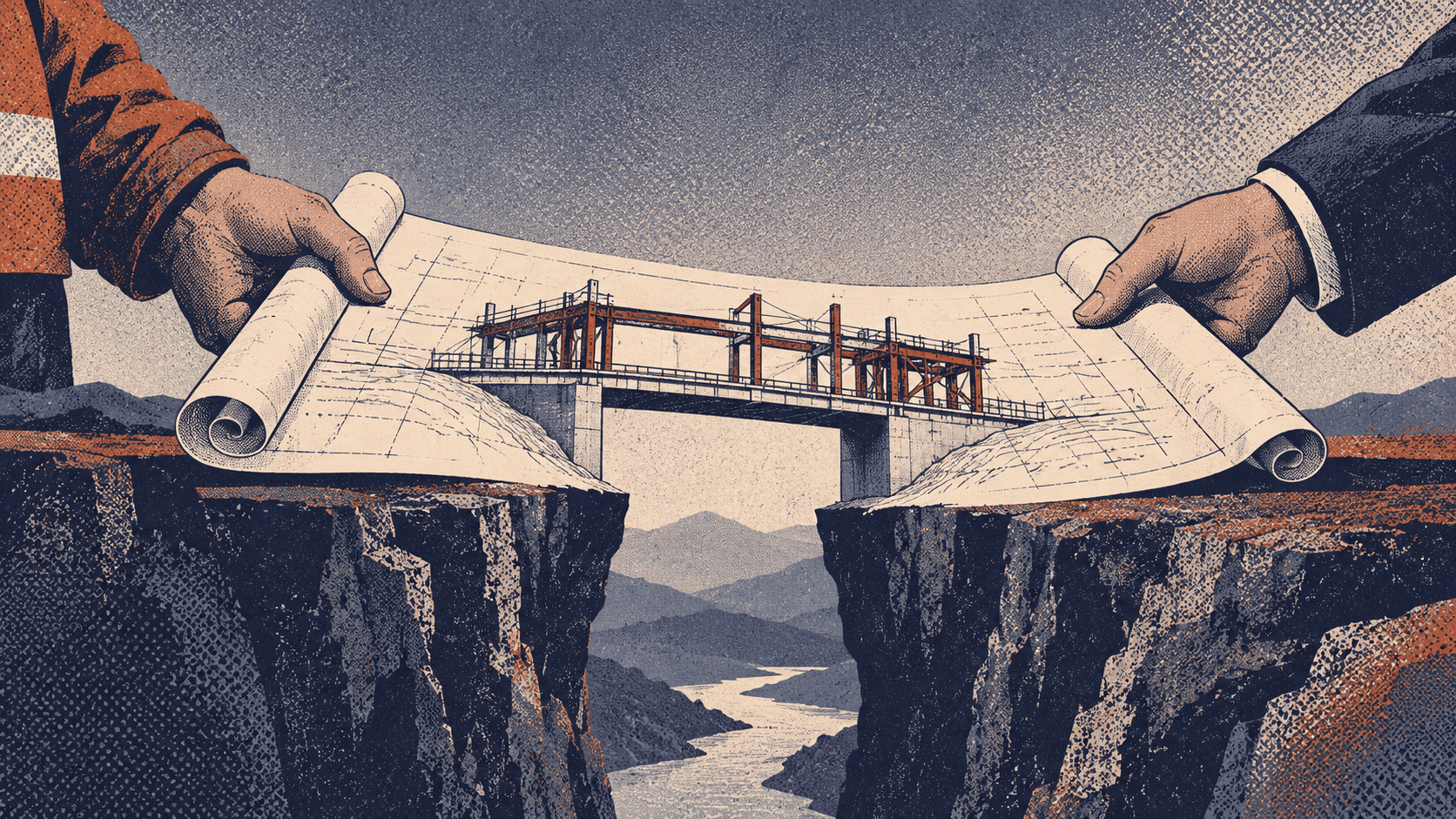
So why does this gap persist, and how can it be filled?
1. Not having a robust and clear Responsibility Matrix from the start
It is extremely important for the Client to establish a clear Responsibility Matrix, with roles and responsibilities signed off between the Client, PMC and cost consultants.
Without this clarity, everyone assumes that the other person is responsible for taking action.
And by the time everyone discovers that nobody actually was, the project has already taken a hit.
2. Client having direct directional/instructional access to contractors and vendors
One of the biggest project management mistakes is the Client having direct access to the contractor and providing instructions without consulting the PMC.
This gradual dilution of authority is quickly mapped by the contractor and used to their advantage.
Over time, the PMC team loses the authority to control the site. It cannot effectively penalise the contractor for delays or quality lapses. It has no teeth in the game.
And slowly, it dissolves into a paper tiger producing colourful MIS reports.
Eventually, the PMC is quite happy collecting its monthly fee while the Client has taken over most of the critical decisions.
It is important to rely on the expert you have hired.
Otherwise, why hire them in the first place?
3. Not taking care of key team members
Any team is only as good as its leadership.
As a Client, it is important to understand that the key person selected after a rigorous selection process needs to be taken care of.
He/She is the custodian of your vision, ethos, culture and project management process.
Most of the time, a person who has spent considerable time understanding and kick-starting the project leaves because of some unmet expectations; which may be a fraction of the project cost and, on a large project, sometimes less than a day's interest cost.
Yet the impact can be significant.
It is the Client's responsibility to ensure that the key person is retained by the PMC.
This may seem like a trivial matter in a fast-paced, booming job market, but it can have a large intangible impact on project timelines and sometimes cost as well.
4. The PMC needs to be the custodian of the vision as well
A PMC also needs to understand that it is not just a white-collared executor.
It is a custodian of the overall project vision.
A PMC that brings international best practices, processes and systems has little impact if it is not aligned and actively preserving the project vision.
And the vision is not only about design.
It is also about time, cost and quality.
This is one of the biggest pain points I have heard repeatedly in boardrooms and promoter discussions.
The tag of “paper pushers” is earned by a bad PMC. It is not inherited, as many would like to believe.
These are not the only gaps in a complex project environment, but some of the important ones.

As the scale of projects in India gets larger; we are now building some of the largest hotels, hospitals, airports and mixed-use developments, the role of specialist consultants is becoming complex, layered and too important not to be viewed through a focused, auditable lens.
Ultimately, the question is not really PMC or no PMC.
The real question is:
What does the project need, and which model gives it the best chance of success?
Choose the structure. Define the accountability. Give the team the authority. And then let them deliver.
Until then……May the Triple Constraints be with you!