NHAI’s 23 October announcement sets out a combined programme for toll-plaza toilet upgrades, parking and maintenance monitoring. The construction task begins with assessing existing facilities. The operating task continues after repairs, through inspection and corrective action. Neither a completed refurbishment nor a dashboard installation establishes that a facility remains usable throughout the day.
A condition survey should lead to a repair scope
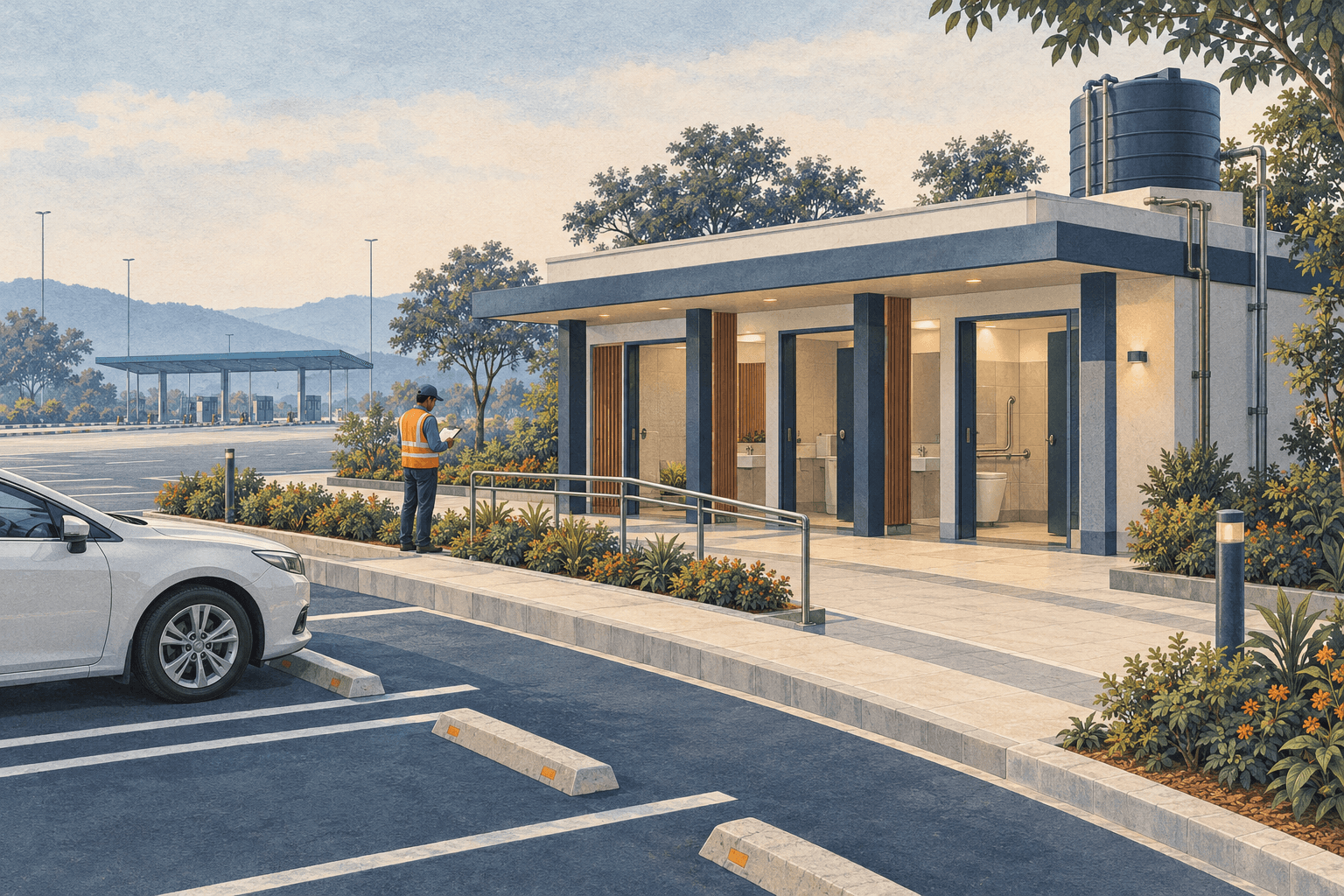
The announcement describes technical assessments before rehabilitation, covering services and building elements such as plumbing, lighting, drainage and ventilation. It also describes a universally accessible unit at each covered plaza, safer approaches and designated parking with drainage. Provisions for future EV charging are part of the parking brief; they do not establish that chargers have been installed.
For an individual site, a useful reporting exercise would match the survey to the sanctioned repair scope, the work accepted and subsequent defects. That would show whether an observed failure needed a repair, a replacement or a change in the operating arrangement. The public announcement does not supply those plaza-level records.
Close the gap between an alert and a repair
NHAI describes monitoring of service conditions, a central platform, user feedback and an inspection hierarchy from daily supervision to annual third-party assessment. It also specifies mechanised desludging and prohibits manual entry into septic tanks, manholes and sewer lines.
The relevant contract and operative directions must define each agency’s responsibilities. Our proposed review would follow a recorded service interruption through assignment, repair and verification. An alert count alone would not show how long a facility was unavailable or whether the underlying problem returned.
A practical public account could report downtime, time to verified restoration and repeated faults for the same facility and period. Those are suggested reporting measures, not performance results published by NHAI in this release.
An earlier enforcement measure has a stated scope
The 12 October ministry announcement provides background on inspection and enforcement. It describes at least weekly inspections, show-cause notices and dated photographs on NHAI’s Data Lake portal, followed by agency replies and corrective photographs. Its stated application is publicly funded plazas and other plazas where NHAI appoints User Fee Collection Agencies.
That background should be read alongside the current project’s contract. The earlier release refers to contractual penalties and a non-performer mechanism; it is not a substitute for examining a specific notice or deciding how a clause applies to an agency. The 23 October summary does not publish a plaza-by-plaza rollout schedule, cost or verified service outcomes.
The next useful record is a named plaza’s condition survey, accepted work, maintenance responsibility and dated fault-resolution history. Together, those would allow users and project managers to assess the result of the upgrade beyond its opening photograph.
Dated record
12 October 2026: the ministry announced an inspection and enforcement mechanism.
23 October 2026: it announced the broader upgrade, accessibility, parking and monitoring guidelines.
26 October 2026: Bridging Room reviewed both summaries. Operative contract terms and site-level performance remain reporting gaps.