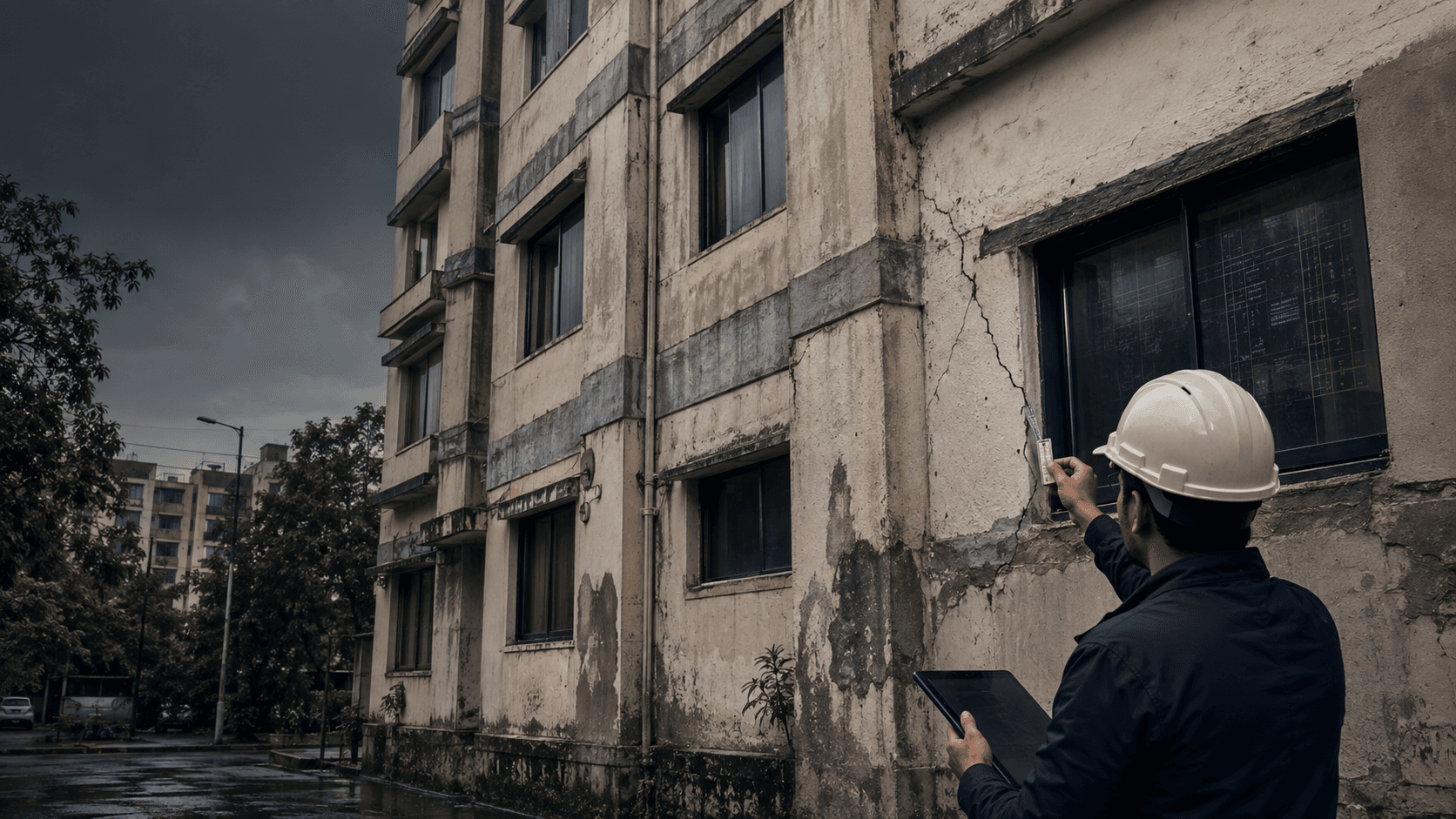
The building was reportedly 40–50 years old. Some accounts note the structure had ballooned from an originally sanctioned single-storey plan into a full G+4 building; four extra floors never accounted for in the original permission.
Residents pointed to basement repair work and days of accumulated rainwater as possible triggers, weakening a foundation that locals say was already fragile. Authorities haven't confirmed a cause yet, but Delhi's Chief Minister has ordered a magisterial probe, an FIR has been filed against the building's owner, and the MCD has evacuated and sealed a nearby girls' PG as a precaution. Political fallout was immediate too, with opposition figures demanding an audit of PG-hostel infrastructure citywide.
It's a familiar, painful script, and that's exactly the problem.
Why this keeps happening
Delhi's student and worker housing belt is dense with buildings like this one: decades old, repeatedly modified, often converted from private homes into multi-storey PGs without matching structural reinforcement. Add monsoon water infiltration, unregulated basement work, and no recent inspection, and you have a structure quietly losing integrity for years before it fails in seconds.
This isn't a one-off. Delhi has seen a string of similar building and infrastructure failures in recent years, and each time, the same root causes surface: unauthorized floor additions, aging structures never re-assessed, and gaps between what regulations say and what gets enforced on the ground.
Where structural audits come in
A structural audit is a technical inspection; cracking, spalling concrete, corrosion, foundation settlement, load changes; that catches deterioration long before it becomes visible to occupants. None of these failure signs are obvious to an untrained eye, but they're measurable and, more importantly, preventable if caught early.
Why they matter:
Prevent catastrophic collapse by flagging degradation, defects, or overloading before failure.
Enforce compliance with Bureau of Indian Standards (BIS) codes and the National Building Code (NBC).
Protect against disaster risk critical in a country exposed to earthquakes, floods, and cyclonic stress.
Preserve asset life and value, catching cheap fixes before they become expensive (or fatal) failures.
How often should audits happen?
Here's the uncomfortable truth: India has no single, uniform national law mandating structural audit frequency. Rules vary state to state, city to city and enforcement varies even more.
That said, some benchmarks have become industry standard:
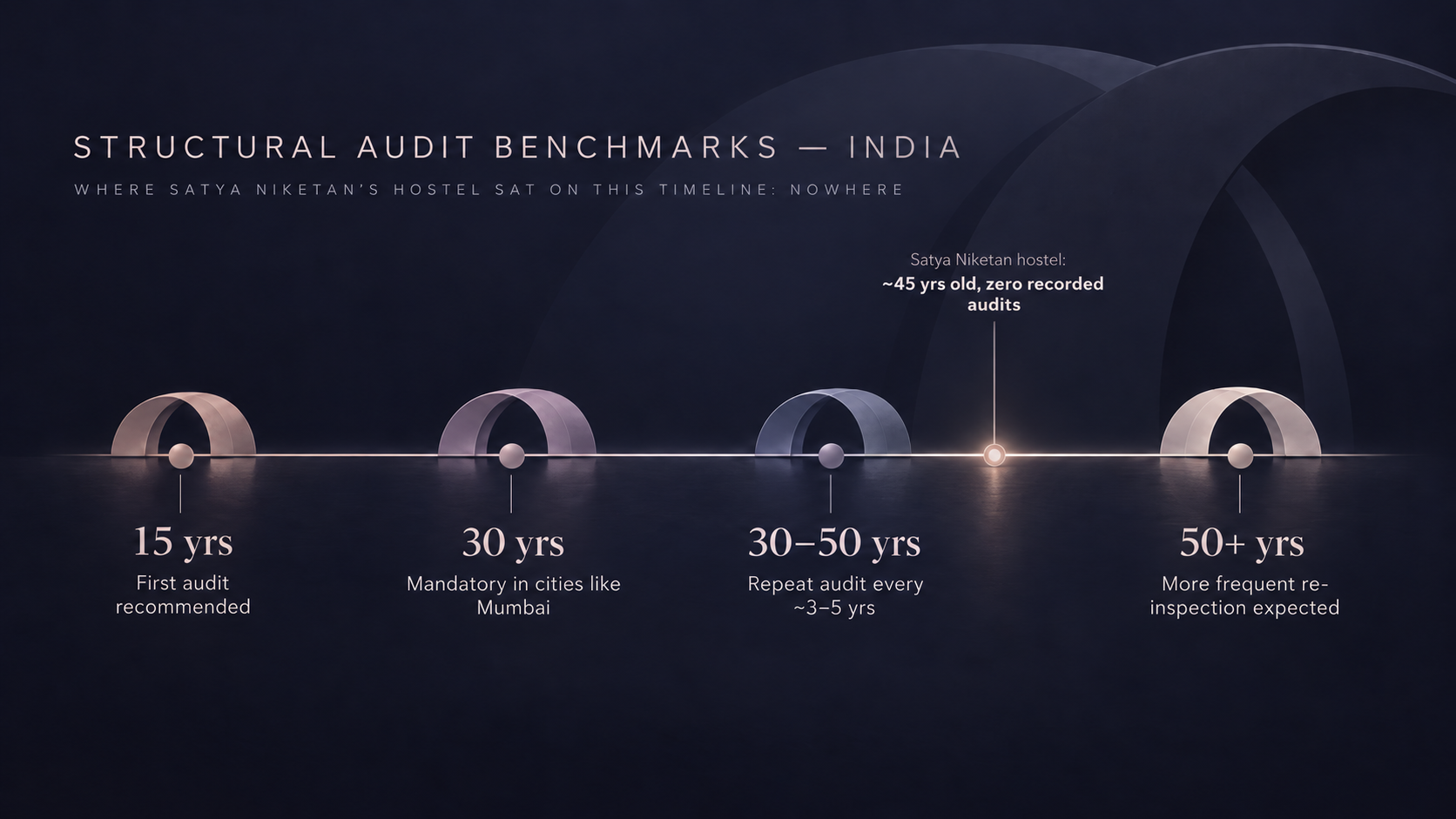
Maharashtra (via MCGM) has the country's most proactive framework, classifying buildings by risk (C1 = dangerous, requiring immediate action; C2 = needs near-term assessment).
Delhi, by contrast, has comparatively weaker enforcement audits that are "recommended," especially for older buildings, but not uniformly mandated or checked the way Mumbai's are. That gap is precisely what critics are pointing to after Sunday's collapse.
The legal and regulatory landscape
National Building Code (NBC), published by BIS the closest thing India has to a national safety bible for construction, covering structural stability, fire safety, sanitation, and periodic assessment. Crucially, the NBC itself is only a recommendatory document; it becomes enforceable only once individual states incorporate it into their local building bye-laws.
BIS (Bureau of Indian Standards) sets and revises the Indian Standards (IS codes) that structural audits are measured against, but implementation is left to municipal and state bodies.
Municipal Corporations (like MCD, MCGM) responsible for actually mandating, inspecting, and penalizing non-compliance with wide variation in how seriously this is enforced.
State Fire Services Acts and the Factories Act layer on additional fire-safety and workplace-specific obligations, especially post-incidents like the 2023 Mundka warehouse fire and the 2024 Rajkot gaming zone fire, both of which triggered temporary nationwide tightening of enforcement.
The pattern is consistent: tragedy triggers tightening, then enforcement fades until the next collapse. Delhi's hostel collapse is likely to spark a similar short-term crackdown, the real test is whether inspection regimes stay tightened once headlines move on.
What needs to change
A binding, uniform national audit mandate not a patchwork of state-level "recommendations."
Mandatory audits tied to occupancy changes especially when residential buildings are converted into dense PG/hostel accommodation, as with Hostel Daze.
Basement and foundation work should trigger automatic re-inspection, given how often water ingress and unauthorized digging are cited as collapse triggers.
Public audit registries so tenants and students can actually check a building's safety status before moving in, the way one checks a restaurant's hygiene rating.
Real penalties for unauthorized floor additions the "G+1 sanctioned, G+4 built" pattern needs to stop being a footnote and start being a prosecutable offense before, not after, a collapse.
The bottom line
Every one of the failure points in Satya Niketan; building age, unauthorized additions, basement water damage, absent inspection was knowable in advance. Structural audits exist precisely to catch these signs before they become funerals. The tragedy isn't just that a 50-year-old building fell down. It's that the tools to have predicted it have existed for years, sitting underused in a regulatory system that treats them as optional until the next collapse makes them urgent again.
Sources: The Week (Sept 6 & 7, 2026 reporting on the Satya Niketan collapse); Business Standard (Sept 7, 2026); ThePrint/PTI; MCGM public notice on compulsory structural audits (Section 353B, MMC Act 1888); Housewise and Punarnava Technosystem summaries of MCGM/cooperative-society audit bye-laws.