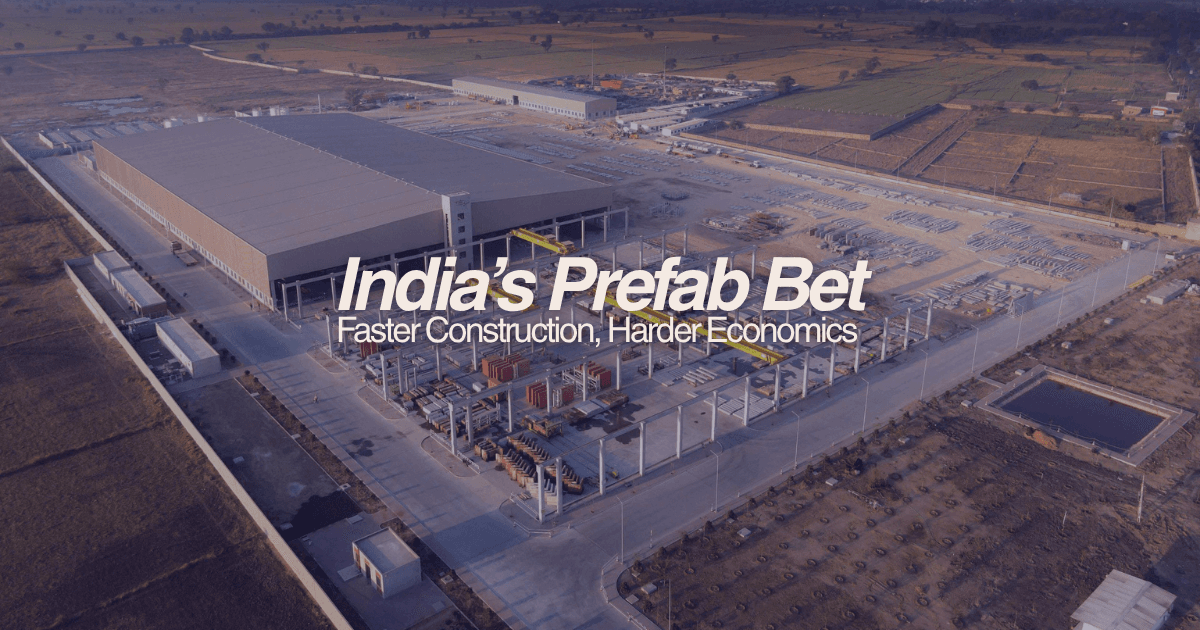
Construction in India still happens overwhelmingly on site, but a growing share of the work is moving into factories. Precast concrete, pre-engineered buildings, sandwich panels and light-gauge steel framing are already established in several segments, while modular construction is beginning to move into housing, healthcare, hostels and transport infrastructure.
The global market is moving in the same direction. MarketsandMarkets estimates that the light-gauge steel framing market will grow from $12.53 billion in 2026 to $15.53 billion by 2031, a CAGR of 4.4%. Asia Pacific accounted for 48.64% of global demand in 2025. Research on modular construction also points to shorter project durations and lower site waste, although the actual savings vary considerably by project and construction system.
The important question for India is not whether prefab works. It already does.
The question is where it makes economic sense, and why adoption remains uneven.
India has already tested the technology at meaningful scale
The government's Global Housing Technology Challenge provides one of the clearest examples. Six Light House Projects were built using different construction systems, with about 1,000 homes at each location.
Chennai used precast concrete for 1,152 homes, while Indore used prefabricated sandwich panels with a pre-engineered steel structural system for 1,024 homes. Ranchi used 3D volumetric precast construction for 1,008 homes, and Agartala adopted a light-gauge steel and pre-engineered steel system for 1,000 homes. The projects were explicitly designed as demonstrations that could help mainstream alternative technologies in Indian housing.
The choice of projects is revealing. Housing, hostels and institutional buildings have a natural advantage because they contain repeated spaces.
An LGSF wall for a hostel room can be designed once and manufactured hundreds of times. The same principle applies to standardised bathrooms, façade panels, structural steel members and service modules.
That repetition is what makes a factory useful.
Hostels and hospitals are natural early markets
Hostels are particularly suited to industrialised construction because room layouts are repetitive and project schedules are often tight. Government demonstration projects have already used LGSF for working-women's hostels and other institutional buildings, while private suppliers now market LGSF and modular systems specifically for education and healthcare.
Healthcare has a different advantage: construction can happen away from an operating facility.
During the pandemic, India developed rapidly deployable modular medical facilities, including portable hospital units designed to be manufactured and assembled quickly. The model has since broadened into modular healthcare infrastructure, where speed and minimal disruption can be more valuable than simply reducing construction cost.
Transport infrastructure offers another model. Indian Railways has developed a modular station framework for repeatable elements such as entrances, concourses, platform structures and footbridges. Here, the value is less about building an entire station in a factory and more about standardising components that would otherwise be repeatedly designed and constructed from scratch.
This distinction is important. India's modular future is unlikely to mean every building arriving on a truck as a finished box. It is more likely to involve increasing industrialisation of the parts of construction that are repetitive, measurable and easy to manufacture away from the site.
The economics depend on keeping the factory busy
This is where the industry becomes less straightforward.
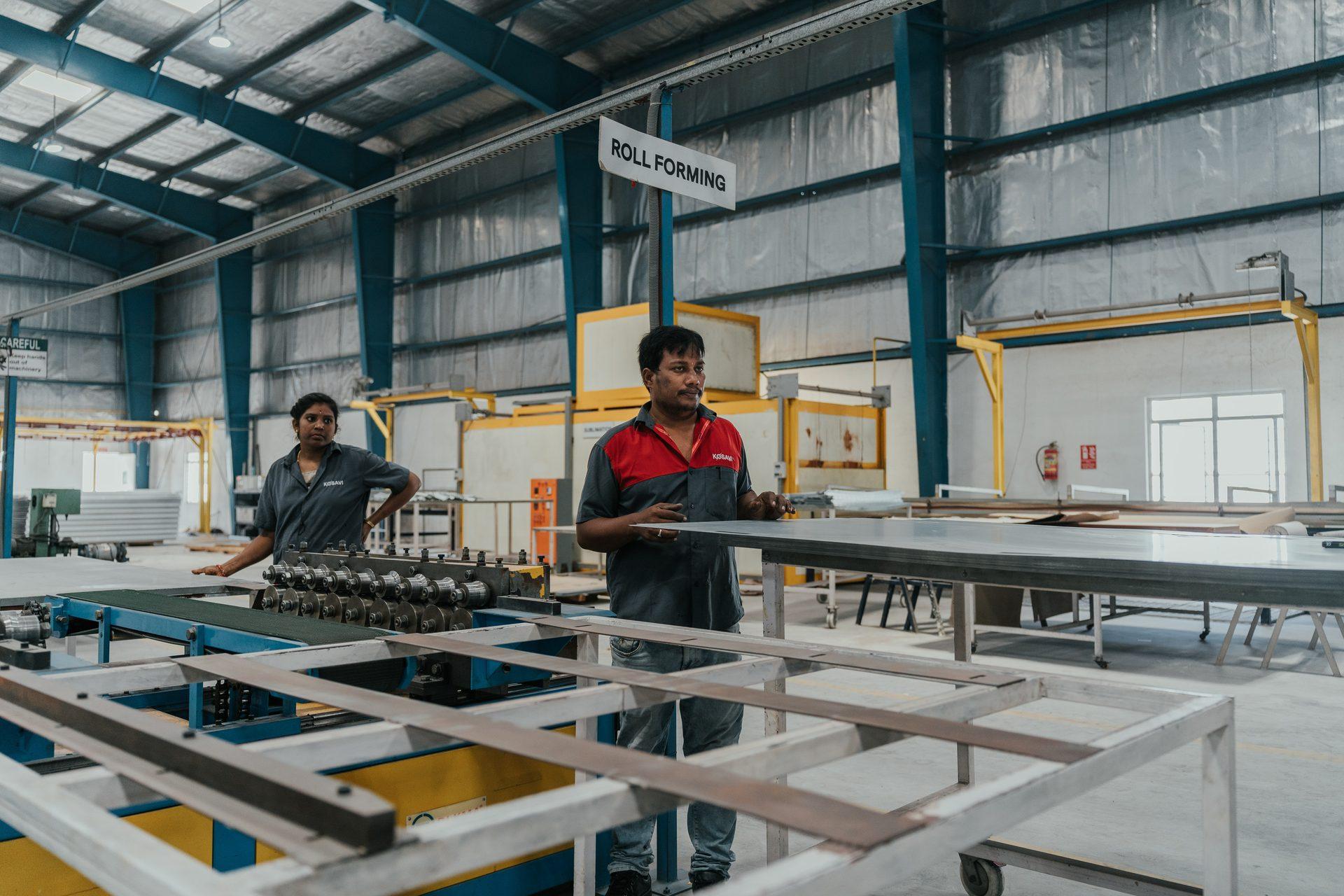
A factory creates consistency and production capacity, but it also creates fixed costs. Machinery, land, engineering teams and skilled manufacturing labour need to be paid whether a particular week's order book is full or not.
That makes utilisation critical.
EPACK Prefab's FY2026 results show what a scaled Indian prefab business can look like. The company reported ₹1,525 crore in revenue, up 34.5% year on year, with EBITDA of ₹160 crore and an order book of roughly ₹1,113 crore. It has completed more than 1,750 projects and operates across PEBs, prefab structures, panels and LGSF.
These numbers do not mean modular construction is automatically more profitable than conventional construction. They show that an Indian manufacturer can build a substantial business by combining factory capacity with a broad enough pipeline.
That is likely to be the commercial model for the sector: not one-off modular buildings, but repeatable products sold across many projects.
The construction site is not disappearing
There is also a misconception that prefab removes the complexity of construction.
It moves some of it.
Design becomes more important because components need to be manufactured before they reach the site. A late change to the location of a window, electrical point or service opening can create manufacturing rework rather than a simple site instruction.
Logistics also become more important. Large modules and panels have to move from factory to site without excessive transport cost or handling damage. That is why regional manufacturing capacity matters, especially for bulky building systems.
LGSF sits in an interesting position because it can achieve factory-level precision without requiring complete rooms to be transported. Sections can be manufactured precisely and assembled on site, making the system more flexible than fully volumetric modular construction. Industry documentation highlights its low weight, CNC-based manufacturing and ability to be transported to difficult locations. (GHTC India)
Regulation and client confidence remain constraints
India already has standards covering cold-formed light-gauge steel construction, so the issue is not simply the absence of codes. The harder problem is familiarity.
Developers, consultants, contractors, regulators and lenders have decades of experience with RCC and conventional steel construction. New systems have to demonstrate structural performance, fire safety, durability, acoustics, thermal performance and maintainability while also fitting existing approval processes.
The supply chain has to adapt at the same time. Designers need to understand design-for-manufacture, contractors need installation capability, and manufacturers need reliable demand.
That combination makes adoption slower than the technology itself would suggest.
India is probably headed for a hybrid model
The strongest opportunity may not be to replace conventional construction, but to decide more intelligently which parts should remain on site.
An RCC building can use factory-made stairs, façade panels, bathroom pods and MEP modules. A hostel can combine conventional foundations with LGSF walls. A metro station can use conventional civil works with prefabricated steel structures. Affordable housing can combine precast or LGSF components with locally executed finishing work.
That approach fits India's fragmented construction market better than trying to impose one universal system.
The global modular construction market is growing because factory production can offer speed, consistency and lower site dependency. India already has many of the ingredients required to participate: steel manufacturing, engineering capability, a large construction pipeline and increasingly experienced prefab companies. The missing piece is scale across the wider ecosystem.
For India, the transition will probably happen less through a single modular revolution and more through a series of decisions about what is better manufactured, what is better built on site, and where the economics favour moving the boundary between the two.