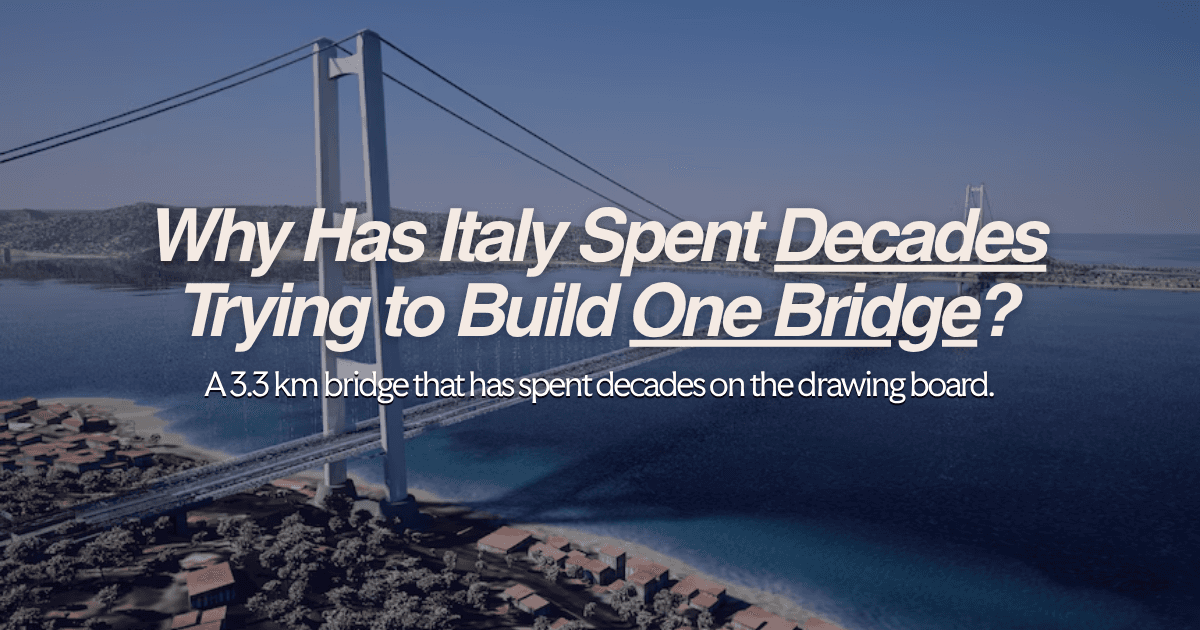
For more than half a century, Italy has been trying to connect Sicily to mainland Europe with a permanent road-and-rail crossing over the Strait of Messina.
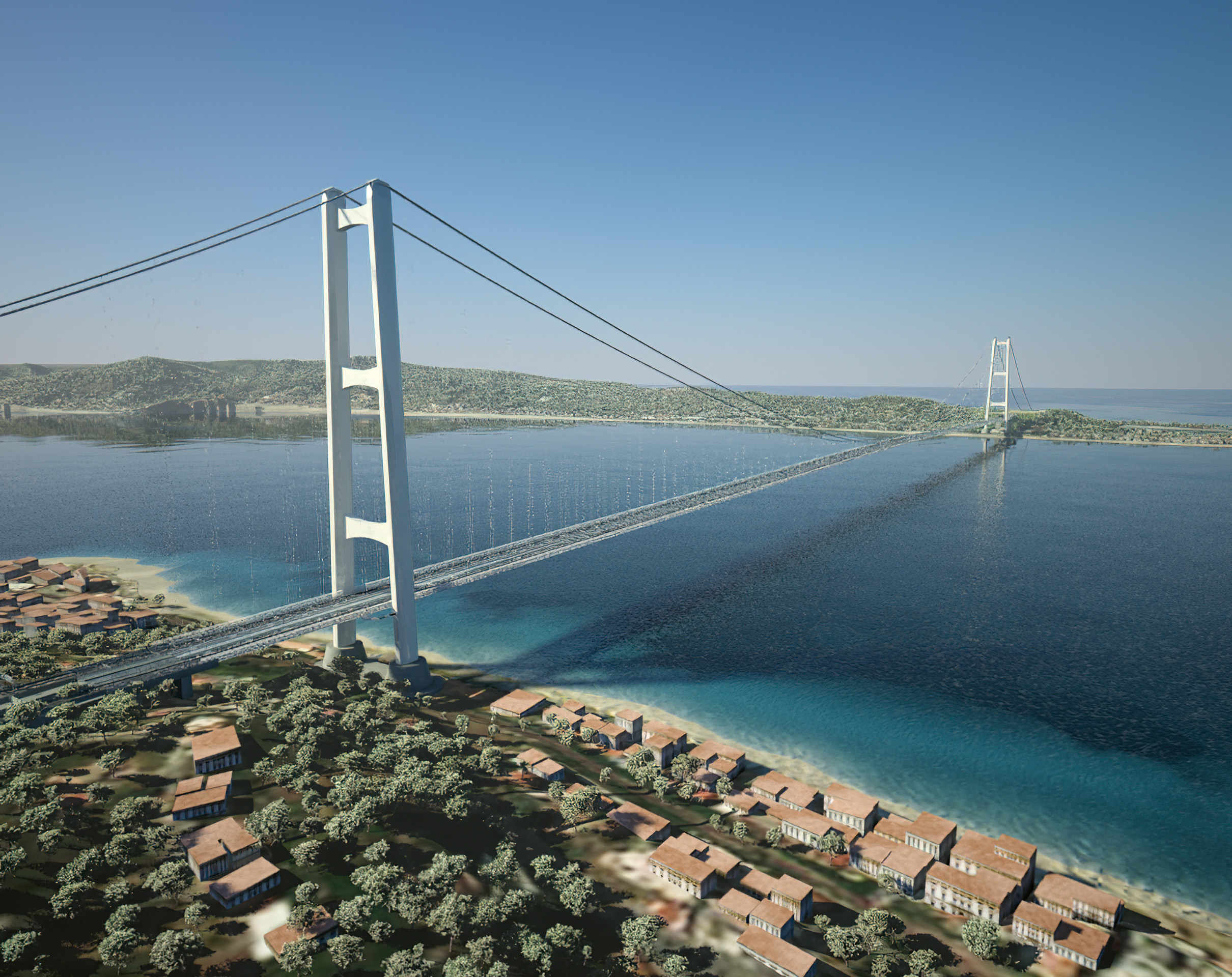
The latest version is enormous. Its central suspension span would measure 3,300 metres, almost 1.7 times the current longest suspension bridge span, while the two towers would rise 399 metres. The complete crossing, including the side spans, would be 3,666 metres long. It is designed for six road lanes, two railway tracks and two service lanes, with a planned useful life of 200 years.
The price has also become enormous. Italy's government currently puts the project cost at €13.532 billion, fully covered by public funds.
Yet, as of September 2026, no main construction work has started.
The latest milestone came on August 6, when Italy's Superior Council of Public Works gave a favourable technical opinion on the project, subject to prescriptions and recommendations. In September, the transport ministry and Stretto di Messina are due to begin the process for a new CIPESS approval, after which the project still has to clear the Court of Auditors. The government says it wants preparatory works and the executive-design phase underway by the end of 2026, with traffic opening targeted for 2034.
That is the latest chapter in a story that began long before the current government.
The idea is older than the modern project
In 1968, Italy's road authority ANAS launched an international competition for a permanent connection between Sicily and Calabria. A law passed in 1971 created the legal framework for a publicly owned company to develop the project, and Stretto di Messina was incorporated in 1981. Studies considered bridges, submerged tubes and tunnels before the single-span suspension bridge emerged as the preferred solution.
A preliminary design was presented in 1992 and approved by Italy's Superior Council of Public Works in 1997. By then, the project had already spent years moving between technical studies and government decisions.
The modern push began in the 2000s. Eurolink, led by Impregilo, won the tender in 2005 with a bid of about €3.88 billion, and the contract was signed in 2006. The project then stalled again after a change in government. In 2012, under the Monti government, the project was suspended amid Italy's austerity measures. The consortium later pursued compensation, while the bridge remained effectively frozen.
That history matters because the latest €13.5 billion figure is often compared with the €3.88 billion contract from 2005.
The two numbers describe very different stages and scopes. The current estimate incorporates the updated bridge project, land connections and other works, after two decades of inflation, redesign and changes to the surrounding network. Even so, the gap is large enough to have become part of the project's political and legal debate. The European Parliament has explicitly raised questions about the difference between the old contract value and the current estimate.
The engineering is difficult, but that is not the only problem
The bridge would be unlike any suspension bridge currently operating.
Its 3.3 km central span would set a world record. Each tower would weigh around 55,000 tonnes, and each of the four main suspension cables would contain 44,323 steel wires. The towers would stand on reinforced-concrete foundations with diameters of 55 metres on the Sicilian side and 48 metres on the Calabrian side.
The Strait also presents serious seismic and wind conditions. The design is intended to withstand an earthquake corresponding to magnitude 7.1, comparable with the 1908 Messina earthquake, and the bridge's aerodynamic deck is designed for wind speeds up to 216 km/h according to the project's technical documentation.
The project's proponents argue that decades of engineering studies, wind-tunnel testing and seismic analysis have produced a structure capable of operating safely under these conditions.
The criticism is not that no engineers have studied the problem. It is that the project combines an extreme structure with an unusually difficult site, a very large public investment and a regulatory process involving multiple institutions.
That makes the bridge as much a governance problem as a structural one.
The bridge keeps getting approved, then having to be approved again
In August 2025, Italy's interministerial economic committee, CIPESS, approved the final design, financial plan and environmental documentation. The government presented that decision as the start of the construction phase.
The next obstacle came from the Court of Auditors.
In late 2025, the court refused to register the approval and related concession changes. The concerns covered issues including environmental protection, contractual changes and procurement rules. Reuters reported that the court also questioned how the updated project related to the original 2005 tender.
The government did not abandon the project. Instead, it changed the legal and administrative route.
A March 2026 decree reaffirmed the government's intention to build the bridge and confirmed the €13.5 billion funding envelope. The project company says the law also addressed several issues raised by the court. By May, the Court of Auditors had cleared a broader programme agreement involving the transport ministry, the two regional governments, ANAS and Rete Ferroviaria Italiana.
Then came the Superior Council of Public Works review in August.
It was favourable, but not unconditional. Italian reporting said the 353-page opinion contained more than 100 prescriptions and recommendations covering areas including seismic analysis, geology, materials, traffic loads and calculations. The project company says its engineers are incorporating the observations into the next design stage.
So the bridge is moving forward.
But it is moving forward through another layer of review.
The economics are equally contested
The Italian government has a clear economic argument.
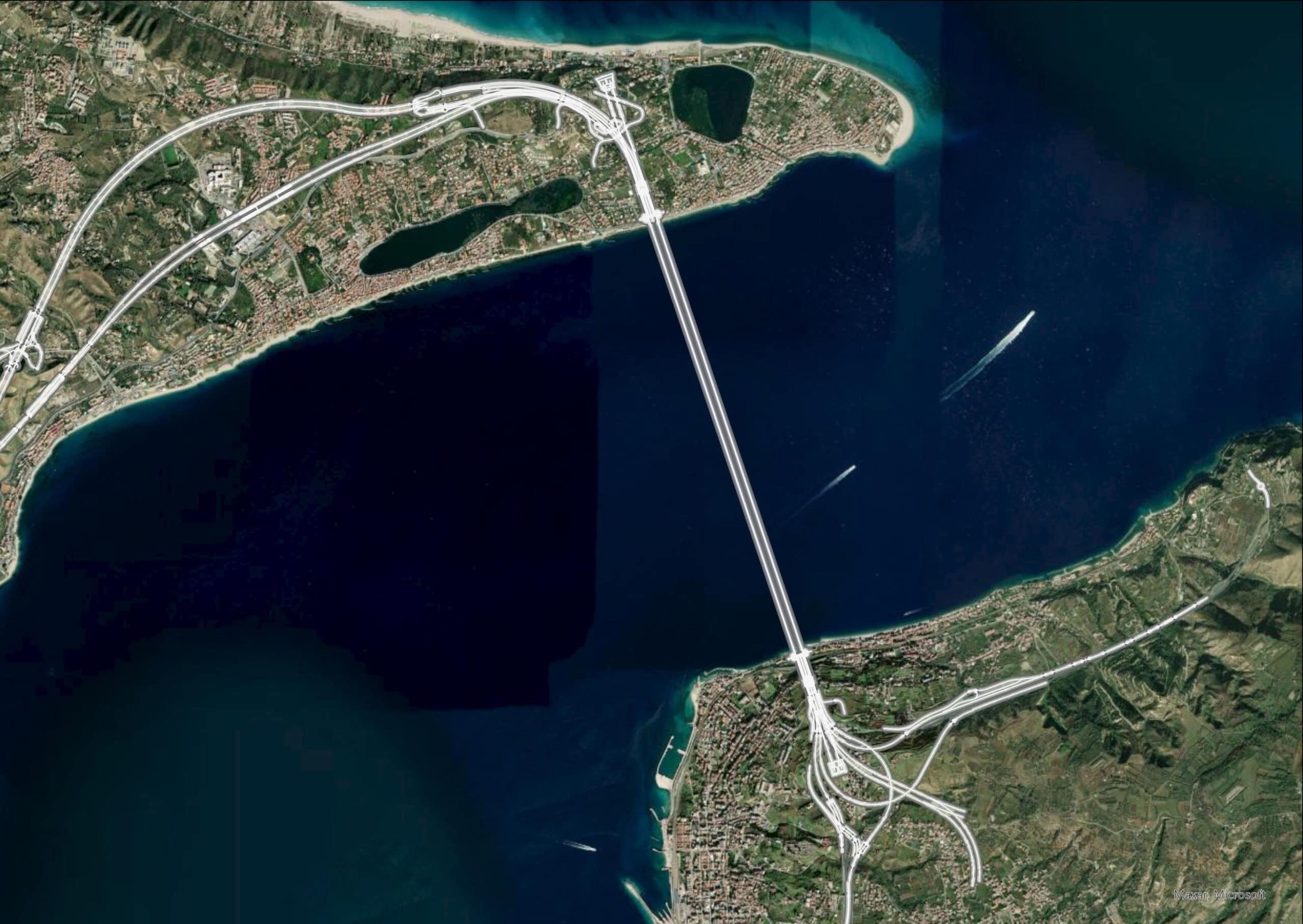
Sicily and Calabria are separated by a short stretch of water, but crossing it is time-consuming. According to the project's 2024 cost-benefit analysis, average rail travel between Villa San Giovanni and Messina Centrale could fall to about 15 minutes from 120 minutes for passenger trains, while road crossings could fall to roughly 10–13 minutes from around 70 minutes for cars. The project company estimates a net economic present value of €3.9 billion against the €13.5 billion investment and an economic internal rate of return of 4.51%.
Critics dispute whether those benefits justify the capital expenditure and argue that Sicily's existing roads and railways need investment before a new crossing can deliver its full value.
That is an important infrastructure question because the bridge cannot be evaluated in isolation.
The government itself is planning about 40 km of connecting road and rail infrastructure, roughly 80% of which would run through tunnels. The bridge therefore becomes one element inside a much larger transport system.
A record-setting bridge connecting poor-quality feeder infrastructure would have limited value. Conversely, a bridge supported by strong connections could change the economics of movement across the Strait.
The investment case therefore depends partly on what happens beyond the bridge itself.
Why has it taken so long?
There is no single explanation.
The project has moved repeatedly between governments with different infrastructure priorities. Technical studies have evolved. The contract has survived long interruptions. Construction costs have changed dramatically. Environmental assessments have become more demanding. Procurement rules have changed. And every stage has created new opportunities for legal review.
The project is also unusually large relative to the infrastructure it is connecting.
A conventional road project can be divided into packages, built in sections and adjusted as conditions change. The Messina bridge is a concentrated investment: two towers, a 3.3 km suspended span, major tunnels and approaches, railway integration and extensive land-side works have to function as one system.
That raises the cost of getting a major assumption wrong.
It also increases the number of institutions that have to agree before construction can proceed.
The current process illustrates this clearly. The government is now preparing a new CIPESS resolution after the Superior Council's technical review, after which the Court of Auditors must complete its role. The government hopes this sequence will allow the project to enter its executive-design and preparatory-works phase by the end of 2026.
For an infrastructure project that has been under consideration since the 1960s, another approval cycle is not unusual.
It is the project.
The Messina bridge is really a case study in infrastructure governance
The bridge is frequently discussed as an engineering marvel or a political vanity project. Both descriptions simplify the problem.
It is an example of what happens when an infrastructure proposal becomes large enough that engineering, economics, procurement, environmental review and politics become inseparable.
The structure itself has an extraordinary specification. The business case has been formally modelled. The funding is now earmarked. Major contractors have already been associated with the project for years.
Yet the bridge remains unbuilt because getting a megaproject to construction is itself a major piece of infrastructure management.
For Bridging Room, that is the useful lesson.
The interesting question is not whether Italy can theoretically build a 3.3 km suspension bridge. Engineers have spent decades demonstrating how it might be done.
The harder problem is keeping the technical design, contract, financing, environmental approvals, surrounding transport network and political commitment aligned long enough for construction to begin.
After decades of plans, tenders, suspensions and approvals, Italy is now trying to do exactly that.
Whether it finally succeeds will depend on something less spectacular than the bridge itself: whether the institutions responsible for building it can keep the entire project moving in the same direction.