
How this used to work
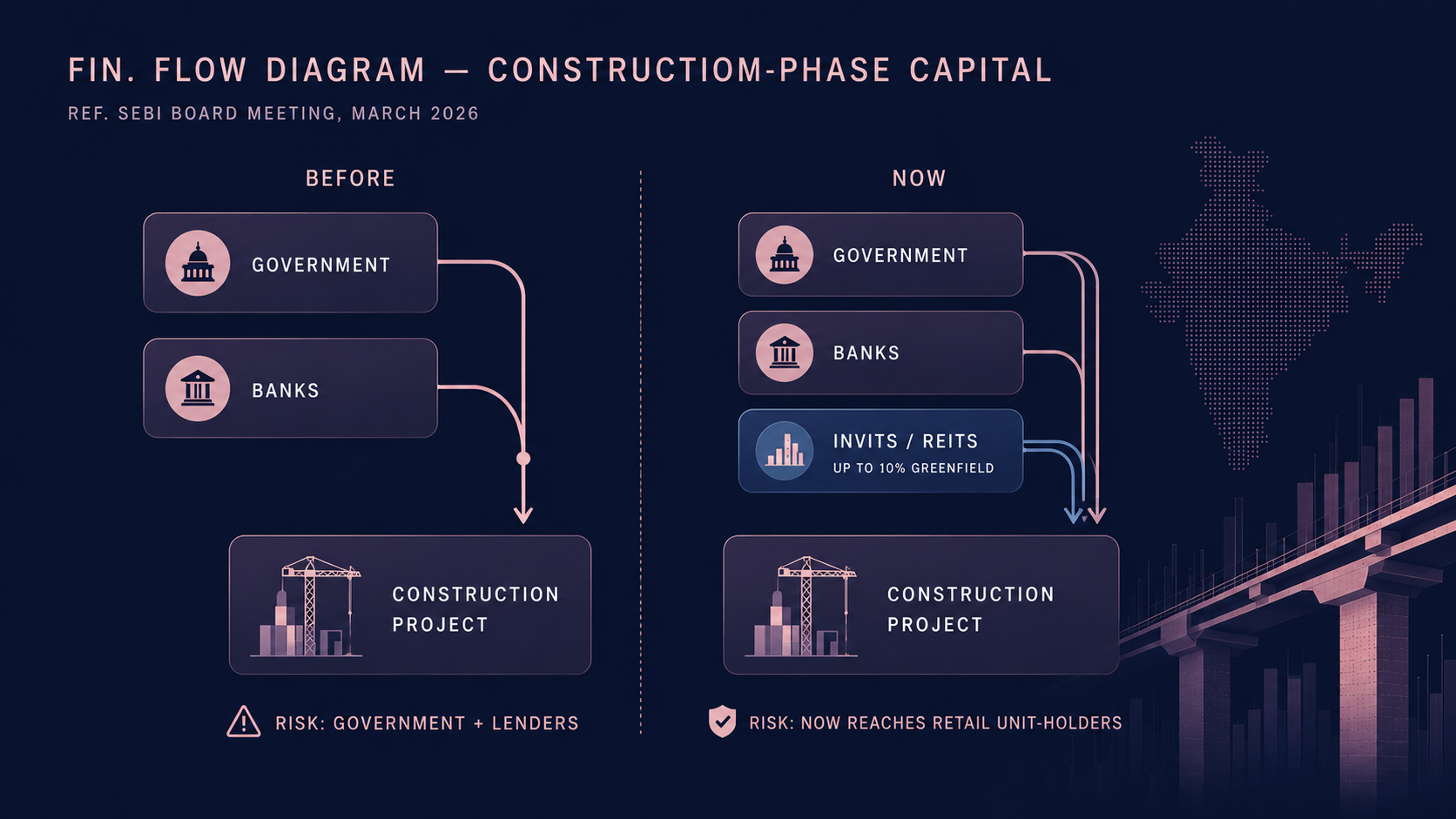
For most of India's post-liberalization infrastructure build-out, financing a road, a power line, or a metro corridor followed a fairly predictable path. The government either paid for it directly out of the budget, or a bank lent money to whichever private company had won the contract to build it. Public-private partnership structures — BOT, HAM, DBFOT, the familiar acronyms — decided how the cash flows and obligations were split between government and contractor, but the money itself came from two places: the exchequer, or a lender's balance sheet check out
That mattered because of what it meant for risk. If a project ran late, blew its budget, hit a land acquisition dispute, or the contractor simply couldn't deliver, the loss landed on the bank that made the loan or the government that backed the project — not on some diversified pool of outside investors. Banks priced that risk into high interest rates for construction-phase lending, precisely because the construction phase is where infrastructure projects most often go wrong.
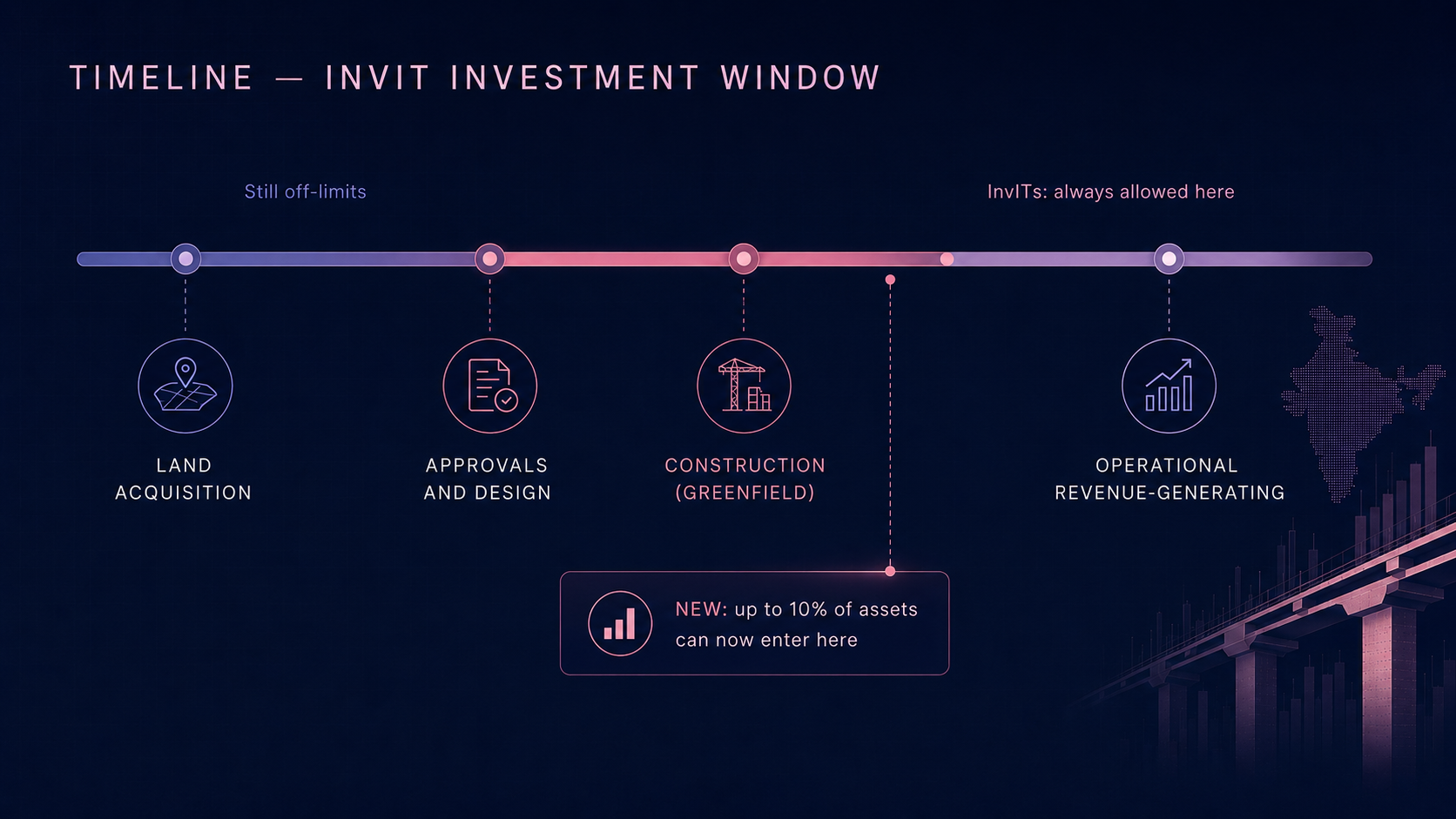
A parallel channel existed for already-built infrastructure: Infrastructure Investment Trusts, or InvITs, introduced by SEBI back in 2014, and later Real Estate Investment Trusts, or REITs. Think of them as mutual funds that don't hold shares in companies — they hold physical assets, like an operating toll road or a rented-out office park, and pass the income from tolls or rent back to unit-holders as regular payouts. Critically, these vehicles were only allowed to invest in assets that were already finished and generating revenue.
What just changed
Two things happened almost back to back this year, and together they mark a real shift.
First, the Union Budget for 2026–27 created an Infrastructure Risk Guarantee Fund, which offers partial credit guarantees to lenders specifically during a project's development and construction phase — the exact window that has historically made banks nervous and pushed up borrowing costs. The same budget introduced dedicated REITs for Central Public Sector Enterprises, opening a new route to monetize government-owned real estate assets through public markets.
Second, and more consequential for how the money actually flows: in its March 2026 board meeting, SEBI removed the long-standing restriction that kept InvITs out of unfinished projects. Privately listed InvITs can now invest up to 10% of their asset value in greenfield, still-under-construction infrastructure — including public-private partnership projects, which were explicitly barred from InvIT investment before.
Why now
Government capital expenditure on infrastructure has grown enormously — from roughly ₹3 lakh crore in FY19 to a budgeted ₹12.2 lakh crore for 2026–27 — and that pace of building cannot be funded by the budget and bank lending alone forever. Cumulative monetization of operating assets through toll-operate-transfer deals and existing InvITs has already reached about ₹1.52 lakh crore, and a first Public InvIT is planned to launch this year.
There's also a governance argument behind it. Construction-phase risk has historically been the single biggest reason private capital stayed cautious about Indian infrastructure, and the new Risk Guarantee Fund is explicitly designed to make that phase less frightening to lenders and investors alike, aligning India's PPP framework more closely with how mature international project finance markets are structured.
How this plays out in the construction industry
More capital chasing construction-phase deals likely means more competition among contractors for financing-friendly projects — the greenfield jobs structured cleanly enough, with strong enough concession terms, to attract InvIT money.
Contract and disclosure standards will likely tighten. When a fund raises money from retail unit-holders to put into a project still being built, the reporting, milestone tracking, and delay disclosure obligations get a lot more public — a real new administrative burden for EPC contractors and developers.
The risk itself hasn't disappeared — it's been redistributed, and not evenly. InvITs are not a substitute for early-stage project risk absorption; their whole model depends on stable cash flows and regulatory certainty. What's more likely is that greenfield InvIT money flows toward projects that are almost de-risked already, rather than true ground-zero greenfield risk.
Retail investors are the least-discussed part of this shift. InvITs and REITs have spent a decade being marketed as steady, bond-like, infrastructure-backed income products — precisely because they weren't exposed to construction risk. That pitch quietly stops being fully true as fund managers start allocating toward unfinished projects.
What to watch next
Which InvITs actually use the new greenfield allowance, and how large a share of their portfolio they allocate to it.
How ratings agencies treat greenfield-exposed InvITs compared to purely operational ones — a re-rating here would be the clearest signal of how the market is actually pricing this new risk.
Whether the Infrastructure Risk Guarantee Fund's guarantees meaningfully lower construction-phase borrowing costs in practice, or remain mostly a policy signal.
Disclosure and reporting requirements that emerge for greenfield projects held inside InvIT structures.
Sources: SEBI board meeting announcements (March 2026); Union Budget 2026–27 documentation; Economic Survey 2025–26 analysis; NaBFID and Ministry of Finance infrastructure financing disclosures.