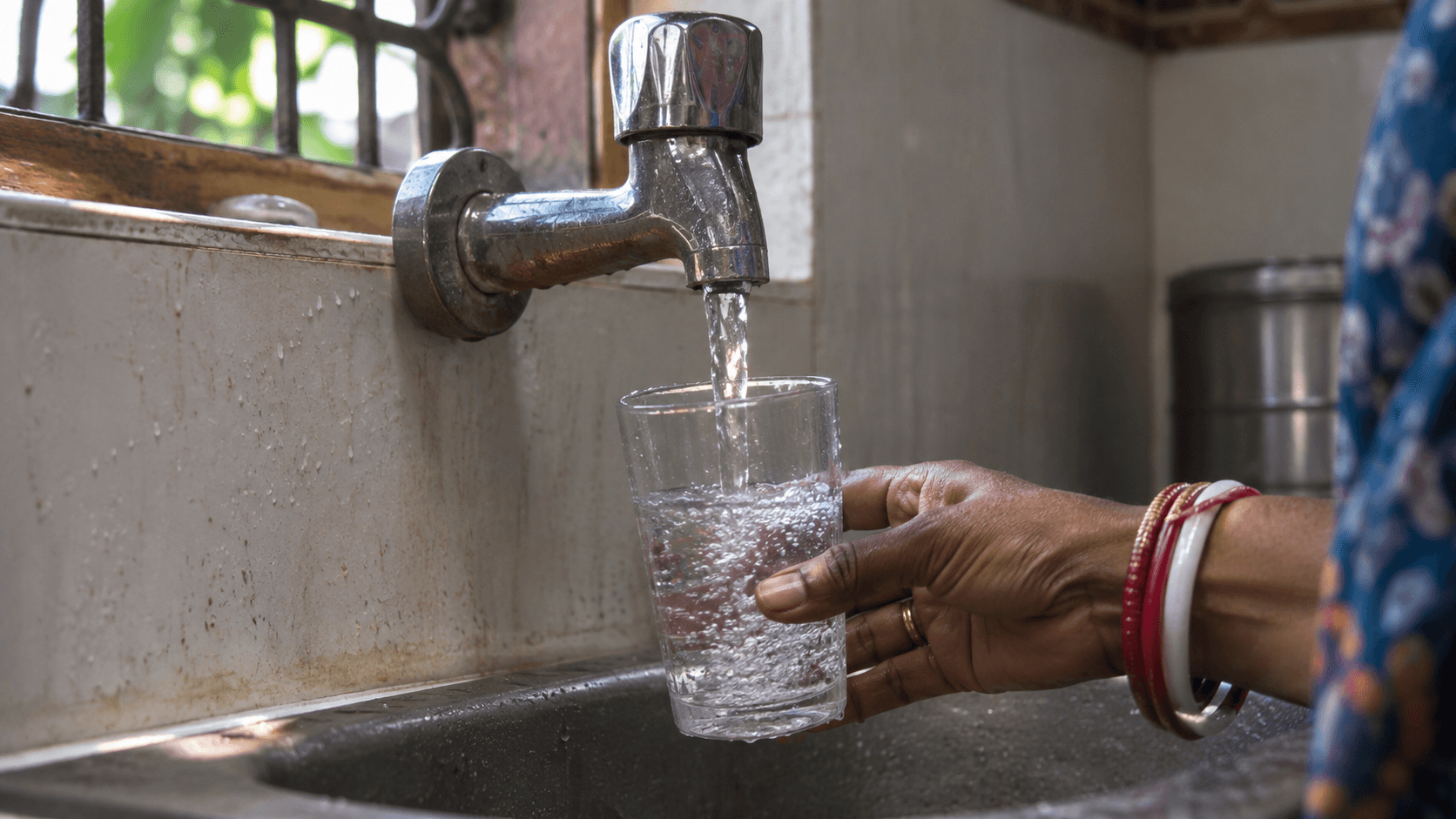
For a household in Puri, the difference between having running water and having drinking water straight from the tap is significant. It can mean not having to boil water before making tea, buying bottled water for everyday consumption or maintaining a domestic purifier. It can also mean spending less time storing water and worrying about when the next supply will arrive.
That was the promise behind Puri's Drink from Tap Mission. In July 2021, Puri became the first city in India to provide round-the-clock drinking water that could be consumed directly from household taps without additional filtration or boiling. The initiative was designed to change not just how water reached homes, but how residents used it.
Five years later, however, the more important question is whether the service continues to deliver on that promise. The existence of a functioning pipeline does not automatically establish that the water reaching every household remains safe to drink. The distinction matters particularly in a city where residents, businesses and a substantial floating population depend on a reliable public water supply.
From intermittent supply to drinking water at home
Before the mission, Puri's water distribution system faced several problems. Supply was intermittent, water pressure varied across neighbourhoods and households were vulnerable to contamination entering pipelines during periods when the network was not pressurised. According to the government's 2021 case study, only around half of Puri's households had piped water connections before the wider expansion of its water infrastructure. Others depended on public standposts and alternative sources.
The project sought to address these shortcomings by moving from an intermittent groundwater-based supply system to a continuous, pressurised network drawing water from the Bhargavi River.
The scale of the infrastructure was considerable. The 2021 CPHEEO case study recorded: A 42 million litres per day (MLD) water treatment plant against an estimated demand of 38 MLD, Five ground-level service reservoirs and 19 elevated service reservoirs ,Nineteen operational zones, organised into District Metered Areas (DMAs),Approximately 275 km of distribution pipelines and Around 32,017 household connections serving a population of approximately 2.5 lakh.
The project also covered 64 slum areas, with an estimated slum population of 66,000. This was particularly important because unreliable water supply disproportionately affects households that cannot afford private storage systems, pumps and water purifiers.
The shift was therefore about more than convenience. It was intended to reduce household dependence on private water arrangements and make access to treated drinking water more equitable.
What happens after the water leaves the treatment plant?
The real test of a drinking-water scheme is not the quality of water at the treatment plant alone. It is the quality of water when it reaches the consumer.This is particularly relevant in Puri because the mission relies on a network extending across different neighbourhoods and supply zones. A treatment plant can produce water that meets prescribed standards, but leaks, damaged connections, pressure fluctuations and contamination within the distribution system can affect the final supply.
To address this, the project introduced 19 DMAs, allowing water distribution to be monitored and managed zone by zone. The system also incorporated GIS mapping, SCADA-based monitoring, bulk flow meters and pressure-control mechanisms.The 2021 case study reported that non-revenue water, which includes losses through leakage and unauthorised consumption, had been reduced from 55% to 15%. It also documented the use of independent third-party laboratories and mobile testing facilities.
These measures established an operating framework for maintaining the network. But infrastructure design and reported improvements from 2021 cannot, by themselves, establish how consistently the system is performing in 2026.
What does the current water-quality data show?
An important source for examining the present-day situation is the Odisha Public Health Engineering Organisation's (PHEO) online water-quality surveillance portal, which publishes testing information for urban water-supply systems.
A review of the portal on 22 November 2026 shows Puri marked as 'Safe' under the Free Residual Chlorine category in its ULB-wise test status. However, the same dashboard displays 'NA' for Puri's pH and turbidity status.
This is an encouraging but incomplete indication.Free residual chlorine is an important indicator of disinfection in a distribution network. Its presence helps establish whether water retains some protection against microbial contamination as it travels through pipelines. However, a safe chlorine reading alone cannot establish that water meets all drinking-water quality requirements.
The missing pH and turbidity readings are particularly relevant. Turbidity measures the cloudiness of water and can indicate the presence of suspended particles. pH helps establish whether water falls within the prescribed chemical range. Neither can be independently verified through a dashboard entry marked 'NA'.
There is another limitation. The portal's citywide status does not, by itself, demonstrate that every supply zone or household connection has been tested. The detailed test entries visible during this review predominantly identify distribution-system locations in Bhubaneswar. They should not be presented as household-level test results from Puri.
Consequently, the available surveillance information supports a limited conclusion: Puri has a favourable reported chlorine status, but the publicly visible dashboard does not provide enough evidence to independently establish comprehensive drinking-water safety across the city's households.
Why household-level reliability matters
For residents, the consequences of inconsistent water quality extend beyond the municipal network.A household that cannot confidently drink directly from its tap may continue boiling water, purchasing packaged drinking water or maintaining a domestic purifier. These arrangements involve additional expenditure and effort, reducing the practical benefits that the mission was supposed to deliver.
The implications are particularly important for lower-income households. A family that cannot afford regular purchases of packaged water or expensive purification equipment has a greater stake in the reliability of the public supply.The project recognised this challenge through its Jalsathi initiative. Women belonging to self-help groups were engaged to connect households with WATCO, facilitate new connections, collect bills, assist with complaints and conduct basic water-quality tests.
The 2021 case study recorded 32 Jalsathis working in Puri and reported a 97% revenue-collection efficiency. Their role illustrates how water infrastructure depends not only on engineering but also on the people responsible for maintaining public confidence in the service. For households, these community-level connections are important because a water-quality concern needs to translate into a complaint, investigation and corrective action rather than remain an unresolved inconvenience.
The gap between infrastructure and assurance
There is also a distinction between Puri's original Drink from Tap project and subsequent expansion of water infrastructure in the wider district.
In a written reply to the Rajya Sabha on 11 August 2025, the Ministry of Jal Shakti reported that approximately 2.44 lakh of Puri district's 3.22 lakh rural households had tap-water connections under the Jal Jeevan Mission as of 8 August 2025. The reply also clarified that Odisha had not taken up any new 24x7 Drink from Tap projects in Puri district under AMRUT 2.0.
These figures concern rural households across Puri district, not the operational performance of the original urban mission. They should not be confused with the 2021 coverage figures for Puri city.Nevertheless, they highlight an important distinction in water policy: providing a household connection is only the first step. The larger responsibility is ensuring that water arrives regularly, in adequate quantities and at the prescribed quality.
The National Institute of Urban Affairs (NIUA) had earlier undertaken an evaluation of the Drink from Tap initiative, examining technical efficiency, consumer perception and institutional capacity. Its evaluation framework included 1,600 planned consumer-perception surveys across Puri and Bhubaneswar, 27 DMAs and more than 1,000 slum households.
That approach is important because public confidence cannot be measured through infrastructure statistics alone. Whether residents actually drink the supplied water, continue using purifiers, experience interruptions or report quality-related complaints is equally relevant.
What needs to be established now?
The next stage of assessing the mission should focus on whether the service works consistently at the point where it matters most: the household tap.A small, disclosed sample across selected supply zones would help establish this. It should examine whether households receive water throughout the day, whether residents drink it without boiling or filtering, whether they have experienced changes in taste, colour or odour, and whether they continue spending money on alternative drinking-water arrangements.
These household observations should be compared with water-quality results from the corresponding DMAs. Ideally, samples should be collected both at the distribution point and at household taps and tested for relevant physical, chemical and bacteriological parameters against BIS 10500 standards.Without this comparison, neither the municipality's infrastructure claims nor a favourable citywide dashboard status can establish that every household receives consistently potable water.
The real measure of success
Puri's Drink from Tap Mission addressed a problem that affects millions of urban households: access to water that is not merely available but safe to consume.Its original infrastructure, distribution network and community-management model represented a significant improvement over the intermittent supply system that preceded it. The project also demonstrated how continuous pressurised distribution, metering and local participation can work together to improve urban water services.
But a successful launch is not the same as sustained service delivery.The available evidence in November 2026 offers some reassurance through Puri's reported chlorine status. At the same time, gaps in publicly visible pH and turbidity data, alongside the absence of independently established household-level results, make it difficult to verify the mission's original promise across the entire city.
Ultimately, the success of Puri's Drink from Tap Mission should not be measured by the number of connections installed or kilometres of pipelines laid. It should be measured by whether a resident can turn on a tap, fill a glass and drink the water without having to question its safety.For a project built around that promise, the household tap remains the most important measure of performance.