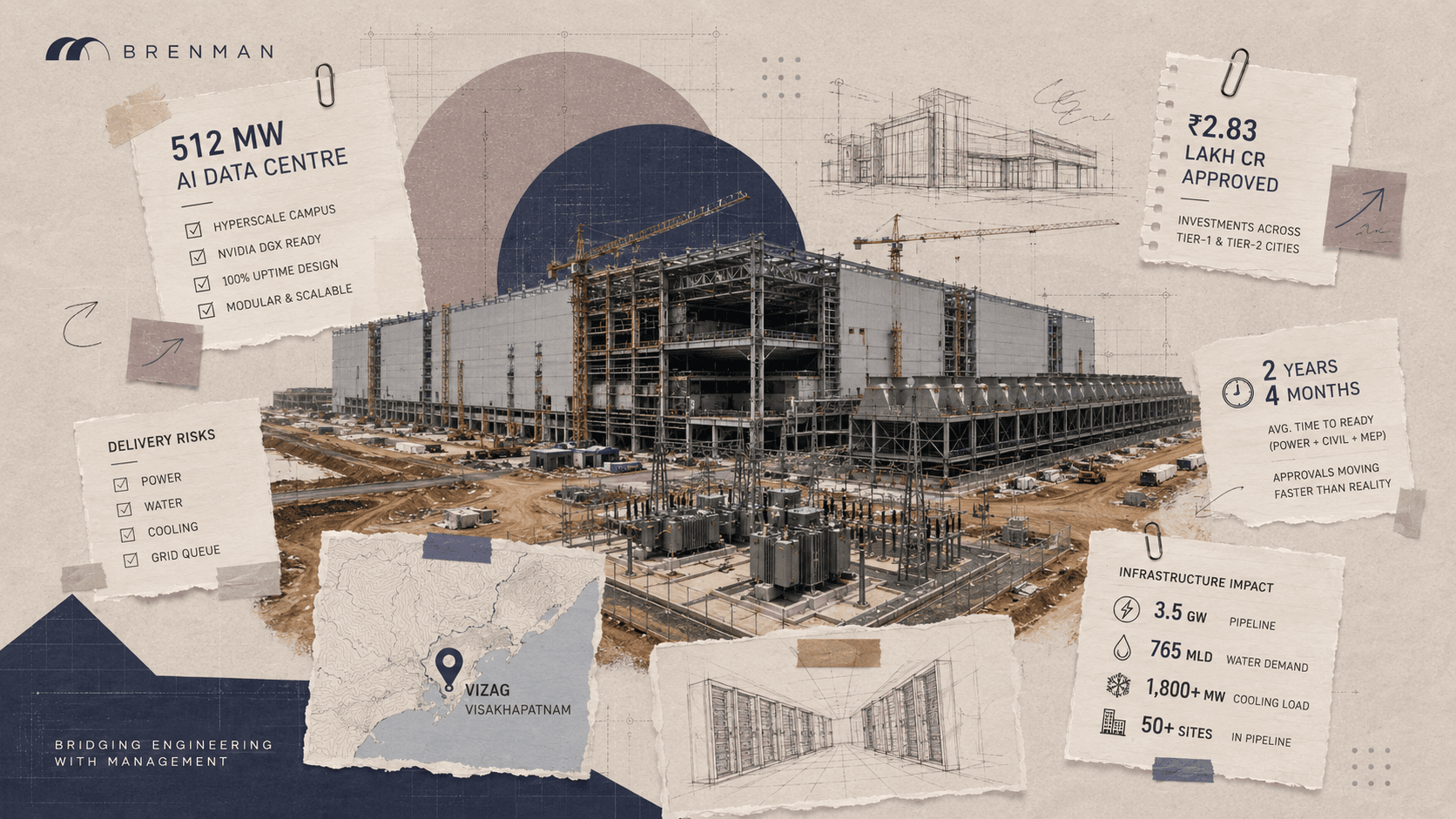
On Saturday, August 22, the Andhra Pradesh government approved a company most people had never heard of to build one of India's largest AI data centres.
AM AI Factory (Vizag) Pvt Ltd got the nod for a 512 MW green integrated AI data centre at Amanam village near Visakhapatnam, at an investment of over ₹31,387 crore. The government order promises power infrastructure support, assured water supply, and exemptions from stamp duty and electricity duty. The deadline in the GO: two years and four months.
It wasn't alone. The same clearance round waved through four data centre projects worth a combined ₹2.83 lakh crore, including a green data centre at Anakapalli carrying incentives worth up to ₹14,400 crore. This sits on top of Google's commitment, announced last October, to build hyperscale campuses across three sites in the Vizag region, an investment pegged between $10 and $15 billion. The state has started calling it AI City Vizag.
Two details in the fine print deserve more attention than they're getting. First, AM AI Factory (Vizag) is a newly created entity, majority-held by AM Intelligence Labs, and the government order does not specify who owns the remaining 49 percent. A state just attached mega-project incentives to a company whose full ownership isn't on paper. Second, that timeline. Two years and four months to design, build, power, and commission 512 MW of AI-grade capacity would be world-class execution anywhere on earth. In India, where the largest operational campuses took the better part of a decade to reach a fraction of that, it is a number from a pitch deck, not a construction schedule.
This is the gap this piece is about. India's data centre story is being written in announcements, and announcements move at the speed of a cabinet meeting. Construction moves at the speed of transformers, chillers, and grid queues. The distance between those two speeds is where the next five years of this industry will actually happen.

How big is India's data centre rush?
The short answer: cumulative investment commitments crossed $126 billion by end-2025 and are projected to exceed $180 billion in 2026. In the thirteen months to April 2026 alone, operators announced roughly 30 large projects adding 3.5 GW of planned capacity, more than double everything India has built in two decades.
Read that again. India's entire operational data centre base, built since the early 2000s, is estimated at around 1.5 GW. The announced pipeline of a single year is more than twice that. Microsoft has pledged $17.5 billion, Google $15 billion, and AWS more, before counting the domestic wave: Adani, Reliance, the Tatas' HyperVault platform with TPG, Yotta's GPU superclusters, and now state-blessed vehicles like AM AI Factory.
The market sizing reports say the sector will roughly double by 2031. The announcements say it will quintuple by 2028. Both cannot be true, and the difference between them is not demand. It is delivery.
Why is a data centre a construction problem, not a tech problem?
The short answer: because the servers are the easy part. A data centre is a power and cooling project with some IT inside. The electrical and mechanical packages typically account for well over half the project cost, the civil shell is the cheapest bit, and the scarcest resource on site is not capital but commissioning expertise.
The Indian construction industry has spent two decades organised around civil-heavy work: roads, metros, towers, plants. A hyperscale data centre inverts that pyramid. The building itself is a fast, boring box. The project lives or dies on high-voltage substations, switchgear, generators, UPS systems, chillers, and increasingly liquid cooling for AI racks, all of it built to uptime tolerances that road and realty contractors have never had to hit. A highway that opens a month late loses face. A data centre that fails its uptime certification loses its anchor tenant.
The delivery economics are brutal in a way this industry isn't used to. Industry analysis puts one month of construction delay on a 60 MW facility at roughly $14.2 million in foregone revenue plus interest carry, and a three-month slip compresses the developer's return from around 17 percent to under 13, erasing the entire premium for taking development risk. Now scale that arithmetic to 512 MW. On these projects, the general contractor's schedule is not a management topic. It is the investment thesis.
Which is why the same handful of contractors and MEP specialists are being fought over for every major build, why hyperscalers fly in commissioning agents, and why the real bottleneck conversation in this sector is about people who can test and integrate a 100 MW electrical system, not people who can pour concrete. India produces civil engineers in bulk. It produces data centre commissioning managers in dozens.
What are the real constraints nobody puts in the press release?
The short answer: grid power, water, and the queue. A 512 MW facility draws roughly the electricity of a mid-sized Indian city, continuously, with near-zero tolerance for interruption. The generation may exist on paper. The transmission, substations, and approvals rarely do, and they run on infrastructure time, not announcement time.
Start with power, because everything else is downstream of it. "512 MW" in the project name is not a description of the building. It is a claim on the grid. Getting that claim honoured means new substations, dedicated transmission, and state discom commitments, each with its own land, clearance, and construction timeline. The due diligence literature already carries the cautionary tale: a developer who discovered, three months after financial close, that state electricity infrastructure was 18 to 24 months away. The site was suddenly a liability with a fence around it.
This is where the Vizag GOs deserve a careful read. "Power infrastructure support" and "assured water supply" are the state's promises, and they are precisely the two promises Indian states have historically struggled to keep on schedule. Readers of this publication will recognise the pattern from the highway sector: the sanction arrives dressed as certainty, and the enabling infrastructure arrives when it arrives. The land is the state's to give. The 400 kV bay is not built by a government order.
Then water. AI-grade cooling is thirsty, and the industry's answer, liquid cooling and treated water systems, moves the problem rather than removing it. Coastal Vizag has options that Delhi NCR and Hyderabad's dry plateau do not, which is partly why the map of announcements is quietly redrawing itself toward the coasts. Expect water, not land, to decide the second wave of site selection, and expect the first public fight between a data centre and a city over water within a few years.
And finally the queue. Transformers, switchgear, and gensets are on global allocation, with lead times that stretched past two years at the peak. Every gigawatt India announces is bidding against Virginia, Texas, and Malaysia for the same equipment. A cabinet can clear ₹2.83 lakh crore on a Saturday. It cannot clear a transformer waiting list.
Who actually benefits, and who carries the risk?
The short answer: the construction and MEP ecosystem gets the biggest order-book gift in a generation. The states carry incentive and infrastructure risk for facilities that employ very few people. And the gap between the two is wider than anyone is pricing.
Do the employment math on the flagship. ₹31,387 crore of investment, up to 1,000 jobs. That is over ₹31 crore of capital per permanent job, one of the most capital-intensive ratios in Indian industry. The jobs that matter are in the build: two to three years of work for thousands of engineers, electricians, HVAC specialists, and site staff per campus. For the AEC industry, this is the point. Data centres are not a tech story with a construction footnote. They are a construction market forming in real time, one that rewards exactly the skills, MEP depth, schedule discipline, quality systems, that the traditional Indian contracting model treats as afterthoughts.
The states, meanwhile, are competing with stamp duty waivers, electricity duty exemptions, capital subsidies, land discounts, and GST refunds to attract assets that generate little direct employment and consume enormous public infrastructure. Some of that competition is rational: compute capacity is strategic, and anchor investments pull ecosystems. But handing mega-project incentives to newly minted entities with incomplete ownership disclosure, against timelines no one in the industry believes, is not strategy. It is announcement inflation, and this sector has seen where that ends. The last decade's highway story began the same way: bulk approvals, heroic schedules, enabling conditions assumed rather than built.
The projects that get built, and many will be, will be the ones where someone did the unglamorous work early: locked the grid connection before the press release, secured the water before the render, and hired the MEP and commissioning team before the groundbreaking. The rest will join a quieter list, the announced-but-unbuilt gigawatts, and in 2029 someone will write the story of why India's data centre capacity is a fraction of what was promised in the golden year of 2026.
The demand is real. The capital is real. What stands between them is the oldest constraint in this country's development story, the one this publication exists to cover: the gap between approving a thing and building it.
Frequently asked questions
How much is being invested in data centres in India? Cumulative investment commitments reached about $126 billion by end-2025 and are projected to exceed $180 billion during 2026. Microsoft, Google, and AWS alone account for tens of billions, alongside major domestic commitments from Adani, Reliance, Tata-backed platforms, and state-approved projects such as the ₹31,387 crore AI data centre cleared in Visakhapatnam in August 2026.
Why do data centres need so much power? AI and cloud servers run continuously at high load, and cooling them consumes almost as much energy as computing does. A large campus like the proposed 512 MW Vizag facility draws roughly as much electricity as a mid-sized city, and requires dedicated substations and transmission built specifically for it.
What does it cost to build a data centre in India? Large projects are running at roughly ₹55 to 65 crore per MW of IT capacity, with electrical and mechanical systems making up well over half the cost. Delay is the biggest cost risk: industry estimates put one month of delay on a 60 MW facility at around $14 million in lost revenue.
Which cities are India's data centre hubs? Mumbai and Navi Mumbai lead, followed by Chennai, Hyderabad, Pune, and Delhi NCR, with Visakhapatnam emerging fast on the back of state incentives and coastal advantages in power and water access.
What are the biggest risks to India's data centre boom? Grid connectivity timelines, water availability for cooling, global shortages of transformers and electrical equipment, and a shortage of MEP and commissioning talent. Announced capacity far exceeds what current construction and grid capability can deliver on stated schedules.
Sources: Andhra Pradesh government orders and PTI reporting (August 2026), Medianama's analysis of the AP clearances, Deccan Herald and state briefings on Google's Visakhapatnam investment, IMARC and ResearchAndMarkets industry analyses, Business Standard.