The difference between having a toilet and being able to use one
For a student attending school, a toilet is not simply another facility on an infrastructure checklist. It is a basic requirement that affects hygiene, privacy, dignity and the ability to remain in school throughout the day. For adolescent girls, particularly during menstruation, access to a clean and functioning toilet is especially important.Yet, infrastructure reporting often begins and ends with whether a school has a toilet. The more difficult question is whether that facility remains accessible and usable from the first period to the end of the school day.
India's Unified District Information System for Education Plus (UDISE+) provides a useful starting point for examining this gap. The Ministry of Education released its 2025–26 report on 7 July 2026, covering 14.67 lakh schools across the country. According to the report, 98.5% of schools had girls' toilets, 97.2% had boys' toilets, and 99.5% had access to safe drinking water. Handwashing facilities were recorded in 96.9% of schools. These figures indicate extensive infrastructure coverage. However, the presence of a facility does not independently establish whether it has running water, is cleaned regularly, has functioning plumbing or is accessible to students whenever required.
Why Assam deserves closer examination
Assam provides a useful setting for examining the difference between infrastructure provision and everyday functionality. The state's education department, through its Samagra Shiksha Axom portal, reported that 44,300 government and provincialised schools were covered by its 2024–25 infrastructure baseline.Of these, 43,744 schools reported boys' toilets, 43,974 reported girls' toilets and 43,937 reported drinking-water facilities. These represented 98.7%, 99.3% and 99.2% respectively.
However, an independent study offers a more detailed picture of what these infrastructure indicators can leave out. A 2022 study by the Centre for Budget and Policy Studies (CBPS), conducted with the Purva Bharati Educational Trust, examined 46 schools across five Assam districts: Jorhat, Dibrugarh, Lakhimpur, Sonitpur and Tinsukia. The study deliberately assessed access and actual use rather than limiting its evaluation to whether facilities existed.
Jorhat is a useful district for a closer investigation because it accounted for 17 schools in that study, the largest district-level sample. This provides an existing research base, although the findings should not be mistaken for a current district-wide estimate.
What happens after the toilet is constructed?
The CBPS study identified a substantial gap between reported availability and usability. Although 85% of the surveyed schools had separate toilets for girls, only 37% met the study's functionality criteria. Among schools in tea-garden areas, the proportion of functional girls' toilets was 41%.
The researchers identified several practical problems: some toilets were locked and students could not access the keys, others lacked adequate water or regular cleaning because schools did not have sufficient cleaning staff. These findings point towards three operational requirements that determine whether school sanitation infrastructure delivers its intended purpose.
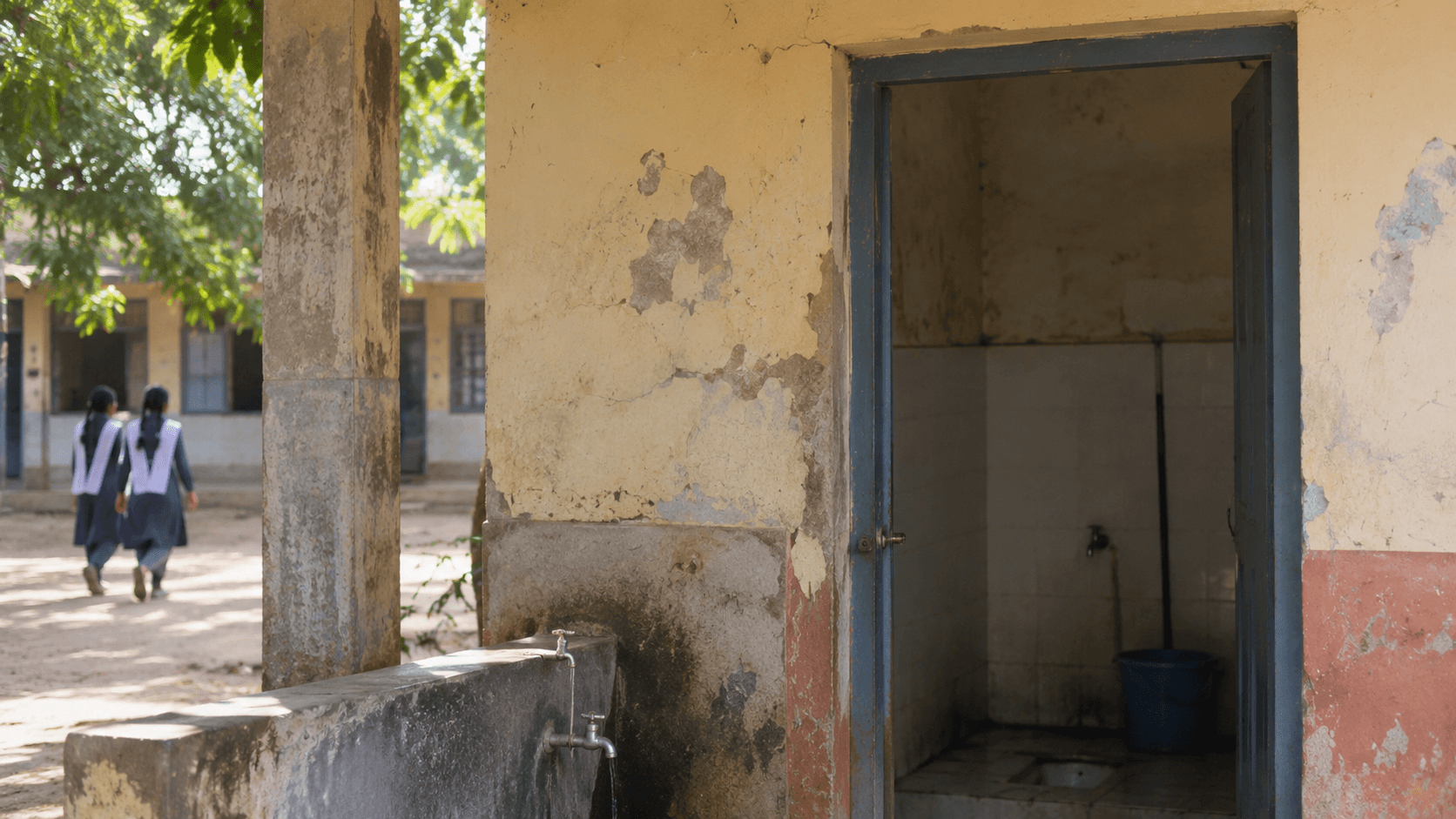
First, water availability. A toilet may have been constructed and recorded in the school database, but without a dependable water supply, flushing, cleaning and handwashing become difficult. The issue is not merely whether a school has a drinking-water connection. It is whether water reaches the sanitation facility consistently during school hours.
Second, cleaning arrangements. Toilets require a defined cleaning schedule, appropriate materials and someone responsible for carrying out the work. The Ministry of Education's Swachh Vidyalaya guidelines include daily, weekly and periodic maintenance activities, with toilet-cleaning frequency and the use of appropriate cleaning materials forming part of the assessment. This makes sanitation an ongoing operational responsibility rather than a one-time construction activity.
Third, repairs and maintenance. Broken taps, blocked drains, damaged doors, faulty flushing systems and leaking pipes can make a facility unusable even when the structure remains intact. Addressing these problems requires a functioning maintenance mechanism, access to funds and clarity over who is responsible for arranging repairs.
The infrastructure behind everyday sanitation
The Right of Children to Free and Compulsory Education Act, 2009, establishes separate toilets for boys and girls and safe, adequate drinking water as school infrastructure requirements. The responsibility for providing these facilities rests with the appropriate government and local authorities. However, construction and maintenance involve different stages of public expenditure and administration. Building a toilet addresses the initial infrastructure requirement. Keeping it operational requires recurring expenditure on cleaning materials, water, plumbing, sanitation workers and repairs.
This distinction is important for infrastructure planning. Public investment cannot be assessed only through the number of facilities constructed or schools reporting their availability. The quality of an infrastructure asset also depends on its operation and maintenance arrangements after construction.For a closer examination in Jorhat, a small school-level sample should therefore cover government and provincialised schools across different blocks, including schools in tea-garden and non-tea-garden areas. Each facility should be checked for water availability at different points during the school day, cleaning frequency, accessibility, working taps and flushes, drainage, and the availability of maintenance funds. Interviews with headteachers, school management committee members and students would help establish who handles cleaning, how faults are reported and how long repairs take.
A closer look at the sanitation gap in the Northeast
Firsthand accounts from Assam highlight the gap between having school sanitation infrastructure and being able to use it. At Kaliram Baruah Girls' High School in Guwahati, a student told The Assam Tribune that water shortages sometimes forced students to return home before the school day ended. The school's borewell had stopped functioning following nearby flyover construction, and repeated requests for repairs had not produced a permanent solution. In Darrang district, Hiyamoni Deka, a student at Uttar Mangaldoi High School, described how the toilets were difficult to use before renovation but became usable afterwards. She also highlighted the need for more frequent cleaning. A 2025 Government of Assam stakeholder consultation document further recorded concerns about inadequate water, privacy and menstrual hygiene facilities, including findings from a study of 29,700 adolescent girls across 495 schools. More recently, a July 2026 academic study examining Assam's secondary schools found that students continued to face difficulties involving water access, cleanliness and privacy.
Firsthand accounts from across India
Experiences from other parts of the country show that school sanitation challenges extend beyond Assam. In Karnataka's Bidar district, a December 2025 Times of India report documented conditions at Chitaguppa Government Girls' High School, where approximately 200 girls shared a single toilet.
Class X student Bhagyashri described long queues during lunch breaks and difficulties using the facility when it became blocked. Another student, Ambika, highlighted the lack of a suitable alternative, explaining that the open area behind the school was unsafe because of stray dogs. The school had reportedly approached education authorities for additional toilets.
Similar concerns were documented in a 2023 Sulabh International study covering 4,839 women and girls across 84 villages in 14 districts across seven states. Participants reported inadequate school toilet facilities, including missing doors, taps, dustbins, water and soap.
These accounts highlight that the problem is not limited to the absence of toilets. Overcrowding, insufficient facilities, poor maintenance, unreliable water supply and inadequate menstrual hygiene arrangements can all prevent students from using existing infrastructure.
Menstrual Hygiene: The Impact on Girls' School Attendance
Across India, inadequate school sanitation creates additional difficulties for girls during menstruation. In Andhra Pradesh's Chittoor district, students at Rajagopalapuram Zila Parishad High School reported having to fetch water from an outside hand pump because their toilets lacked a reliable water supply. One student, Lakshmamma, said she missed one to three school days every month because managing menstruation without adequate water was difficult. These experiences were documented by WaterAid India.
A 2025 study involving 279 adolescent girls across four schools in Bihar's Begusarai district found that girls sometimes had to leave school to change sanitary pads because there were no private changing spaces or proper disposal facilities. Some reported carrying used pads home in their schoolbags. In rural Rajasthan, a 2024 consultation by ARTH also documented girls continuing to use the same sanitary pad throughout the school day because of inadequate water, privacy and cleaning arrangements.
These accounts show that functional school sanitation requires more than separate toilets. Reliable water, working locks, private changing spaces, regular cleaning and safe sanitary-waste disposal are essential to ensuring that girls can attend school without disruption during menstruation.
Measuring infrastructure by whether it works
The significance of school sanitation extends beyond the physical condition of a toilet. It concerns whether students can attend to basic needs without compromising their health, privacy or participation in classroom activities.For girls, inadequate sanitation can make the school environment particularly difficult during menstruation. For students with disabilities, inaccessible toilets create an additional barrier. A facility that exists but cannot be reached, entered or used does not fulfil its intended function.
The larger lesson for India's infrastructure sector is that asset creation and asset management must be evaluated together. School sanitation requires more than construction targets: it needs accountable maintenance, reliable water systems, predictable funding and regular inspections. UDISE+ can help identify where facilities are reported to exist. But the more meaningful measure of progress is whether a student can enter a clean, accessible toilet, find water and use it whenever necessary during the school day.
A toilet counted in a database is an infrastructure asset. A toilet that works throughout the school day is a functioning public service. The distinction is where the real measure of progress lies.